After Ueno Bank's November 3 collapse, Paraguay removed President Santiago Peña on November 6. By November 9, 93.1% of depositors had received guarantee advances. Pension funds and investigations remain unresolved.
Money no Sofá Global Newsroom | November 10, 2026 | Paraguay → World | Banking, politics and household money
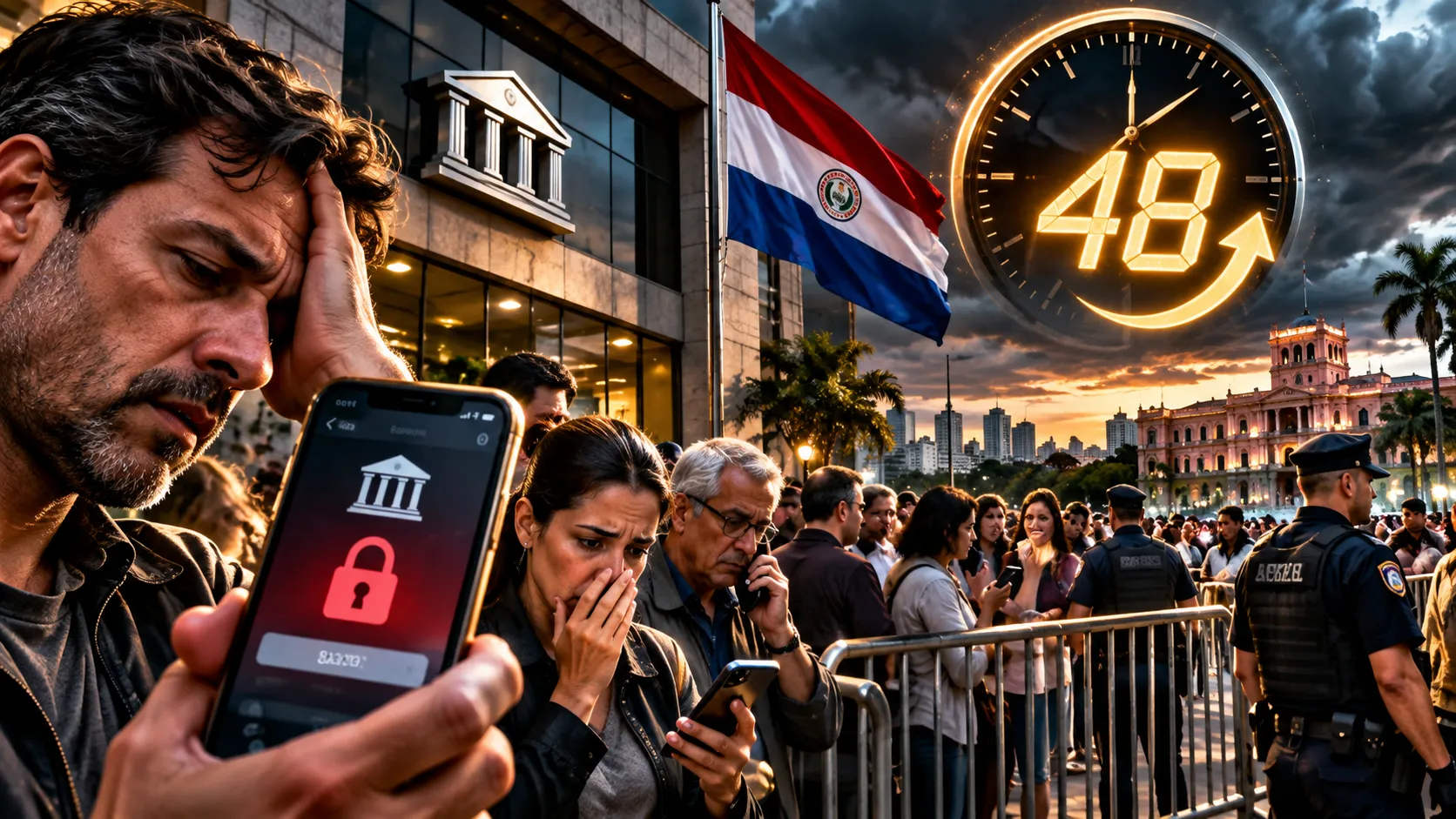
THE REAL STORY: Paraguay moved from bank intervention to mass deposit-guarantee advances in days. Ueno Bank entered resolution on November 3. Payments began on November 5. On November 6, the Senate removed President Santiago Peña and Pedro Alliana took office. By the end of November 9, the central bank said 1,738,804 depositors — 93.1% of the eligible depositor population it was tracking — had received guarantee advances worth approximately ₲2.126 trillion (around US$340 million). That rapid payment response is remarkable. It does not mean the failed bank reopened, every deposit was paid in full, or public pension assets were recovered.
IN 30 SECONDS
- November 3: Paraguay’s central bank announced Ueno Bank’s resolution after serious solvency deficiencies.
- November 5: Staged payments from the Deposit Guarantee Fund began, two days after the public resolution announcement.
- November 6: The Senate removed Santiago Peña after he offered to resign. Pedro Alliana was sworn in to complete the term.
- November 9: Advance payments reached 93.1% of depositors on the central bank’s official count.
- November 10: The unresolved story includes blocked accounts, savings certificates, public and pension funds, and continuing criminal investigations.
THE NUMBER THAT MATTERS
93.1% of depositors received an advance. According to the Banco Central del Paraguay (BCP), 1,738,804 people received a combined ₲2,125.6 billion by the close of November 9. It is a count of depositors who received advance payments against deposit protection, not a statement that 93.1% of every guaraní held at Ueno has been recovered. The BCP and EFE described approximately 128,000 accounts still awaiting transfers, including accounts with restrictions, savings certificates (CDA) and borrowers connected to the development finance agency AFD.
WHAT HAPPENED — A BANK FAILURE IN FIVE DATES
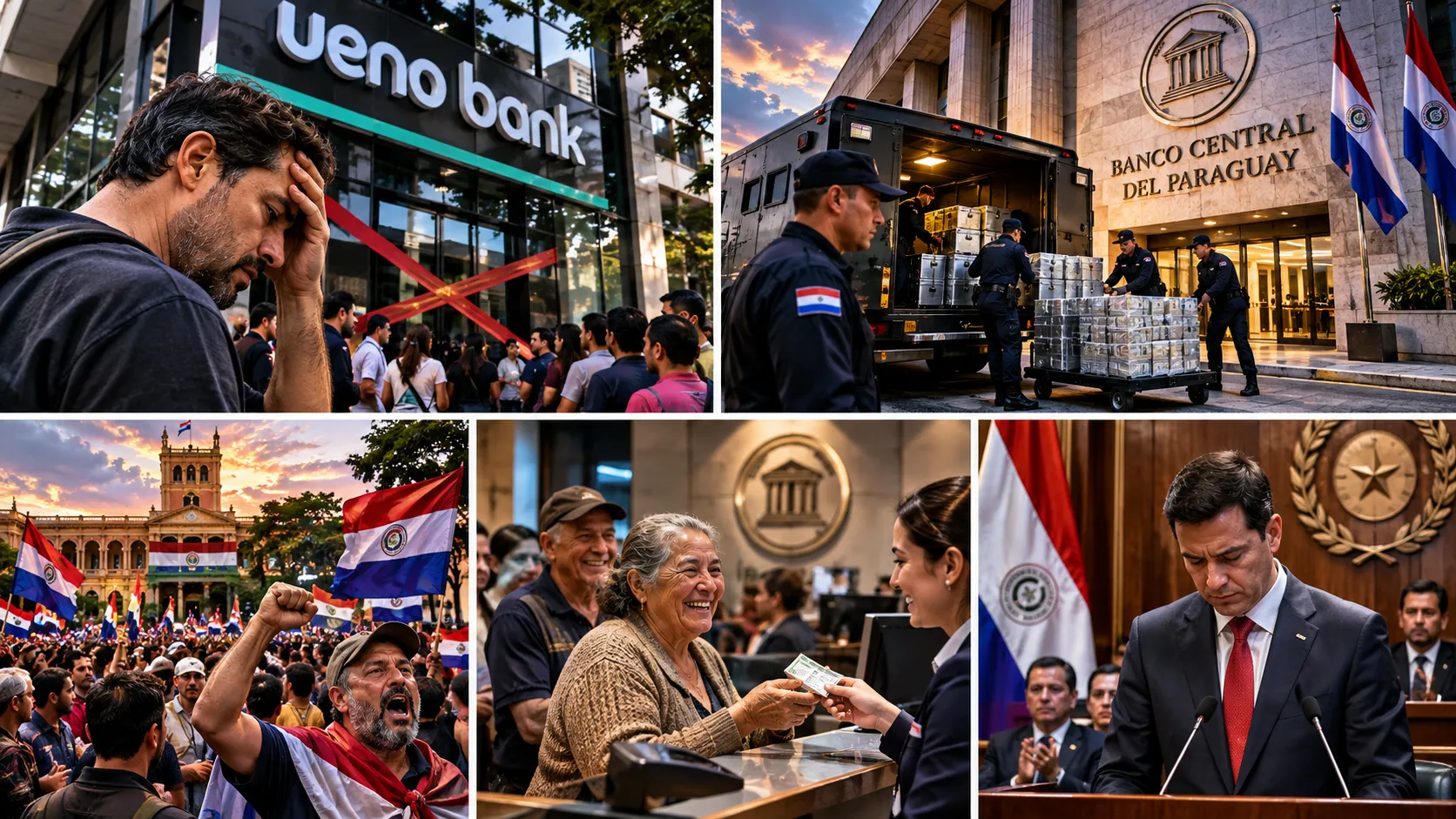
The BCP’s November 3 announcement said its board had authorized resolution of Ueno following accounting adjustments that left the lender’s solvency index below half the required minimum. Resolution is a supervised process for dealing with an institution that cannot continue as before; it is not a declaration that deposits have vanished or that the bank is already operating normally again.
Authorities then communicated a payout plan. The first group covered qualifying deposits of up to ₲10 million, provided customers had no debts with Ueno and an account at another institution. The second group expanded to deposits above ₲10 million and up to ₲121.76 million, again with conditions. Government measures allowed advance payments up to 40 minimum salaries, while the ordinary statutory deposit guarantee is a separate ceiling of 75 minimum salaries. The distinction matters: an advance, legal coverage and a completed recovery are three different things.
By November 5, payments were being initiated through other banks. The transfer machinery kept working over the weekend. The regulator published eligibility groups and a public lookup mechanism rather than telling customers to rely on rumors or private intermediaries. The timetable put the deadline for these advance payments at Wednesday, November 11. Cases beyond the advance and amounts above the statutory limit require separate processes.
WHY DID A BANK COLLAPSE BECOME A PRESIDENTIAL CRISIS?
The financial shock turned political because Ueno’s relationship with public deposits, pension money, bank supervision and former business connections of President Santiago Peña raised serious questions. Peña said he had sold his previous stake in the group that controlled Ueno in March 2025 and denied wrongdoing. The opposition and prosecutors questioned whether oversight and public money had been handled properly. These allegations remain subject to investigation and legal defense.
Peña offered to resign on November 5. Parliament proceeded with impeachment instead. On November 6, the Senate voted to remove him, and the congressional record confirms that Pedro Alliana became president later that day. The Senate’s finding was political and constitutional; it was not a criminal conviction for financial misconduct. That difference remains essential as investigations continue.

MONEY CONSEQUENCE — THE FAST REFUND AND THE UNFINISHED REPAIR
Returning guaranteed money quickly can reduce the immediate damage to households. Someone who cannot access a salary or savings account may be unable to pay for groceries, rent or medication even if their savings are legally insured. In that sense, speed is an economic policy choice, not merely a technical banking metric.
But the payments described by the BCP are advances to eligible depositors. Not all balances are within the fund’s coverage. Outstanding issues include restricted accounts, larger deposits, public-sector funds and investment or pension assets. On November 9, teachers protested over more than US$60 million in retirement resources reportedly held at Ueno. Their representatives said President Alliana pledged to work toward recovery. A pledge is not the same as money returned.
The fair conclusion is more precise than ‘the central bank paid everybody.’ Most eligible people in the official count had received advances by November 9, while important financial losses and legal questions remained unresolved.
THE PUBLIC MONEY QUESTION
Reuters and other newsrooms reported that Ueno had handled roughly US$850 million in public-sector funds. This is a reported exposure figure, not a verified measure of missing money or an amount proven stolen. Investigators must determine the ownership, terms, documentation and ultimate recoverability of specific assets. For a pensioner, the difference between public deposit exposure, an insured personal bank balance and a pension plan’s investment is not academic: each may be governed by a different recovery mechanism.
WHAT CHANGED ON NOVEMBER 10?
The latest reporting includes a more detailed investigation into Ueno and people associated with it. ABC Color reported new documents seized from a related brokerage office and continuing attempts to open secured compartments uncovered during searches. Such searches are investigative steps, not proof of guilt or confirmation that particular assets were diverted. Authorities will need to establish what those materials show and what can legally be recovered.
At the same time, the human story is changing from ‘my app is locked’ to ‘which balance was actually reimbursed, and what remains?’ EFE’s November 10 reporting confirmed the BCP’s 93.1% figure while highlighting uncertainty over larger public and pension holdings. The ability to transfer an insured advance is an important operational outcome, but it should not be confused with a full return to normal.
THE MNS LENS — A CASE STUDY IN TRUST
Paraguay’s experience contains two truths at once. A bank’s failure can quickly become a political earthquake. And an organized deposit-guarantee mechanism can put usable money back into households before the wider legal and financial cleanup is complete. Neither truth cancels the other.
The real measure of success is not only the first 48 hours or the headline 93.1%. It is whether the remaining depositors are treated fairly, whether pension assets are accounted for, whether investigations follow due process and whether lessons are implemented before another bank reaches the same point.
WHO IS AFFECTED?
Households: the availability and timing of guaranteed savings determine whether everyday bills get paid. Workers and pensioners: public or retirement money may face a different legal and recovery route. Small businesses: frozen working capital and delayed transfers can interrupt payroll and suppliers. Banks and fintechs: trust in rapid digital growth depends on sound capital, supervision and transparent deposit protection. Global investors: country risk is not just the exchange rate; it includes oversight, institutional continuity and treatment of customers when an institution fails.
WHAT TO WATCH NEXT
The immediate checkpoint is the BCP’s November 11 deadline for advance payments. After that, track the next eligibility groups, the treatment of savings certificates and AFD-linked borrowers, the remaining statutory guarantee payments, the recovery of public and pension deposits, and official results from the investigations. No one should interpret a social-media post or an unsolicited ‘recovery’ service as an official refund channel.
ASK NOVA — YOUR MONEY IF A BANK FAILS
Question: ‘What does deposit insurance actually protect, how do I document my account balance, and how can I plan emergency cash if my bank temporarily freezes withdrawals?’ Ask NOVA.
Money Tool: Emergency Fund and Bank Exposure Checklist — keep enough liquid money to handle essential expenses without assuming that a guarantee means instant access.
MORE MONEY CONTEXT
How to start an emergency fund · Build a monthly budget · Read Money Now.
OFFICIAL SOURCES AND REPORTING
- Banco Central del Paraguay — November 3 resolution announcement.
- BCP — November 5 first payout group.
- BCP — November 9 total: 93.1% of depositors, ₲2.126 trillion in advances.
- Paraguayan Senate — November 6 removal and Alliana’s swearing-in.
- EFE — November 10 payout and uncovered-balance context.
- EFE — November 9 teachers and pension-fund protests.
- ABC Color — November 10 investigative update.
Editorial note, November 10, 2026: The 93.1% figure refers to people paid an advance, not all money or assets fully recovered. The failed bank remains under resolution. Impeachment is a political determination, distinct from the ongoing criminal investigation; the former president denies wrongdoing. All five visuals are original AI-generated conceptual illustrations, not journalistic photographs, real documents or evidence of specific events. This article is informational and is not legal, investment or banking advice.
The headline is only the start.
Ask Nova what this story could change in your budget, savings, debt, investments or next purchase.