Stablecoins are turning dollar exposure into internet-native infrastructure, extending global access while creating new reserve, redemption and dollarization risks.
MONEY NO SOFÁ — PREMIUM EDITORIAL
Stablecoins are turning dollar exposure into internet-native infrastructure. The opportunity is faster settlement. The strategic consequence is a new form of digital dollarization.
Approx. 17–19-minute read
Stablecoins began as a practical bridge inside crypto markets. Traders needed a dollar-like unit that could move between exchanges without returning to a bank after every transaction. That narrow function has expanded. Stablecoins now support payments, remittances, savings, settlement, decentralized finance, corporate treasury experiments, and access to dollar-linked value in countries where direct dollar banking is difficult.
The change is easy to underestimate because the interface often looks ordinary. A wallet displays a balance. A business sends a payment link. A contractor receives a token and converts it locally. Behind that simplicity is a major monetary development: private issuers are distributing claims designed to track national currencies over public or permissioned digital networks.
The Bank for International Settlements reported in 2026 that approximately 98% of stablecoin value was dollar-denominated. Stablecoin growth is not creating a neutral global internet currency. It is extending the reach of the dollar in a new technological form. For users in unstable economies, that can provide useful protection and payment access. For governments, banks, and central banks, it can accelerate currency substitution and weaken control over domestic money.
Stablecoins are therefore more than a crypto product. They are becoming a contest over who issues digital money, who holds the reserves, which rules govern redemption, and which currency becomes the default unit of online commerce.
A stablecoin is a promise, not a banknote
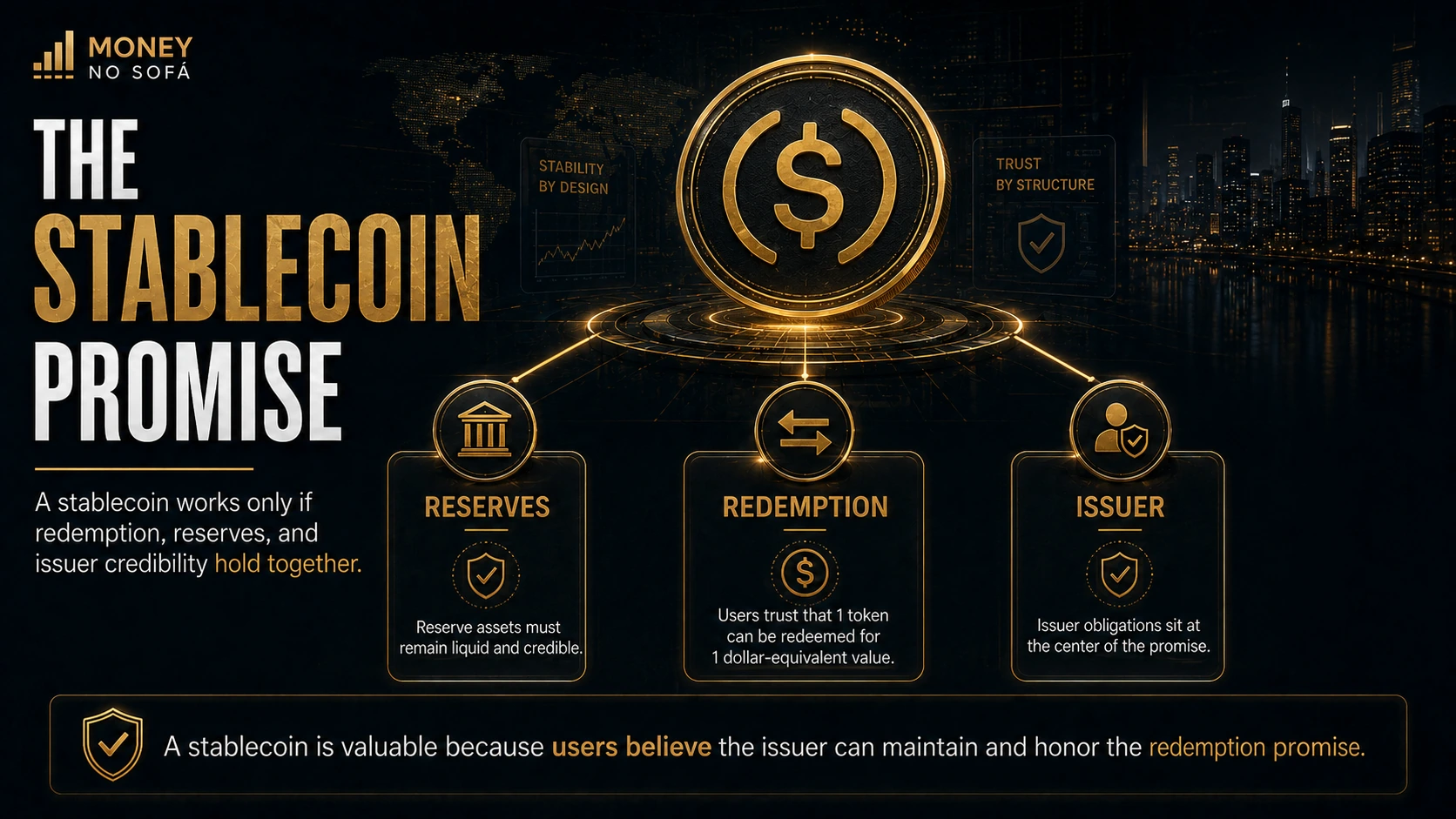
A stablecoin usually represents a promise that one token will maintain a value close to a reference asset, commonly one US dollar. The mechanism can vary. Some issuers hold cash and short-term government securities. Some rely on crypto collateral and automated liquidation. Others use more complex structures. The label “stablecoin” describes the objective, not a guarantee.
The user does not hold a Federal Reserve liability simply because the token uses a dollar symbol. The user holds an instrument issued under specific terms, backed by specific reserves, redeemable through specific channels, and exposed to specific legal and operational risks. The quality of the promise depends on reserve assets, transparency, segregation, governance, custody, liquidity, and regulation.
This distinction matters during stress. A token can trade below its target because users doubt reserves, redemption access, banking partners, or market liquidity. Even a well-backed token can deviate temporarily when demand for immediate exit overwhelms market makers. A token can also trade above the target when access is scarce.
Before using a stablecoin as savings or business cash, read the issuer’s reserve and redemption information. Ask who can redeem directly, what identification is required, which countries are supported, and how long the process takes. A secondary-market price near one dollar is useful evidence, but it is not the complete legal claim.
Why the dollar dominates stablecoins
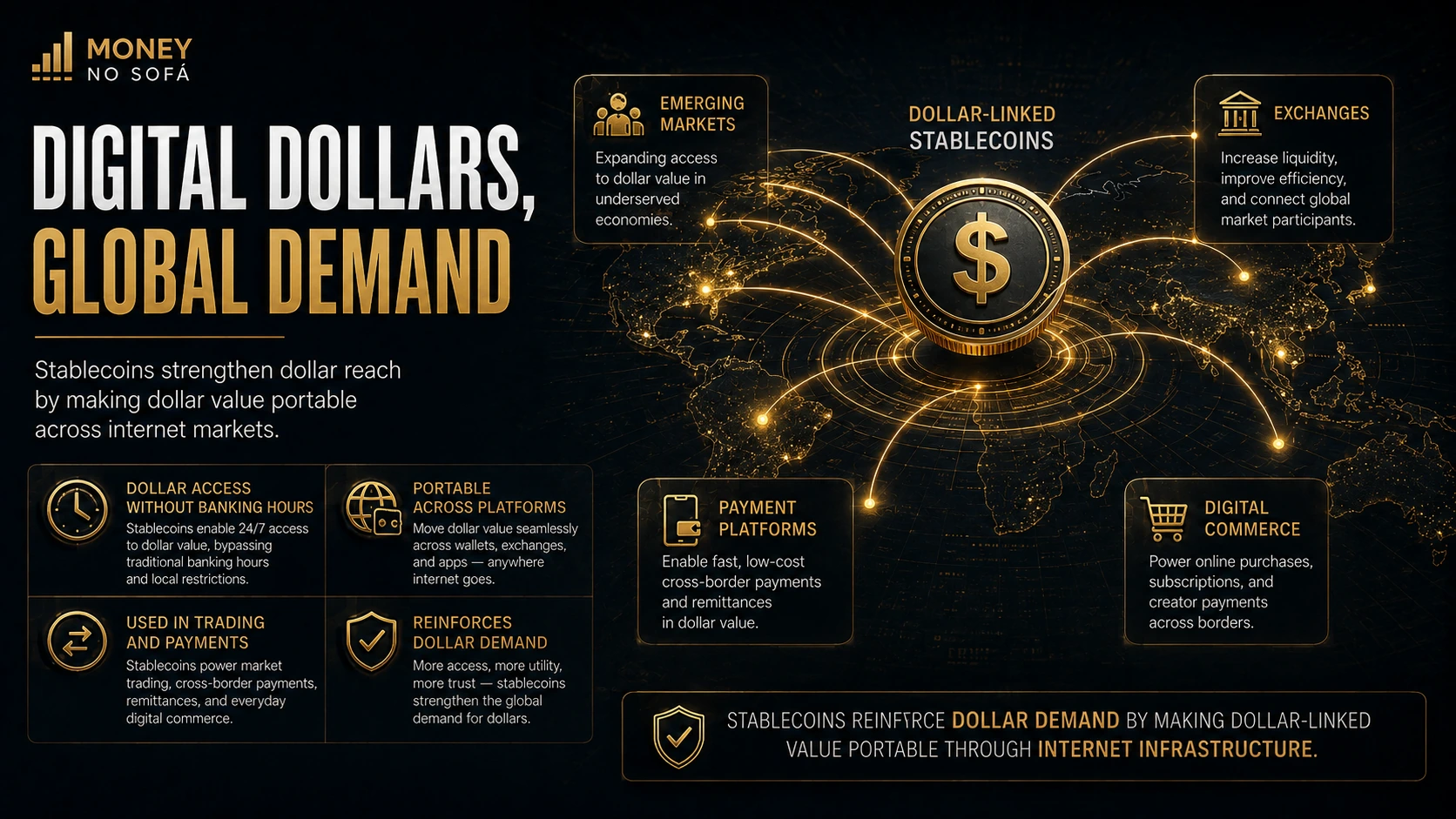
The dollar already dominates international trade invoicing, reserves, commodity pricing, debt, and financial markets. Stablecoins inherit that network effect. Users want a unit that counterparties recognize, markets quote, and exchanges support. Issuers choose the currency with the largest addressable demand. The result is a feedback loop that favors dollar-denominated tokens.
Stablecoins also solve a distribution problem. Opening a US bank account can be difficult for a person or small business outside the United States. Receiving a dollar-linked token may be easier where local exchanges, wallets, or peer-to-peer markets provide access. The token does not grant every right of a US bank deposit, but it can deliver price exposure and payment functionality.
This digital distribution can reinforce the dollar without requiring every transaction to pass through a traditional correspondent banking chain. The BIS argues that widespread adoption could strengthen existing currency hierarchies and create digital dollarization in emerging economies. The effect is strongest where inflation, capital controls, weak banking, or political uncertainty already reduce confidence in local money.
For the individual user, dollar access may feel like protection. At national scale, the same behavior can reduce monetary-policy effectiveness, shrink local bank deposits, and increase vulnerability to foreign rules and private issuer decisions.
The GENIUS Act changed the US framework
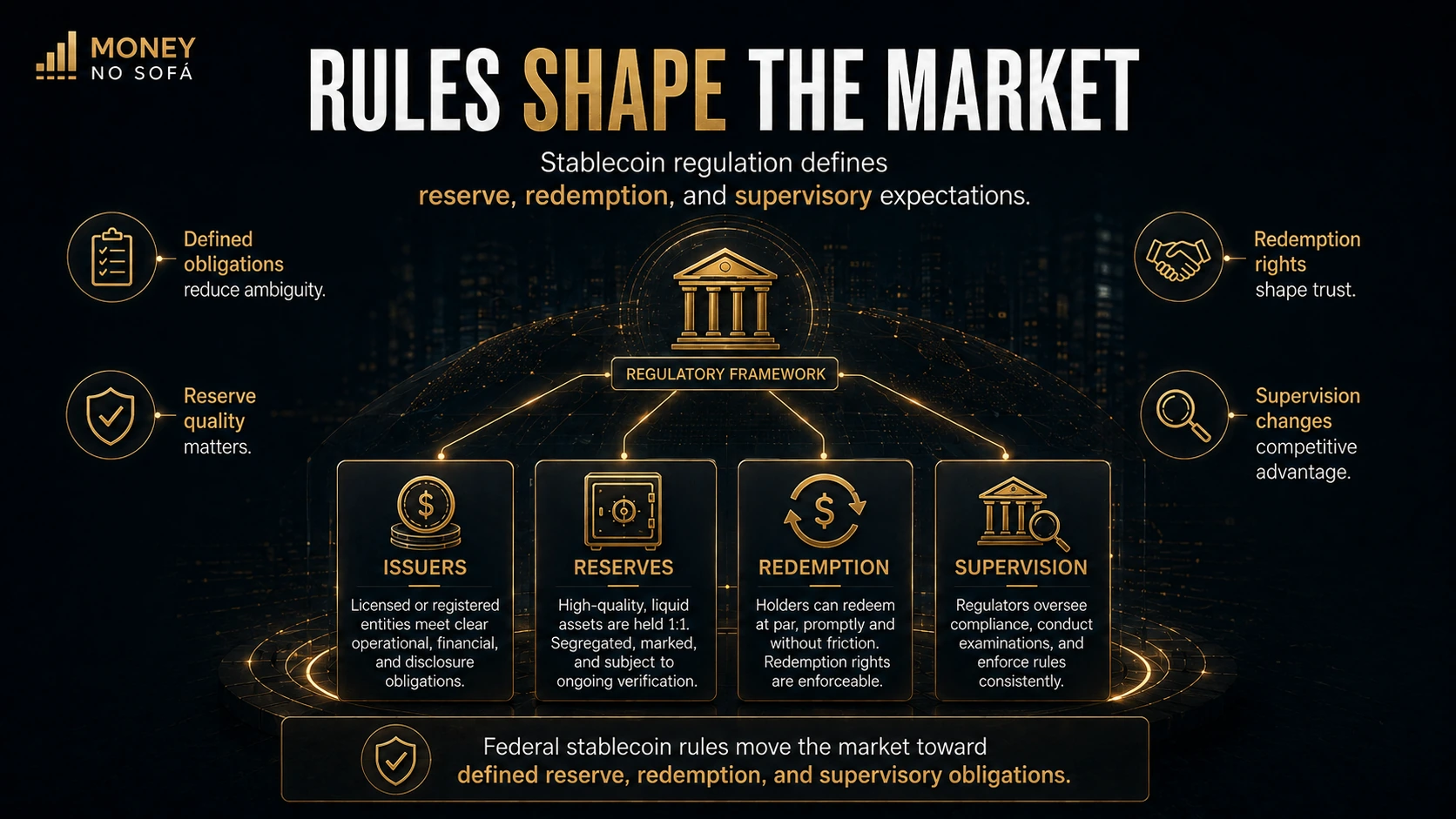
On July 18, 2025, the United States enacted the Guiding and Establishing National Innovation for U.S. Stablecoins Act, commonly called the GENIUS Act. The law created a federal framework for payment stablecoins and established definitions, issuer categories, supervisory responsibilities, and operating requirements.
The strategic importance extends beyond compliance. A clearer framework can encourage banks, fintech companies, payment providers, and large platforms to consider stablecoin products with less legal ambiguity. It can also increase confidence among businesses that need reserve standards and redemption rules before using a private digital dollar at scale.
Regulation does not eliminate issuer risk. The quality of implementation, supervision, disclosures, reserve management, cybersecurity, and resolution procedures still matters. Different issuers may offer different levels of access, geography, liquidity, and commercial integration. Users must still understand the instrument they hold.
The framework also reinforces the geopolitical dimension. A regulated US stablecoin industry can extend demand for dollar-denominated assets and bring digital payment activity inside a rules-based perimeter. Other countries must decide whether to permit, integrate, restrict, or compete with privately issued digital dollars.
Payments are the visible use case
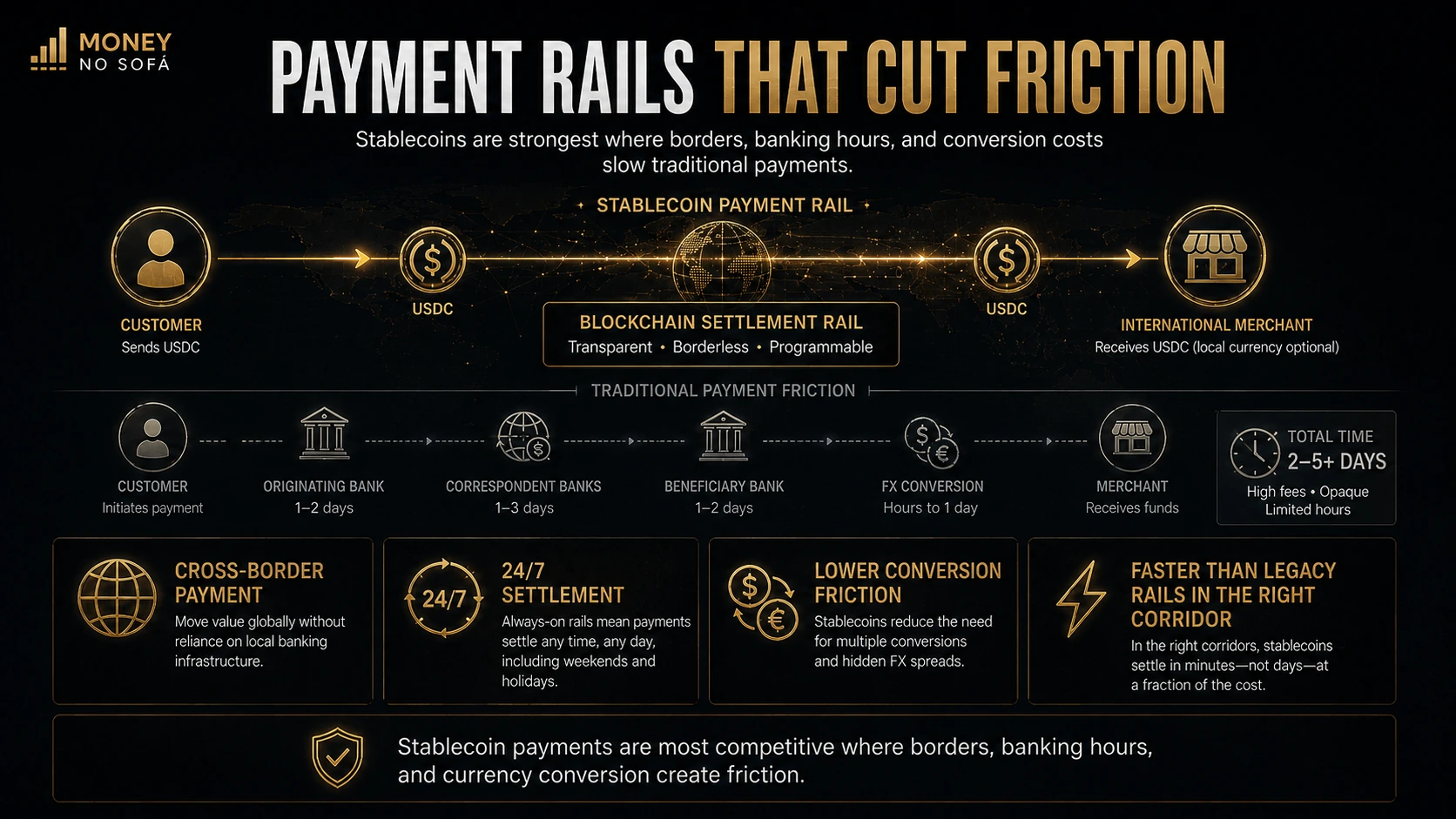
Stablecoins can settle across blockchain networks at any hour. This makes them attractive for international invoices, contractor payments, treasury transfers, and online commerce. A transaction can move directly between compatible wallets without waiting for a chain of correspondent banks to open and reconcile.
The advantage is corridor-specific. Domestic card systems and instant bank networks can already be fast, trusted, and inexpensive. A stablecoin adds value when the payer and receiver operate in different countries, the banking route is slow, foreign-exchange spreads are high, or the receiver wants dollar-linked value rather than immediate conversion into local currency.
The blockchain fee is not the total cost. The business must include on-ramp and off-ramp fees, exchange spreads, compliance, support, accounting, wallet risk, and the possibility of sending the wrong asset or network. A transaction that confirms quickly can still take longer to become usable fiat in the recipient’s bank account. Eligible readers comparing stablecoin conversion routes can check the current Binance registration offer with code BITCOIN15, then compare the actual spread, supported networks, fiat rails and regional eligibility against other providers.
The strongest implementation hides technical complexity while preserving transparency. The customer sees the supported token, network, amount, expiration, and confirmation status. The business receives a record linked to the invoice and can explain refund and conversion procedures.
Reserve quality is the core product
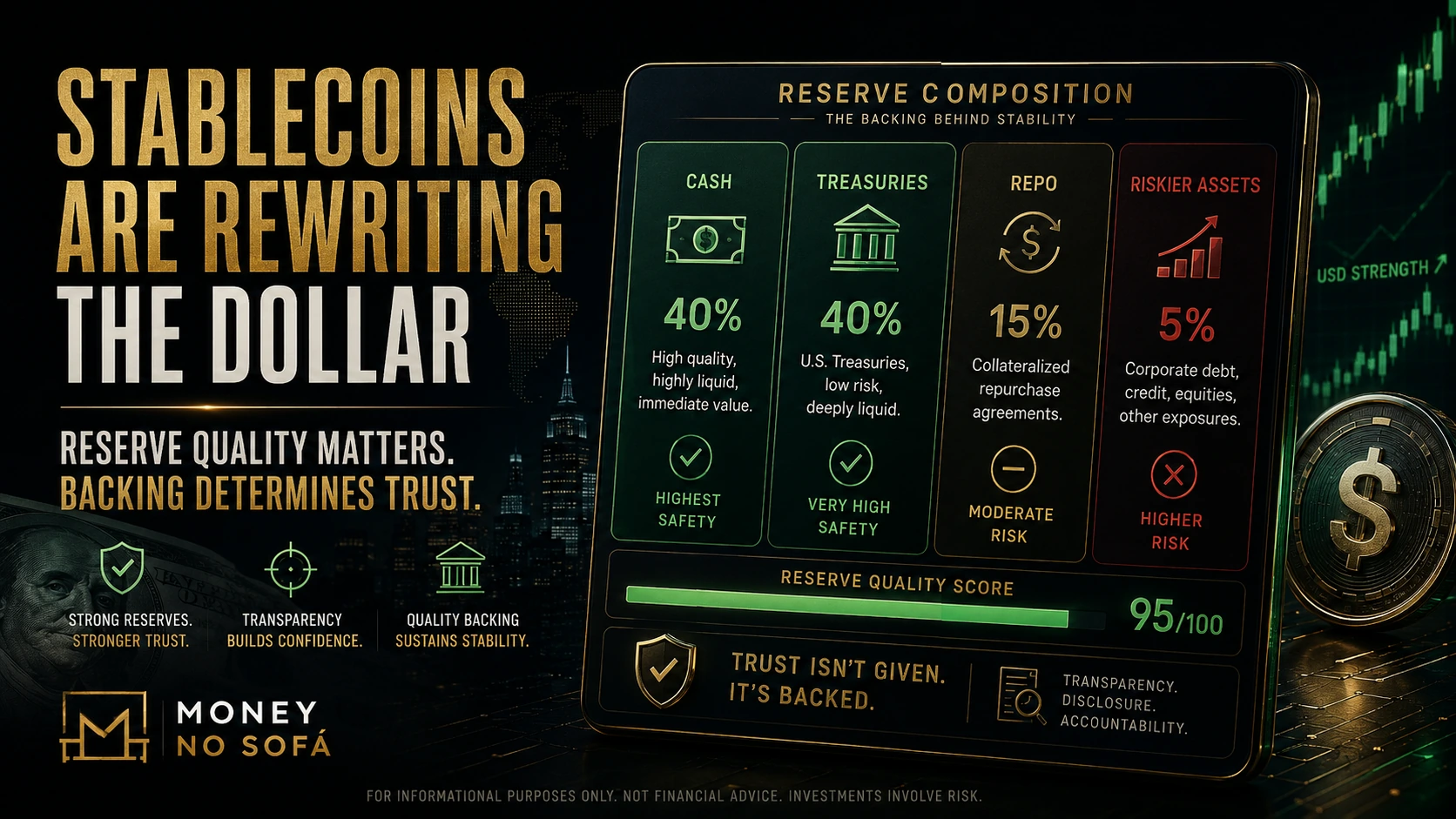
Stablecoin marketing focuses on speed and technology. The economic product is reserve management. An issuer receives assets, creates tokens, invests or safeguards reserves, and must remain able to honor redemptions. The safest-looking interface cannot compensate for weak reserves or uncertain legal claims.
Users should examine the composition, maturity, custody, and reporting of reserves. Cash and short-term government obligations behave differently from corporate debt, loans, commercial paper, or crypto collateral. The ability to sell assets quickly without large losses matters when redemption demand rises.
Attestations and audits provide information, but scope matters. What date is covered? Which entity holds the reserves? Are assets segregated from operating funds? Are liabilities measured consistently? Can ordinary users redeem directly, or must they sell through an exchange? What happens if a bank partner fails?
A stablecoin can be fully backed and still create access risk if the holder depends on one exchange or jurisdiction to convert it. Reserve quality and distribution access must be evaluated together.
The hidden bank-run dynamic
Stablecoins can experience a digital version of a bank run. When confidence falls, users sell or redeem simultaneously. Blockchain markets operate continuously, so the price signal appears immediately. Social media can accelerate fear before an issuer publishes a formal response.
The outcome depends on reserve liquidity, redemption capacity, banking access, market-maker balance sheets, and communication. A strong reserve can support recovery if the issuer processes redemptions and proves access to assets. A weak or opaque structure can enter a reflexive decline as falling price creates more doubt and more selling.
Users should plan for the possibility that a stablecoin temporarily trades below its target or becomes difficult to convert. Businesses should avoid holding all operating liquidity in one token, issuer, exchange, or network. Treasury policies need exposure limits and alternative settlement routes.
The lesson is not that stablecoins are uniquely fragile. Banks, money-market funds, and payment institutions also manage liquidity and confidence. The difference is that stablecoin runs can unfold globally and visibly on public markets at internet speed.
Digital dollarization changes emerging markets

In economies with high inflation or capital restrictions, stablecoins can offer a practical escape from local currency risk. A household can hold a dollar-linked token, a freelancer can invoice internationally, and a small business can preserve working capital between payments. These benefits are concrete and explain demand better than crypto ideology.
At scale, the same behavior can reduce demand for local money and bank deposits. Credit creation may weaken if funds move outside domestic institutions. Central banks can lose influence over payment conditions and capital flows. Tax enforcement and sanctions compliance become more complex when value moves through global wallets.
The BIS describes several possible outcomes, from niche crypto use to digital dollarization and domestic integration under stronger regulation. The path depends on macroeconomic stability, legal treatment, banking integration, and user behavior. Countries with credible money and efficient payments may see stablecoins remain a specialized tool. Countries with weak trust may see rapid substitution.
The policy debate should acknowledge both sides. Restricting access does not remove the demand created by inflation or financial exclusion. Uncontrolled adoption can create systemic dependence on foreign currency and private issuers. Durable solutions require better domestic money as well as sensible digital-asset rules.
A business decision framework
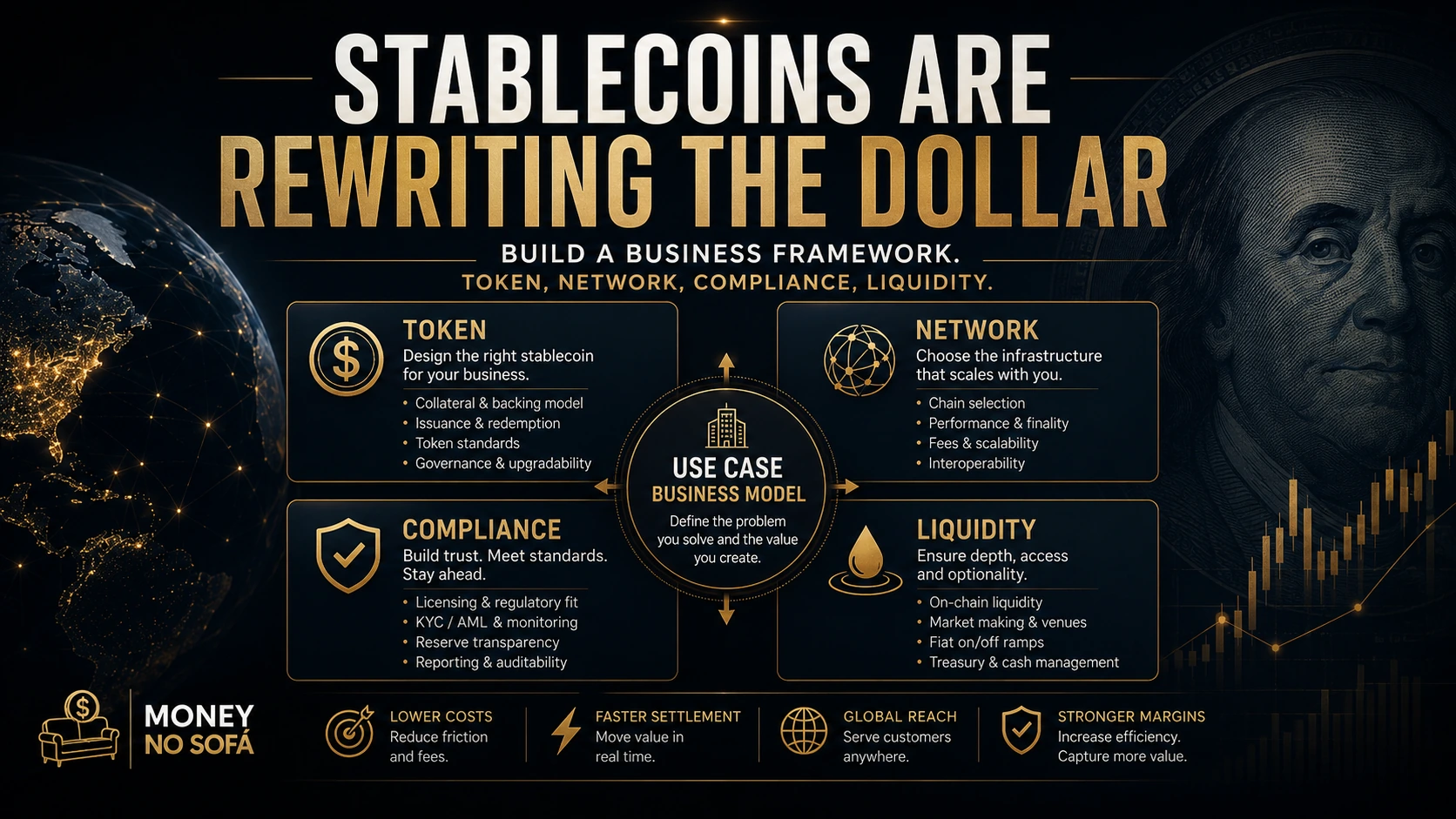
A business considering stablecoins should begin with a specific payment problem. Measure the current fee, foreign-exchange spread, settlement delay, failure rate, chargeback exposure, support time, and reconciliation effort. Then model the stablecoin route using the same units.
The stablecoin route must include token and network support, provider fees, conversion spread, wallet procedures, compliance, accounting, refund handling, and the cash-flow value of faster settlement. A cheap network transaction may still be expensive after conversion and support. A higher direct fee may be justified if settlement becomes usable days earlier.
Pilot one corridor with existing customers who understand the method. Set a transaction cap. Use a single token and network. Convert to fiat automatically at first unless the business has a documented treasury policy. Test underpayment, refund, delayed confirmation, and customer-support scenarios.
Expand only after the measured advantage survives the full operating cost. Stablecoins are infrastructure, not branding. The customer should receive a reliable payment experience rather than a lesson in blockchain.
A practical place to compare the market
Binance can be evaluated as one route for eligible users and businesses to acquire, convert, or transfer supported stablecoins. Compare the actual spread, withdrawal network, compliance requirements, and fiat availability for your country before relying on it operationally.
Check the current Binance referral offer with code BITCOIN15.
Availability, eligibility, fees, products, and referral benefits vary by country and account. Crypto assets are volatile and may result in loss.
Choosing a stablecoin and network
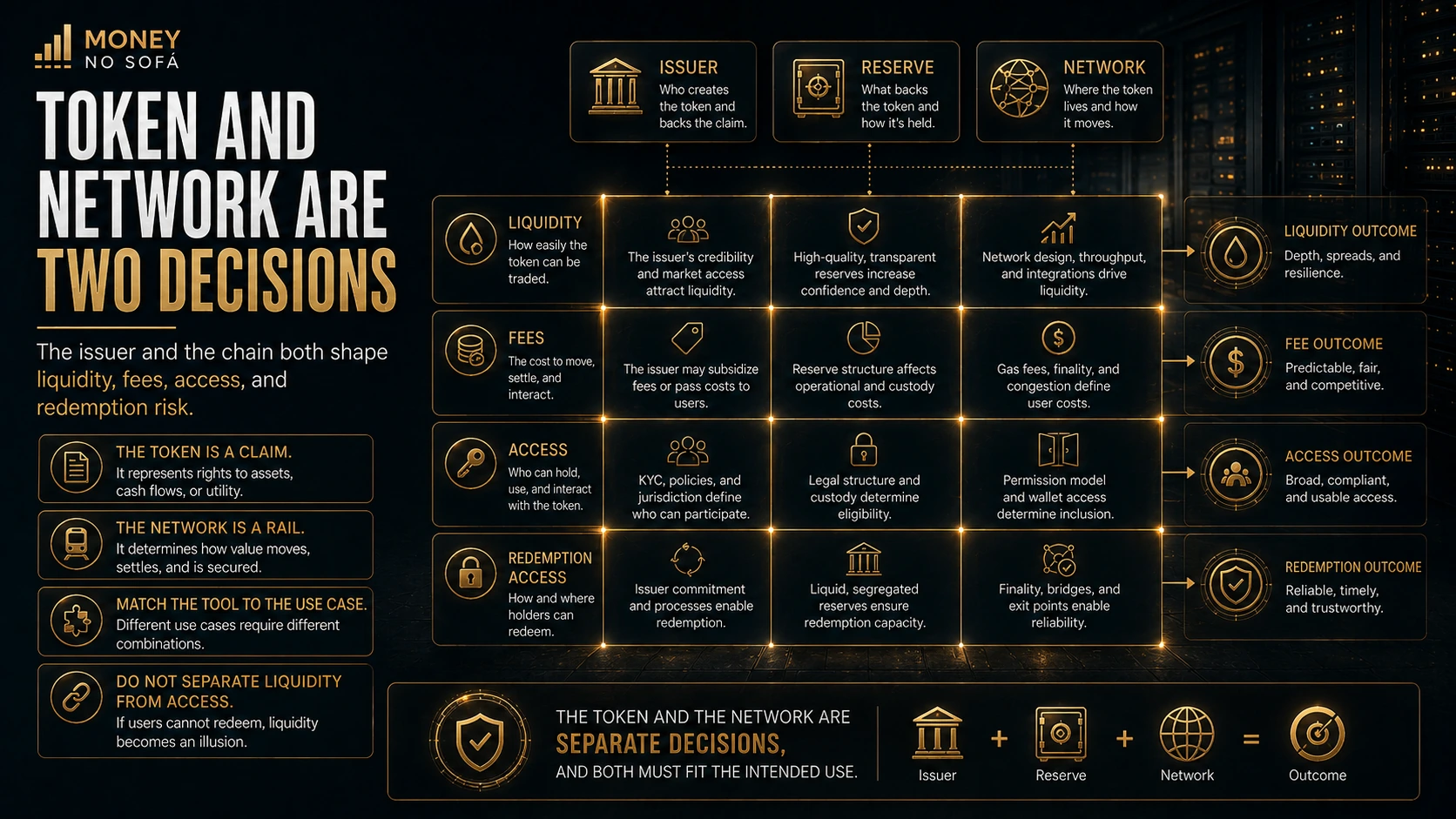
The same stablecoin may exist on multiple networks. Sending a supported token through an unsupported network can delay or permanently complicate recovery. Network choice affects fees, confirmation time, wallet compatibility, exchange support, smart-contract risk, and operational complexity.
Begin with issuer quality and redemption. Then evaluate market liquidity and the networks supported by both payer and receiver. A small business should prefer a narrow set of well-supported options rather than presenting customers with a confusing list. A treasury team should document approved token-network combinations and test them with small transfers.
Avoid assuming that every dollar token is equivalent. Reserve design, legal claim, transparency, concentration, and market depth differ. Algorithmic or heavily crypto-collateralized designs require a different risk analysis from reserve-backed payment stablecoins.
The best option is the one that can be explained, reconciled, converted, and recovered—not the one with the most attractive logo or highest advertised yield.
| Decision | What to verify | Why it matters |
|---|---|---|
| Issuer | Legal entity, reserve reports, redemption terms | Defines the promise behind the token |
| Reserve | Assets, maturity, custody, liquidity | Determines stress resilience |
| Network | Fees, support, congestion, contract address | Prevents incompatible transfers |
| Liquidity | Market depth and conversion routes | Controls exit cost |
| Access | Country, KYC, banking and exchange availability | Determines whether value is usable |
| Accounting | Records, valuation, tax treatment | Makes the system operable for a business |
The stablecoin risk checklist
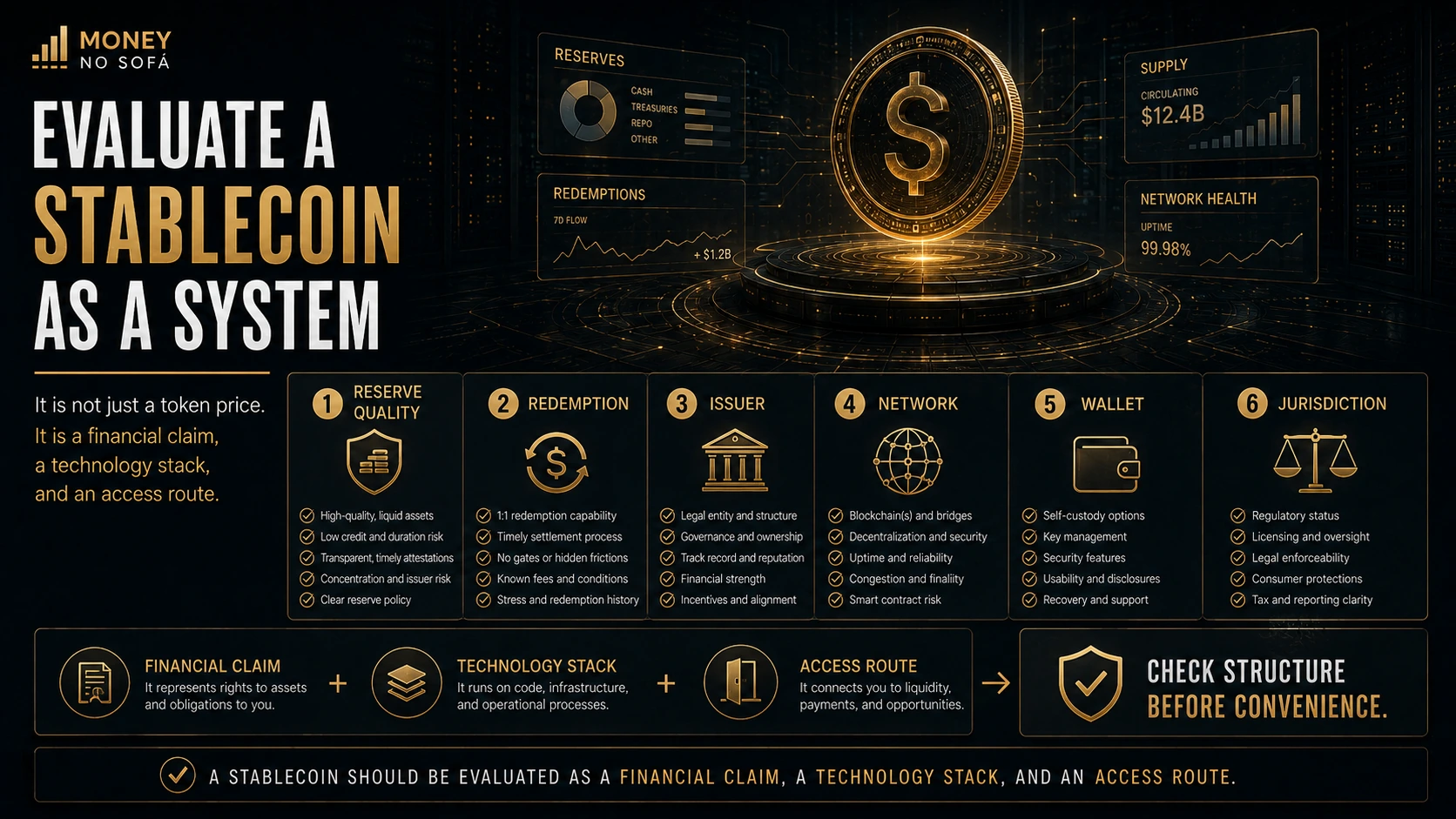
Stablecoin risk is layered. Issuer risk concerns the organization making the promise. Reserve risk concerns the assets supporting it. Redemption risk concerns the path from token to reference currency. Network risk concerns the blockchain and smart contract. Wallet risk concerns access and transaction security. Jurisdiction risk concerns rules, freezes, sanctions, and service availability.
A user may be comfortable with one layer and exposed through another. A token can have strong reserves but be held on a compromised exchange account. A secure wallet can hold a weak token. A business can receive a sound stablecoin but lack a compliant conversion route. The complete path matters.
Review concentration monthly if stablecoins are used as working capital. Set a maximum balance by issuer and platform. Maintain a tested bank or payment alternative. Export transaction records. Separate operating cash from speculative decentralized-finance positions.
Do not chase yield with money needed for payroll, rent, taxes, or emergency reserves. Yield generally introduces lending, duration, liquidity, smart-contract, or counterparty risk beyond the stablecoin itself.
- Verify the issuer and legal claim.
- Read reserve and redemption disclosures.
- Use only approved token-network combinations.
- Test conversion into usable local money.
- Limit issuer, platform, and network concentration.
- Keep operating cash separate from yield strategies.
Frequently asked questions
Are stablecoins the same as dollars in a bank?
No. A stablecoin is a claim issued under specific terms and supported by a reserve or collateral design. Deposit insurance, redemption rights, legal status, and access differ from a bank deposit.
Why are most stablecoins dollar-denominated?
The dollar already has dominant international demand, deep markets, and widespread use in trade and savings. Stablecoins extend that network effect through digital distribution.
Can a fully backed stablecoin lose its peg?
Yes, temporarily. Market liquidity, banking access, redemption capacity, operational incidents, and fear can push the market price away from the target even when reserves are strong.
Are stablecoins cheaper than bank transfers?
Sometimes. The correct comparison includes blockchain fees, exchange spreads, conversion, compliance, support, accounting, and the value of settlement speed. The result depends on the corridor.
Should a business hold stablecoins after receiving payment?
Only under a documented treasury policy. Accepting a token and holding it are separate decisions. Operating cash should have issuer, platform, network, and duration limits.
What is digital dollarization?
It is the replacement or weakening of local-currency use by dollar-linked instruments. Stablecoins can accelerate the process by making dollar exposure easier to access and transfer.
Stablecoins, banks, and the future of deposits
Stablecoin growth changes the competition for short-term savings. If users move balances from bank deposits into tokens backed by government securities, funding can shift away from banks toward stablecoin issuers and reserve custodians. The effect depends on where reserves are held and how banks participate in issuance and distribution.
Banks can respond by issuing tokenized deposits, integrating stablecoin settlement, improving cross-border payments, or partnering with regulated issuers. The future may not be stablecoins replacing banks. It may be banks and fintech platforms adopting tokenized forms of money while competing over user relationships and reserve economics.
For consumers, the product boundaries can become confusing. A bank deposit, tokenized deposit, money-market fund, central-bank liability, and payment stablecoin may all display a value near one dollar while providing different legal claims, insurance, redemption rights, and yields. Interfaces should not flatten those differences.
The winning form of digital money will combine speed with a credible claim. Technology can move the record. Trust determines whether the record functions as money.
Redemption and operating continuity
A stablecoin can look liquid on an exchange while redemption through the issuer follows a different process. Businesses should distinguish three exits: selling the token in a secondary market, converting through a payment provider, and redeeming directly with the issuer. Each route may have different minimums, eligibility rules, banking partners, settlement times, fees, and compliance checks. During normal conditions those differences appear minor. During stress they determine whether a holder receives something close to one dollar or accepts a discount for immediate liquidity.
Operating continuity matters just as much as reserve composition. A token can be fully backed and still become difficult to use if a blockchain pauses, an exchange suspends withdrawals, a banking partner closes, or the issuer freezes an address under legal authority. A serious treasury policy therefore avoids treating one stablecoin, network, wallet, or provider as an infallible cash account. It defines backup routes before a disruption.
For a business, the continuity plan should name the approved tokens, maximum balance, preferred conversion provider, alternative venue, supported networks, responsible approvers, and the evidence required for accounting. A small test withdrawal should be performed periodically. Wallet access should be recoverable without concentrating every key or device in one person. Large transfers should use address allowlists and independent confirmation.
Consumers need a simpler version of the same discipline. Verify the token contract and network. Keep only an amount consistent with the purpose. Understand whether the balance is held by an exchange, custodian, or self-controlled wallet. Test the exit route before it becomes urgent. The ability to buy a stablecoin is not the same as a guaranteed ability to redeem it under every condition.
The dollar is becoming programmable infrastructure
Stablecoins are rewriting the dollar by making dollar-linked value portable across internet networks. The innovation is not a new unit of account. It is a new distribution, settlement, and programming layer for the world’s dominant currency.
That layer can reduce friction for international payments, protect purchasing power in unstable economies, and create new financial products. It can also concentrate power in private issuers, extend digital dollarization, create run dynamics, and move activity outside domestic banking systems.
The correct response is neither blind adoption nor reflexive rejection. Users should evaluate the promise, reserves, redemption, network, access, and purpose. Businesses should pilot measurable corridors. Governments should improve domestic money and establish credible rules. Stablecoins will be most valuable when they solve real payment problems without hiding the financial claims underneath the technology.
A practical place to compare the market
Eligible readers can use Binance to compare supported stablecoins, networks, conversion routes, and current market liquidity. Confirm the exact token contract, network, fees, and regional rules before sending money.
Check the current Binance referral offer with code BITCOIN15.
Availability, eligibility, fees, products, and referral benefits vary by country and account. Crypto assets are volatile and may result in loss.
Stablecoins for Normal Businesses
Turn the monetary story into an operating framework: payments, settlement, reserves, custody and business risk in plain English.
Educational notice: This article is general editorial information, not personalized financial, investment, legal, accounting, tax, or security advice. Crypto products, rules, prices, and availability can change rapidly.
Selected sources
Continue Learning About Bitcoin
To compare stablecoins with a different monetary design, explore how Bitcoin changes money. For the platform layer, review crypto exchange risks.
For a book-length introduction to Bitcoin’s origins, Satoshi and the ideas behind money, explore The Bitcoin Trilogy — Complete Set.
The headline is only the start.
Ask Nova what this story could change in your budget, savings, debt, investments or next purchase.