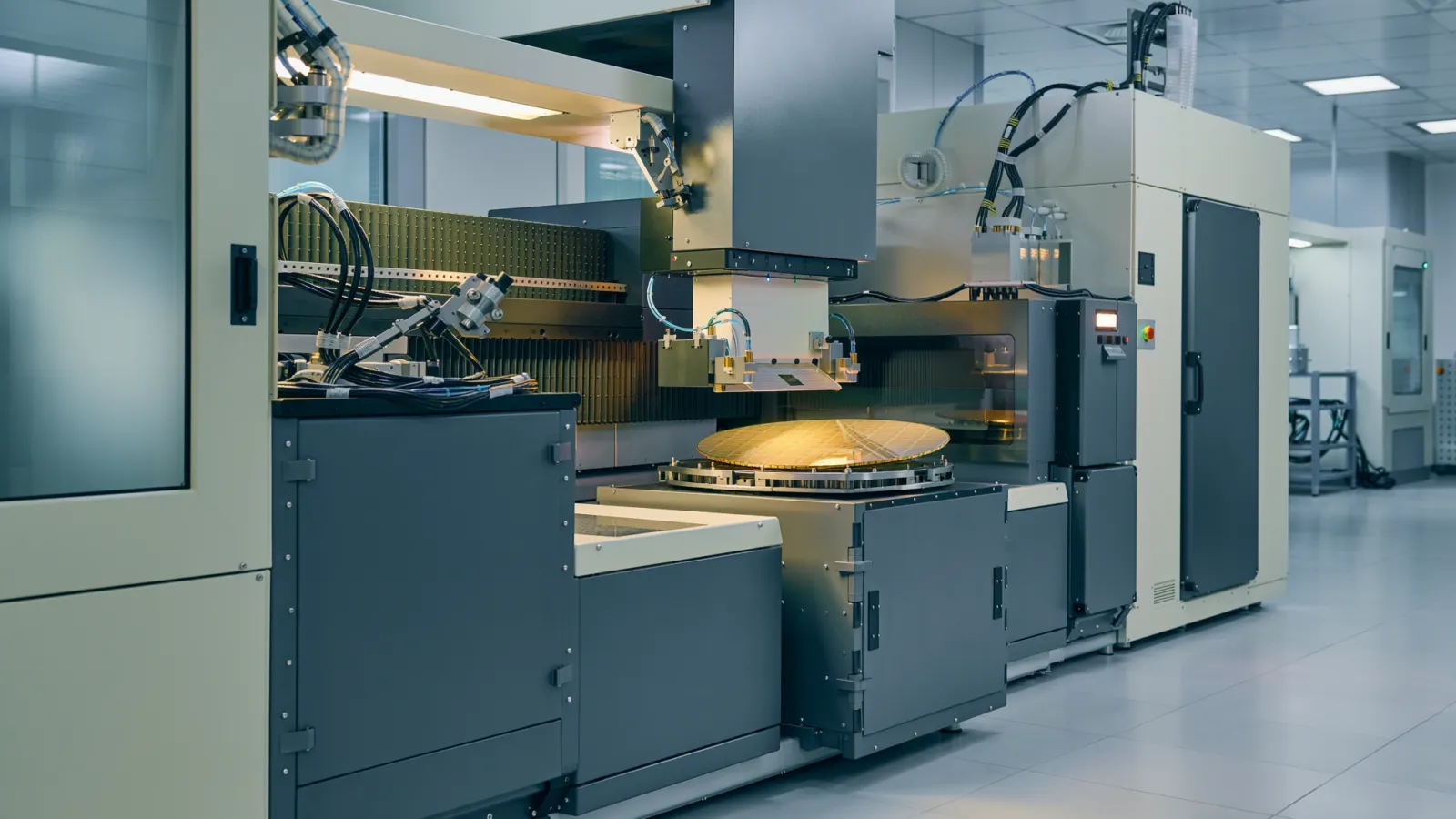
Equipment demand meets limits.
AI’s Chip Bottleneck: ASML’s Record Quarter and the Capacity Question
Equipment demand meets limits.
A record from the equipment layer
ASML’s October 14 results put an important part of the AI economy in focus: the machines needed before a leading-edge chip can exist. The Dutch company reported third-quarter 2026 net sales of about €11.7 billion and net income of approximately €5.0 billion, with a gross margin of 57.5%. It forecast full-year sales of €44 billion to €45 billion. These are company-reported results and guidance, not guarantees for future quarters. The important consequence is that semiconductor manufacturing capacity depends on complex equipment investment, long production cycles and the ability of customers to bring new factories and processes online.
Why the bottleneck matters beyond the stock
When demand for computing power increases, attention naturally goes to chip designers and data-center operators. Yet lithography equipment sits upstream of the final chip. An order for more AI accelerators does not instantly become finished silicon. Fabrication plants need tools, cleanrooms, skilled technicians, materials and time. Even a very profitable equipment supplier cannot remove every physical constraint at once. That is why the economics of AI infrastructure must be read as a system. A large capital expenditure announcement by a cloud company is not the same as immediate computing capacity available to customers.
Revenue, orders and capacity are different concepts
Revenue records what a company recognized during a period. Orders indicate customer commitments under particular conditions. Production capacity is the amount of output the industrial system can realistically deliver. Mixing these three concepts can produce misleading headlines. ASML’s quarter is evidence of strong equipment activity, but it does not establish that every chip shortage is solved or that demand will grow indefinitely. Customers can change timing, governments can alter trade restrictions and technical transitions can require different equipment mixes. Investors and entrepreneurs should follow the distinctions rather than extrapolating one quarterly percentage into a decade-long forecast.
The cost of waiting
For a data-center operator, delayed chip availability can postpone revenue from rented computing capacity. For a startup building AI software, higher infrastructure costs can change the economics of serving users. For a manufacturer, a delayed equipment installation can push back the date at which a new production process starts generating sales. These are not identical problems, but all involve the time value of capital. Money committed today may not produce usable output for months or years. The longer that gap, the more important financing terms and operational execution become.
Why a high margin does not settle the AI debate
ASML’s reported profitability reflects its business model, product mix and industrial position. It should not be treated as proof that every participant in the AI value chain earns similar returns. A chipmaker may face large capital costs; a cloud operator may face energy and utilization risk; an application company may face intense competition and customer acquisition costs. The equipment maker’s economics therefore provide one piece of a larger picture. A credible investment thesis needs to explain how spending turns into cash flow at each layer, and where that process might disappoint.
The geographic dimension
The Netherlands is central to this particular technology supply chain, but the economic effects reach fabrication plants and customers across Asia, the United States and Europe. That creates opportunity for regions building semiconductor ecosystems, as well as exposure to export controls and trade policy. Location matters: factories, electricity supply, workforce training and equipment service networks are not easily moved overnight. A headline about Dutch earnings can therefore have consequences for employment and investment decisions thousands of kilometers away. Those consequences should be described as potential channels, not claimed as already measured local outcomes.
What to watch next
The useful follow-up indicators include ASML’s future guidance, customer capital expenditure plans, tool delivery schedules and actual semiconductor output. Also watch the price of computing capacity and the profitability of companies purchasing it. If equipment supply improves faster than demand, economics can change; if demand outruns installation capacity, bottlenecks can persist. Neither path is assured. Ask NOVA to map the cost drivers of an AI product, from infrastructure to monthly revenue, before treating the chip boom as an automatic business opportunity.
The long lead-time problem
An advanced semiconductor factory cannot be expanded like a small office by adding desks and computers. Cleanroom design, specialized machinery, installation, calibration and process qualification all take time. The commercial implication is that a purchase order for future capacity may be tied to a schedule that extends well beyond the current quarter. A cloud company planning a new service has to account for that delay in its revenue forecast. A supplier to a chip factory may need financing while waiting for milestones. For investors, the delay between announced investment and usable output makes execution risk central. Record equipment revenue is encouraging evidence for one stage of the chain, not proof that every downstream project will arrive on time.
Where labor enters the equation
The supply chain depends on highly trained engineers, technicians, equipment service specialists and construction teams. Capital can purchase a machine, but not instant experience in maintaining a complex industrial process. Regions seeking semiconductor investment must think about universities, vocational training, energy infrastructure and supplier ecosystems. Those are long-term economic commitments. A surge in equipment demand can create specialized job opportunities, but hiring effects differ by geography and project stage. It would be misleading to infer a specific number of jobs from ASML’s quarterly sales alone. The more useful labor-market question is which skills remain scarce across several years of investment and which training paths connect workers to them.
The buyer return on capital
For an equipment customer, the essential measure is whether the additional capacity earns enough over its useful life to justify the purchase and operating costs. That calculation depends on chip yields, selling prices, utilization and future technology shifts. High demand today can support investment, but overbuilding is possible if several companies expand at the same time. Likewise, insufficient capacity can leave profitable orders unfilled. The AI cycle will eventually be judged by the value customers receive from computing power, not only by the money spent creating it. A disciplined reader should ask where final demand comes from and whether it can sustain the industrial commitments being made now.
Explore your next decision with NOVA
Primary/source reference: https://investor.asml.com/news-releases/news-release-details/asml-reports-eu11.7-billion-total-net-sales-and-eu5.0-billion-net-income-q3-2026
The headline is only the start.
Ask Nova what this story could change in your budget, savings, debt, investments or next purchase.
