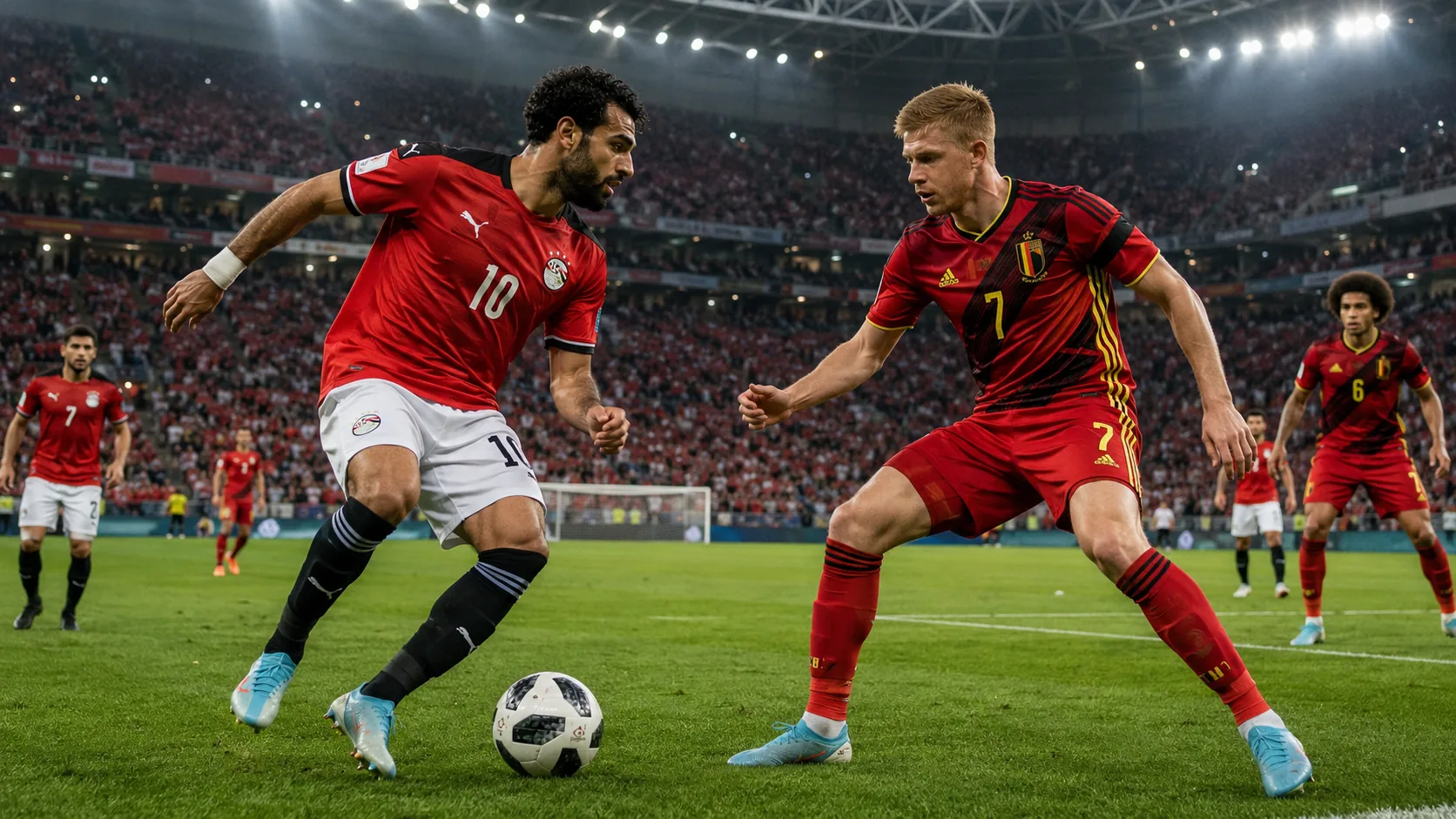
Egypt Tests Belgium as Group G Opens is not only a football story. It is a reminder that every major World Cup match quickly becomes a home event: food, streaming, friends, delivery, emotion and decisions made faster than usual.
Egypt enters with belief
Egypt came into the Belgium match with more than survival in mind. The larger objective is clear: to move beyond the group stage for the first time. That makes the opener against Belgium a difficult but useful test. Belgium still carries elite talent and name recognition, but this is also a team managing transition after its golden generation.
For Egypt, the conversation naturally starts with Mohamed Salah and Omar Marmoush, but it does not end there. The team needs discipline, patience and the ability to turn defensive pressure into practical attacking moments.
Why Group G feels open
Belgium may be the biggest name in the group, but Egypt sees opportunity in the wider schedule. Iran and New Zealand are still ahead, and those matches could become the real road to qualification. That is why one game should not define the whole campaign. A World Cup group is a small tournament inside the tournament.
For families watching from the sofa, that is a useful money lesson too. One emotional result should not drive every decision. Do not buy everything after one win. Do not panic after one loss. Make the plan before the emotion arrives.
The home budget behind a big match
A game like Belgium versus Egypt can quietly increase spending. There is the food order, the second streaming subscription, the quick snack run, the new jersey, the extra drinks and the idea that the home needs to be upgraded before the next kickoff.
Some purchases are worth it. A streaming plan used throughout the tournament can make sense. A planned grocery list for friends can create a good memory. But rushed spending usually feels better before the match than after the card statement arrives.
Money no Sofa match-day checklist
- Choose one main food plan before kickoff.
- Check whether the family already has access to the match through an existing subscription.
- Avoid buying team items after the first emotional result.
- Set a small fixed budget for World Cup gatherings.
- Keep delivery apps closed until the actual plan is clear.
What to watch next
The next Group G stories will matter as much as the opener. Iran and New Zealand can change the shape of the table, while Belgium and Egypt both need to prove that their plans are stronger than their reputations.
Money no Sofa recommendation
Treat the World Cup like a calendar of emotional spending moments. Mark the games, set a limit, and protect the house before the whistle. The best fan experience is not the most expensive one. It is the one that creates memory without creating regret.
Why Egypt versus Belgium is a useful kind of test
Some World Cup matches are easy to sell because they carry obvious star power. Others become valuable because they reveal what a team really is under pressure. Egypt against Belgium belongs in the second group. The story is not only whether one side has more famous names or a stronger recent history. The story is whether Egypt can turn belief into patience, and whether Belgium can turn reputation into performance at a moment when the tournament gives nobody much time to adjust.
A group opener, or the first serious test inside a group, works like a financial month inside a family. It sets the tone. It does not decide everything, but it changes behavior. A calm start creates room. A nervous start forces people to rethink. A good result can make the next decision easier. A bad one can push a team into urgency. That is why Group G feels important beyond the scoreboard. It is a small calendar of risk, opportunity and emotional discipline.
For Egypt, the value of testing Belgium is strategic. A team that wants to move deeper into the tournament must understand how it behaves against a stronger name. Can it defend without becoming passive? Can it attack without becoming reckless? Can it keep its leaders connected to the match when possession becomes difficult? These are football questions, but they also sound like household questions. Can the family face pressure without panic? Can it enjoy a big moment without spending too much? Can it make decisions with a plan instead of reacting to noise?
The pressure on Belgium is not only sporting
Belgium carries a different kind of weight. When a team has lived through an era of elite talent, the public keeps comparing the present to the best version of the past. That comparison can be unfair, but it is real. Fans remember what a team once promised. Commentators ask whether the window has closed. Opponents sense transition. Every match then becomes more than a match. It becomes a judgment on whether the project still has authority.
That kind of pressure is familiar inside the home as well. Families compare the current budget to a better period, an easier year, a cheaper supermarket cart, a lower interest rate or a time when subscriptions felt less expensive. The danger is to let nostalgia create bad decisions. Belgium cannot win because of memory alone. A household cannot protect itself by wishing prices were what they used to be. Both need present discipline.
The Belgium lesson is that reputation helps only when it supports clear execution. A famous team still needs shape, humility and practical choices. A familiar family routine still needs review when prices, schedules and habits change. The World Cup is useful because it compresses this truth into ninety minutes: history matters, but the present makes the bill.
Egypt’s opportunity and the patience problem
For Egypt, the temptation in a match like this is to treat every counterattack as the moment. That is understandable. When a team knows it may have fewer chances, each opening feels urgent. But urgency without patience can waste the very opportunities the team worked to create. The better approach is to recognize which moments are real and which moments are only emotional invitations to rush.
That is exactly how families should read match-day spending. A promotion may look like a chance. A delivery app may look convenient. A new streaming package may look necessary. A larger television may look like the missing piece of the experience. But not every opening is a real opportunity. Some are only pressure wearing the clothes of urgency.
Patience does not mean refusing joy. Egypt can still attack. A family can still celebrate. The point is to choose the right moment. A planned purchase, compared calmly, can improve the home. A rushed purchase, made because the match feels important, often becomes another small regret. The difference is not the product. The difference is timing.
How Group G changes the viewing calendar at home
Group G is not just a set of games. For many fans, it becomes a schedule of evenings, meals, messages and decisions. The first match creates curiosity. The second match creates calculation. The third match may create tension. A family that wants to enjoy the full group without overspending should treat the group stage like a mini-season rather than a sequence of emergencies.
Start by writing down the key matches and deciding which ones deserve a real gathering. Not every match needs the same level of preparation. Belgium versus Egypt may deserve attention. Another game might be watched quietly. A later decisive match might justify inviting relatives. When the calendar is divided this way, the budget stops being surprised by the tournament.
The same idea works for food. Instead of ordering from scratch before every game, build a simple group-stage menu. One larger grocery run can cover snacks, drinks, sandwiches, fruit, coffee and a few easy items for guests. A home that plans the week has more freedom during the match. A home that improvises every time tends to pay delivery fees, rush prices and convenience costs.
The role of stars without letting stars sell everything
Football stars carry attention. Attention attracts advertisers. Advertisers understand that supporters do not watch stars neutrally; they watch them with memory, affection and expectation. That is why a match connected to famous names can become a shopping trigger. The player becomes the mood. The mood becomes a product. The product becomes a purchase that did not exist before kickoff.
For a fan, the question is not whether stars matter. They do. They give the tournament personality. They help children choose sides. They create stories that survive the final whistle. The question is whether the admiration has to become a cart. A jersey, a collectible, a subscription or a gadget can make sense when it is planned. It becomes weaker when it is bought only because a player had one good moment or one dramatic headline.
Money no Sofa reads star power as a useful warning light. When a famous name is involved, slow down. The marketing around the match will be stronger. The emotional pull will be louder. That does not mean do not buy. It means buy only after the purpose is clear.
A practical budget for a big Group G night
The best budget for a match like Egypt and Belgium is simple enough to survive real life. Decide the maximum amount for food. Decide whether guests are expected. Decide which subscription or channel is already available. Decide whether any purchase would still be useful after the tournament. Write the numbers before the match starts. The act of writing matters because it moves the decision from emotion to structure.
A good home budget can divide World Cup spending into four lines: food and drinks, streaming and access, small celebration items, and durable upgrades. Food and drinks should be limited per match or per week. Streaming should be reviewed monthly. Celebration items should stay small. Durable upgrades should require comparison, not impulse. If a purchase does not fit one of these lines, it probably needs a pause.
This framework is not complicated. It simply gives the family a language. Instead of saying yes or no randomly, the household can ask, which line does this belong to? If there is no line, there may be no real need.
What fans should watch tactically and financially
On the field, watch how Egypt handles the first uncomfortable spell. Does the team stay connected? Does it protect space? Does it choose the right pass when Belgium presses? Watch how Belgium reacts if the match becomes slower or more physical than expected. Does reputation become calmness or frustration? These details often reveal more than the final score.
At home, watch the same pattern in your own behavior. Does the family become calmer as the match approaches, or does it start adding purchases? Does the phone become a planning tool or a spending trigger? Are people choosing food because it improves the gathering or because the app made ordering feel effortless? A World Cup match can teach a family about itself if the family pays attention.
This is why Money no Sofa connects football and money. The connection is not forced. Both are about choices under pressure. Both reward preparation. Both punish panic. Both look simple from the outside and complicated when the clock is moving.
Checklist before the next Group G match
- Confirm where the match will be watched before paying for another service.
- Choose one food plan and avoid adding last-minute extras.
- Separate planned celebration from emotional buying.
- Use a 24-hour pause for jerseys, electronics and subscriptions.
- Share costs when more people join the gathering.
- Keep the same budget for wins and losses so the result does not control spending.
FAQ
Why is Egypt versus Belgium important beyond the score?
Because it tests two different pressures: Egypt’s belief against a major opponent and Belgium’s ability to perform beyond reputation. That makes it a useful match for understanding the group and the emotional rhythm of the tournament.
How should families prepare financially for big World Cup matches?
They should plan food, streaming access and guest expectations before kickoff. The goal is to avoid turning every important match into a new spending event.
Should fans buy team products during the group stage?
Only when the purchase is planned and useful beyond one emotional result. A simple 24-hour pause prevents many regret purchases tied to match emotion.
What is the Money no Sofa lesson from Group G?
A group stage rewards discipline. So does a household budget. The best experience comes from planning the emotional moments before they arrive.
Final thought from the sofa
Egypt testing Belgium is a football story, but it is also a reminder of how quickly attention becomes spending. A serious match creates conversation. Conversation creates plans. Plans can become memories or they can become unnecessary expenses. The difference is whether the family decides before the emotion takes over.
The World Cup should make the house feel alive. It should bring people together, create noise, revive old memories and introduce new teams to people who may not watch football every week. But the tournament should not make the household lose sight of the month. A fan can love the match and still protect the budget. In fact, that is the strongest kind of fan experience: one that remains enjoyable after the final whistle, after the guests leave and after the card statement arrives.
A slower planning guide for the rest of the group
The best way to keep a long tournament under control is to make a few decisions once and reuse them. Decide where the family watches weekday games. Decide what counts as a simple meal and what counts as a special gathering. Decide who pays when friends come over. Decide how many delivery nights make sense for the whole month. These decisions sound small, but they remove friction before the most emotional moments arrive.
For a match such as Egypt and Belgium, the planning question is not only who will win. It is what the match asks from the house. Does it deserve a larger meal, or only coffee and snacks? Does it require a new subscription, or is the current access enough? Is the family watching because the match matters, or because the tournament mood has made every game feel urgent? The answers can change from house to house, but asking them creates control.
A useful household rule is to separate joy from upgrade. Joy is the people, the match, the conversation, the noise and the memory. Upgrade is the product added around that emotion. Sometimes the upgrade improves joy; sometimes it only follows it. When the family learns to separate the two, it can spend where value is real and ignore what is only decorative pressure.
This matters because a World Cup group is short, intense and repetitive. The same triggers return every few days: hunger before kickoff, messages from friends, ads for bigger screens, quick-commerce offers, team merchandise and the temptation to make the next match bigger than the last one. Without a plan, the household repeats the same spending conversation again and again. With a plan, the family can focus on the football.
- Before the next Group G match, review what was actually used during the Belgium game.
- Remove one item from the next grocery list if it was left untouched after the opener.
- Keep one shared note with match dates, food plans and expected guests.
- Ask guests to bring one item when the gathering grows beyond the original plan.
- Decide before kickoff whether the night is a full event or a simple watch.
- Do not let a dramatic result change the budget for the following match automatically.
- Keep the same discipline after a win, because celebration can be more expensive than disappointment.
The conclusion is simple: Egypt and Belgium can make Group G more interesting, but the family does not need to make the month more expensive every time the group becomes more dramatic. The calmer the plan, the freer the fan experience becomes.