A 65-inch gaming TV guide for PS5 Pro buyers balancing OLED, Mini-LED, HDR and refresh rate.
Best 65-Inch TV for PS5 Pro in 2026
Affiliate disclosure: Money no Sofá may earn compensation from qualifying purchases made through partner links on this page.
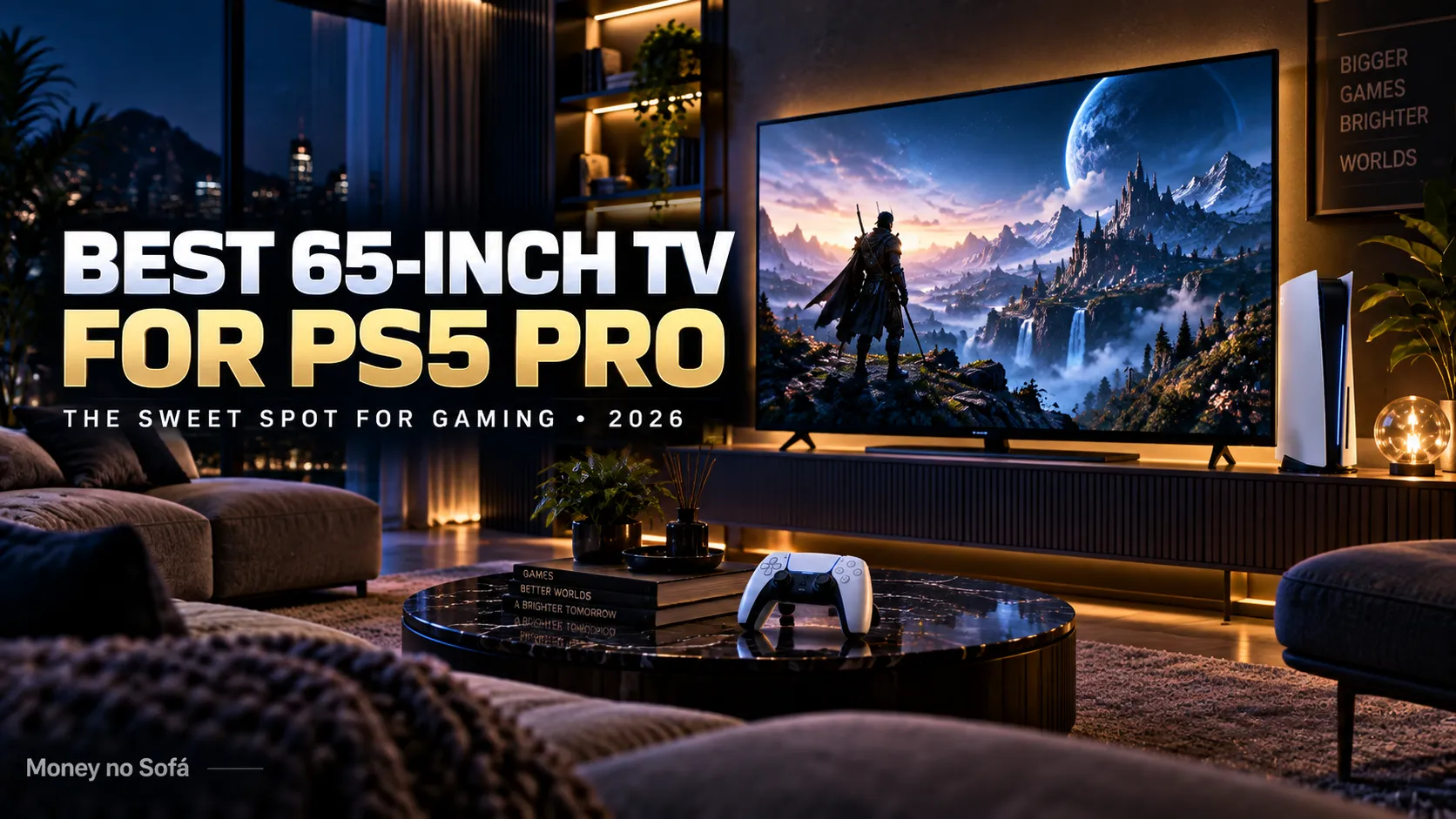
For many living rooms, 65 inches is where PS5 Pro starts to feel properly cinematic without turning the television into the entire room. It is large enough to reveal the extra detail, HDR, and cleaner performance modes you paid for, but still practical for apartments and normal sofa distances.
The best 65-inch TV for PS5 Pro is not simply the brightest panel or the most expensive OLED. It is the one that matches your room, your viewing distance, and the rest of your entertainment. In 2026, the strongest shortlist includes OLED for contrast and response, Mini-LED for brightness, and a few value models that deliver most of the gaming features without flagship pricing.
Quick picks
Best overall for most buyers: LG C6 OLED 65-inch. Four HDMI 2.1 ports, VRR, excellent response, Dolby Vision for movies, and gaming performance that comfortably covers the PS5 Pro’s 4K/120Hz ceiling.
Best premium OLED: Samsung S95H 65-inch. Exceptional brightness, vivid QD-OLED color, excellent glare control, four HDMI 2.1 ports, and very low input lag. Its main compromise is no Dolby Vision.
Best bright-room alternative: premium Mini-LED from Samsung, Sony, TCL, or Hisense. If the room gets heavy daylight, Mini-LED can deliver stronger sustained brightness and less concern about static content.
Best value approach: discounted previous-generation OLED or current TCL/Hisense Mini-LED. A 2025 flagship on clearance can be a better purchase than a 2026 midrange set at full price.
Why 65 inches works so well
Screen size changes how much detail you can actually see. A 4K image on a 65-inch display viewed from roughly normal living-room distances creates enough visual scale for texture, ray-traced reflections, and high-resolution reconstruction to matter. On a smaller screen from far away, some of the PS5 Pro advantage simply becomes harder to notice.
That does not mean bigger is always better. A 77-inch screen can be stunning, but it costs more, needs more wall space, and can overwhelm a small room. A 55-inch can be a better fit for a compact apartment or closer viewing distance. The 65-inch category wins because it balances immersion, price, and practicality.
The features PS5 Pro actually needs
4K at 120Hz: Both PS5 and PS5 Pro can output supported games at up to 120 frames per second. Your TV needs a 120Hz panel and HDMI bandwidth that supports the mode.
VRR: Variable Refresh Rate helps reduce tearing and makes changing frame rates feel smoother.
ALLM and low input lag: Auto Low Latency Mode and a strong Game Mode keep the TV responsive when you press the controller.
Good HDR: HDR is not a logo. The TV needs enough brightness, black level, and color volume to make highlights and shadows look convincing.
Strong motion response: OLED is excellent here because pixels switch very quickly. Good LCD/Mini-LED sets can still perform well, but panel response varies.
Watch before you buy
The LG C6 is a useful reference point because it represents the middle of the premium market well: better than budget TVs in the areas that matter for gaming, without automatically demanding the very top flagship price.
LG C6 65-inch: best balance
The 65-inch LG C6 is one of the easiest recommendations for a PS5 Pro setup. It combines OLED black levels with fast response, four HDMI 2.1 ports, VRR, and low input lag. It also supports Dolby Vision for movie and streaming sources, even though PlayStation gaming itself uses HDR10.
Its biggest weakness is the same one many glossy OLEDs share: direct reflections in a very bright room. If your TV faces a window all afternoon, a brighter or more anti-reflective model may be worth the extra money.
The C6 also supports refresh rates beyond 120Hz for PC gaming. PS5 Pro does not need those higher rates, but they add flexibility if the television doubles as a large PC gaming display.
Samsung S95H 65-inch: premium bright-room OLED
The Samsung S95H is the more aggressive premium choice. Its QD-OLED panel delivers bright, saturated color and excellent contrast, while Samsung’s Glare Free treatment makes it unusually practical for rooms with ambient light.
For gaming, it offers four HDMI 2.1 ports, very low input lag, VRR, and up to 4K/165Hz for PC sources. PS5 Pro tops out at 120Hz, so the extra headroom is not necessary for PlayStation, but it makes the TV versatile.
The caveat is Dolby Vision. Samsung does not support it. That has little impact on PS5 HDR gaming, but it matters if your movie and streaming habits rely heavily on Dolby Vision content.
When Mini-LED is the smarter choice
OLED gets most of the enthusiast attention, but Mini-LED can be the better living-room television. If you have large windows, watch sports during the day, leave news or dashboards on screen for long periods, or simply want maximum brightness, a strong Mini-LED model deserves a serious look.
TCL and Hisense are especially aggressive on value. Their better Mini-LED models can offer 120Hz or 144Hz panels, VRR, high brightness, and local dimming at prices below premium OLED. Sony and Samsung tend to charge more but may offer stronger processing, refinement, or ecosystem features depending on the model.
COMPARE 65-INCH MINI-LED TVs →
OLED vs Mini-LED in one sentence
Choose OLED for dark-room contrast and motion. Choose Mini-LED for brightness and bright-room practicality.
That is more useful than brand loyalty. Panel technology should follow the room.
How far should you sit from a 65-inch 4K TV?
There is no single correct distance because some people prefer a cinematic field of view and others prefer a more relaxed television feel. As a practical starting point, many viewers are comfortable around 6.5 to 9 feet from a 65-inch 4K screen.
If you sit much farther away, the difference between 4K detail levels becomes less visible. If you sit much closer, lower-quality streaming sources and compression artifacts also become easier to notice.
Do you need 8K for PS5 Pro?
No. For most buyers, a high-quality 4K OLED or Mini-LED is a better use of money than an 8K television. Native 8K gaming content remains niche, and image quality factors such as contrast, HDR, motion, and processing matter far more in everyday use.
Do you need a soundbar too?
Maybe. Thin televisions rarely produce audio with the same scale as their picture. If you already own a good TV and feel tempted to upgrade because movies and games lack impact, audio may actually be the bottleneck.
A good soundbar with a subwoofer can create a larger perceived upgrade than moving between two similar TV generations. Check eARC support and make sure the sound system does not consume the only HDMI 2.1 port you need on a TV with limited connectivity.
What about Marvel’s Wolverine?
Marvel’s Wolverine arrives September 15, 2026 and is PS5 Pro Enhanced. Its fast melee combat, dark environments, bright effects, and cinematic presentation make it a natural showpiece for a large high-contrast display. But buying a TV for one game is still the wrong logic. Buy the TV because it improves everything you watch and play.
What we would buy
For a dark or mixed-light room, we would start with the 65-inch LG C6 and compare its live price against discounted C5 stock and the Samsung S95H. For a very bright room, we would compare the S95H against a premium Mini-LED option rather than forcing OLED into the wrong environment.
Price matters. The best TV is often last year’s excellent model at this year’s discount.
MNS verdict
The 65-inch LG C6 is the safest all-round PS5 Pro recommendation. The Samsung S95H is the premium alternative when brightness and glare handling matter more.
Do not buy by logo. Compare room brightness, viewing distance, HDMI ports, 120Hz support, VRR, HDR performance, and real price. Those six things tell you more than a wall of marketing terms.
FAQ
Is 65 inches too big for gaming?
Not for most living rooms. The correct size depends on viewing distance and room layout.
Does PS5 Pro need HDMI 2.1?
For the best access to 4K/120Hz and VRR features, yes.
Is OLED better for Wolverine?
OLED’s black levels and fast response should suit a cinematic action game well, but a strong Mini-LED can be better in a bright room.
Read next
Best OLED TV for PS5 Pro →
Best TV for Marvel’s Wolverine →
VIEW ALL BEST PICKS →
The headline is only the start.
Ask Nova what this story could change in your budget, savings, debt, investments or next purchase.