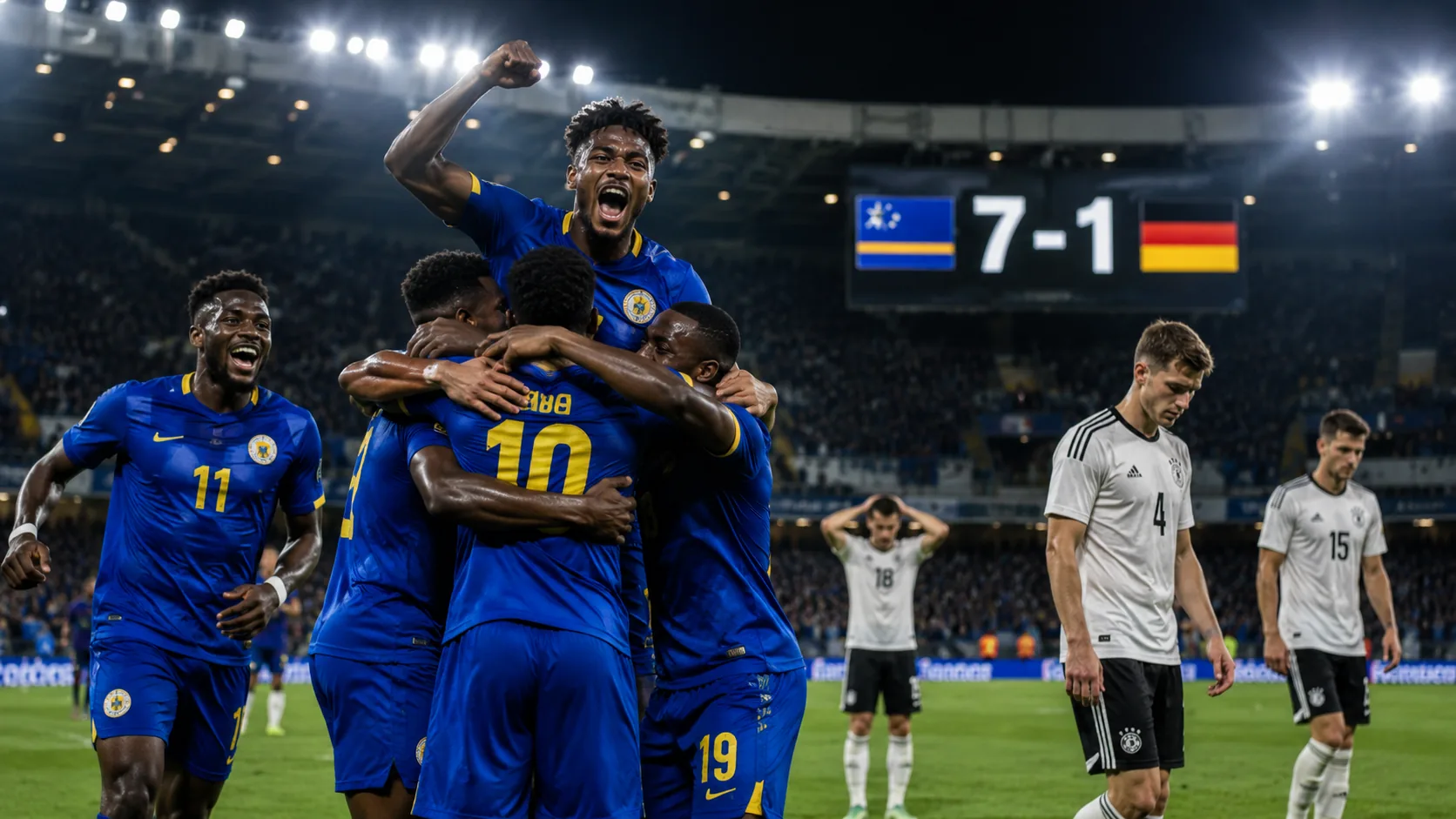
Curacao Turns Germany 7-1 Into Pride is the kind of World Cup story that looks simple on the scoreboard and much bigger inside the home. Germany won 7-1, but Curaçao left the match with something no number can erase: its first World Cup goal and the pride of being on the biggest football stage for the first time.
A heavy defeat with a historic memory
Germany’s victory over Curaçao was dominant and became part of a larger record conversation around World Cup scoring history. But the emotional center of the match was not only Germany’s attack. It was Curaçao’s response. Livano Comenencia’s goal gave the island its first World Cup moment, turning a painful result into a memory that fans could still celebrate.
That matters because the World Cup is not only about who wins. It is also about who arrives, who inspires, who gives a small country a reason to gather around a screen, and who makes children believe that football can take them somewhere larger than their neighborhood.
Why Curaçao’s reaction matters
Curaçao is tiny compared with the football powers around it. That is exactly why its World Cup debut has value beyond the final score. For a country with a small population and a large diaspora, one goal can feel like a flag planted in global memory. Fans can lose the match and still win a story.
The next step is practical: Curaçao still has Ecuador and Ivory Coast ahead in Group E. The tournament is not finished, and the lesson is not to judge a campaign by one emotional afternoon.
The Money no Sofa view
Inside the home, stories like this change behavior. Families buy snacks, jerseys, streaming packages, flags, delivery meals and sometimes even new TVs because the emotion feels immediate. That is normal. Football creates rituals. The risk is when pride becomes impulse buying.
A smarter World Cup budget does not remove emotion. It protects it. The best plan is to decide before the next kickoff how much the family can spend on food, drinks, decorations, subscriptions and small upgrades.
A practical game-day filter
- Buy what will be used after the match, not only during one emotional hour.
- Set a fixed amount for snacks and delivery before the game starts.
- Do not upgrade a TV or streaming plan without comparing total monthly cost.
- Use football as a reason to gather, not as an excuse to lose control of the card.
Money no Sofa recommendation
Germany won the match. Curaçao won a memory. For Money no Sofa, that is the useful lesson: spend for the memory, not for the pressure.
FAQ
What was the key story of Germany 7-1 Curaçao?
The score was heavy, but Curaçao’s first World Cup goal turned the match into a historic moment for the island.
Who does Curaçao play next?
Curaçao is scheduled to face Ecuador and then Ivory Coast in Group E.
What is the money lesson?
World Cup emotion is powerful, but families should set a clear spending limit before buying food, streaming, jerseys or upgrades.
Why a 7-1 can mean more than humiliation
A heavy score usually invites one kind of reaction: shock, jokes, criticism and quick judgment. In football culture, a 7-1 score is almost impossible to read neutrally, especially when Germany is part of the conversation. But Curaçao’s story asks for a slower reading. A debutant nation can lose heavily and still create a memory that survives the defeat. That is not an excuse for the score. It is a recognition that not every World Cup story is measured only by the winner.
For Germany, a large victory can become proof of efficiency and authority. For Curaçao, the same match can become proof of arrival. The scoreboard says one thing. The family watching from home may feel another. A child from Curaçao seeing the national team score at a World Cup may not remember the exact defensive mistakes. That child may remember the celebration, the flag, the sound in the room and the feeling that the country was visible to the world.
This is why the World Cup is different from a league table. It gathers countries with unequal histories, populations, budgets and expectations, then asks them all to share one stage. The favorite wants the title. The newcomer may want recognition, a first goal, a first point, a first night when the world says its name correctly. Those goals are different, but they are still real.
The Brazilian memory behind the number
For Brazilian fans, 7-1 is not just a score. It is a cultural scar. It brings back a day when football became disbelief, silence and national self-reflection. That memory is why any new 7-1 connected to Germany travels quickly through conversation. It is not simply sports news. It is a number that carries emotional weight.
But Curaçao’s version changes the meaning. It does not erase Brazil’s memory, and it does not make a heavy defeat easy. It simply shows that the same number can carry different stories depending on who is living it. For Brazil, the old 7-1 was trauma because expectations were enormous. For Curaçao, a 7-1 can still contain pride because the starting point is different. The island was not defending a century of football dominance. It was building its first global chapter.
That distinction is useful beyond football. Families also compare numbers without context. One household looks at another household’s vacation, car, television or celebration and feels behind. But the same number can mean different things in different homes. A small purchase can be responsible in one family and reckless in another. A big expense can be planned in one budget and dangerous in another. Context turns numbers into meaning.
Small nations and big emotional returns
When a smaller nation reaches the World Cup, the emotional return can be enormous. The tournament gives visibility that normal news cycles rarely provide. It puts the country on maps, screens, conversations and family tables. It gives the diaspora a shared appointment. It gives children a reason to ask about grandparents, islands, flags and journeys. That is why Curaçao’s goal matters even inside a heavy loss.
For the fan at home, this is the kind of story that turns a neutral viewer into an interested viewer. People may tune in for Germany and leave remembering Curaçao. That is the magic of the World Cup: it redistributes attention, if only for a few hours. It lets a smaller country borrow the world’s living room.
Money no Sofa sees a lesson here. Not every valuable experience has to be expensive. Some of the most memorable moments come from paying attention more deeply to what is already happening. A family does not need to buy more every time a story moves them. Sometimes the best response is to sit together, explain the meaning, call someone who cares and let the moment be enough.
How pride becomes spending pressure
Pride is beautiful, but it is also a powerful commercial trigger. When a country does something historic, people want to mark the moment. They buy shirts, flags, food, collectibles, subscriptions and souvenirs. They invite more people over. They order more than planned. They turn a match into an event because the emotion feels rare.
There is nothing wrong with marking a moment. The risk is when pride becomes pressure. A family should not feel forced to spend beyond comfort to prove loyalty. Support is not measured by receipts. A child will remember who watched the match with them more than the price of the snacks. A relative abroad may value the call more than the decoration. A first World Cup memory does not need to be packaged by a store to be real.
A practical rule helps: spend for use, not for proof. If the jersey will be worn for years, it may have value. If the flag will become part of family tradition, it may be worth it. If the purchase only exists because the room was emotional for ten minutes, wait until tomorrow. The pride will remain if the purchase is meaningful. If the desire disappears, the family saved money without losing the memory.
The Germany side of the lesson
Germany’s role in this story is also important. A strong team must still treat a lopsided win responsibly. Dominance can create confidence, but it can also create illusion. A team that scores freely against one opponent may still face very different problems later. That is why serious football cultures do not confuse one big result with a completed mission.
Families should treat positive financial moments the same way. A bonus, a good month, a paid-off bill or a temporary discount can feel like permission to relax all discipline. But one good moment does not remove the need for structure. Germany still needs the next match. The household still needs the next month. The best response to a good result is not uncontrolled celebration. It is to use the momentum wisely.
This is the executive view of football and money: do not overreact to a single data point. A 7-1 says something, but not everything. A discount says something, but not everything. A good paycheck says something, but not everything. Strategy is what survives after the emotional number fades.
A home plan for historic matches
Historic matches deserve preparation because they attract emotion before and after the game. The family can create a simple plan with three parts: what to watch, what to spend and what to remember. The first part is logistical. Make sure everyone knows the time, the channel and the place. The second part is financial. Decide the food, drinks and any shared costs before kickoff. The third part is emotional. Take a photo, call family, explain the story to children or save a small note about why the match mattered.
This plan gives the moment shape without letting it become expensive by default. The memory becomes intentional. The cost becomes visible. The family stays present rather than distracted by last-minute shopping.
For a story like Curaçao and Germany, the emotional question may matter more than the tactical one. What did it feel like for a small nation to score? What did it mean for fans who never expected to see this stage? What does the number 7-1 mean when attached to a different country, a different dream and a different kind of pride? These questions make the match useful long after the highlight ends.
What Brazil fans can learn from Curaçao
Brazil fans know how heavy football can become when expectation turns into obligation. The national shirt carries joy, but it also carries pressure. Curaçao offers a different kind of lesson: sometimes the first victory is simply to arrive, compete, score, gather and be seen. That does not fit the Brazilian standard for itself, but it can soften how Brazilians read the rest of the tournament.
Not every team is living the same dream. Not every fan is measuring success with the same ruler. That perspective makes the World Cup richer. It also helps families avoid the trap of comparison at home. The neighbor’s watch party, television, barbecue or decoration is not the standard. Your household standard should be comfort, clarity and memory within your own numbers.
Checklist for turning pride into memory, not debt
- Choose one meaningful way to mark the match before buying anything.
- Use photos, calls and family stories before reaching for products.
- Set a fixed amount for food if more people join after a historic moment.
- Wait one day before buying jerseys, flags or collectibles after a big emotion.
- Teach children the meaning of the match instead of only showing the score.
- Separate national pride from social pressure to host a bigger event.
- Keep the memory even if the spending stays small.
FAQ
Can a team lose 7-1 and still leave with pride?
Yes, especially when the match includes a first World Cup goal or a historic appearance for a smaller nation. The score matters, but so does the meaning of participating and creating a national memory.
Why does a 7-1 score affect Brazilian fans so strongly?
Because Brazil’s 2014 loss to Germany made that number part of football memory. Any new 7-1 involving Germany naturally brings that comparison back into conversation.
How can families celebrate a historic match without overspending?
They can define a small budget, use food already planned for the week, take photos, call relatives and wait before buying merchandise. Memory does not have to be expensive to be meaningful.
Final thought from the sofa
Germany may own the result, but Curaçao can still own a piece of the story. That is the strange beauty of the World Cup. It can be harsh and generous at the same time. It can expose limits and still create pride. It can produce a number that hurts and a moment that heals. For Money no Sofa, the lesson is direct: let football move you, but do not let emotion spend for you. The best memory is the one the family can keep with a calm heart and a calm budget.
The deeper money lesson behind a symbolic defeat
A symbolic defeat is often more useful than a comfortable win because it forces people to decide what the story really means. Curaçao’s match against Germany can be read only as a lopsided score, but that would be the shallow version. The deeper version is about how families, small countries and ordinary people handle moments when the number looks bad but the meaning still contains value. Many households live this kind of contradiction. A month can be financially difficult and still include a good decision. A family can postpone a dream and still protect its future. A person can avoid a purchase and still feel proud because the restraint had purpose.
That is why football can be useful from the sofa. It gives language to things that happen at home. Germany’s score represents force, scale and efficiency. Curaçao’s goal represents belonging, courage and memory. Most families need both lessons. They need to respect the numbers, but they also need to understand what the numbers cannot measure. A budget is not only a restriction. It is a map of what the family values enough to protect.
When the next World Cup surprise arrives, the family can remember Curaçao. It can ask whether the emotion deserves a purchase or simply deserves attention. It can choose to gather without exaggerating. It can tell the story to children without turning the day into a shopping event. It can celebrate the flag, the goal and the pride while still respecting the month.
How to keep the story after the match ends
The strongest football memories are not always attached to products. They are attached to who was in the room, what was said, what the family laughed about, what a child asked, what an older fan remembered and how the home felt in that hour. If a household wants to keep the memory of a match like this, it can do it with simple rituals: save a photo of the gathering, write down the score and the meaning, call someone from the community, cook the same simple food for the next match or create a small family tradition around underdog stories.
These rituals are inexpensive and powerful because they give the emotion somewhere to live. Without a ritual, emotion often looks for a product. With a ritual, the memory becomes independent of spending. That is one of the best Money no Sofa principles for a World Cup month: make memory deliberate before marketing makes it expensive.
Curaçao’s pride does not require a perfect result. A family’s pride does not require a perfect event. Both require presence, context and enough clarity to separate what matters from what is only noise around the moment.