Learn how to turn research, comparison and synthesis into a paid service. Build decision-ready briefs, price the outcome, use AI safely and find your first clients.
MONEY NO SOFÁ — MAKE MONEY
The internet made information abundant. AI made summaries cheap. That did not kill research as a business. It raised the value of one thing most people still struggle to produce: a reliable answer that helps someone make a decision.
Approx. 17–19-minute read
There is a strange opportunity hiding inside the information economy. Almost everything is searchable, yet companies still waste hours comparing vendors, checking competitors, organizing customer feedback, building prospect lists, understanding new markets, and turning scattered facts into something a decision-maker can actually use.
The opportunity is not “selling information.” Raw information is becoming cheaper every year. The opportunity is selling reduction of uncertainty. A useful research service takes a messy question, finds credible evidence, filters noise, explains trade-offs, and produces a compact recommendation that saves a client time or lowers the chance of a bad decision.
That difference matters. Anyone can paste a question into an AI tool. Not everyone can define the real question, choose trustworthy sources, notice contradictions, verify claims, understand what is missing, and communicate the result in a format that makes the next action obvious. That is where a small independent operator can create value.
The market is not hypothetical. The U.S. Bureau of Labor Statistics lists roughly 942,000 market research analyst and marketing specialist jobs in 2024 and projects the occupation to grow faster than the average through 2034. Upwork’s 2025 skills data also placed general research services and market research among its most in-demand customer-support and administrative skills, while its 2026 data showed continuing demand for specialist freelance work even as AI becomes embedded in everyday workflows. The signal is simple: research work is changing, but businesses still pay for judgment.
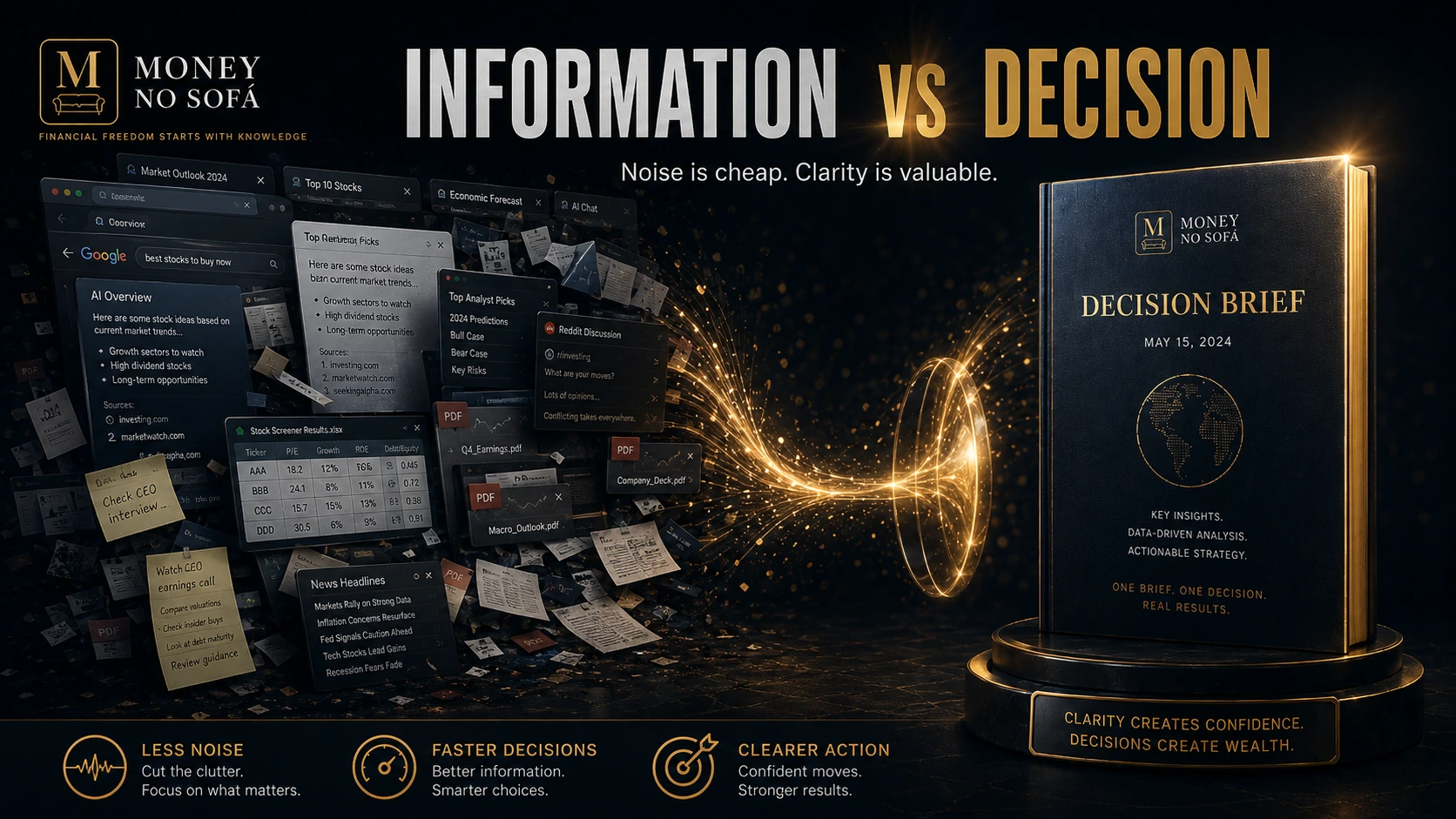
The real product is a decision, not a document
A beginner often describes a research service in terms of tasks: “I will search the web, collect links, and make a report.” That sounds like labor. A stronger offer describes the business decision the research supports: “I will compare the five most credible payroll platforms for a 20-person company, identify hidden fees, summarize integration limits, and recommend the two best fits.”
The second offer is easier to buy because the client can see the endpoint. It also gives you a way to price the work based on usefulness instead of the number of browser tabs you opened.
Think in terms of decision categories. A company may need to choose a vendor, enter a market, prioritize a customer segment, find prospects, respond to a competitor, understand complaints, validate a product idea, prepare for a sales meeting, or decide which content topics deserve investment. Each decision creates a different research product.
That is the first rule of research arbitrage: do not sell “research.” Sell a defined answer to a recurring business question.
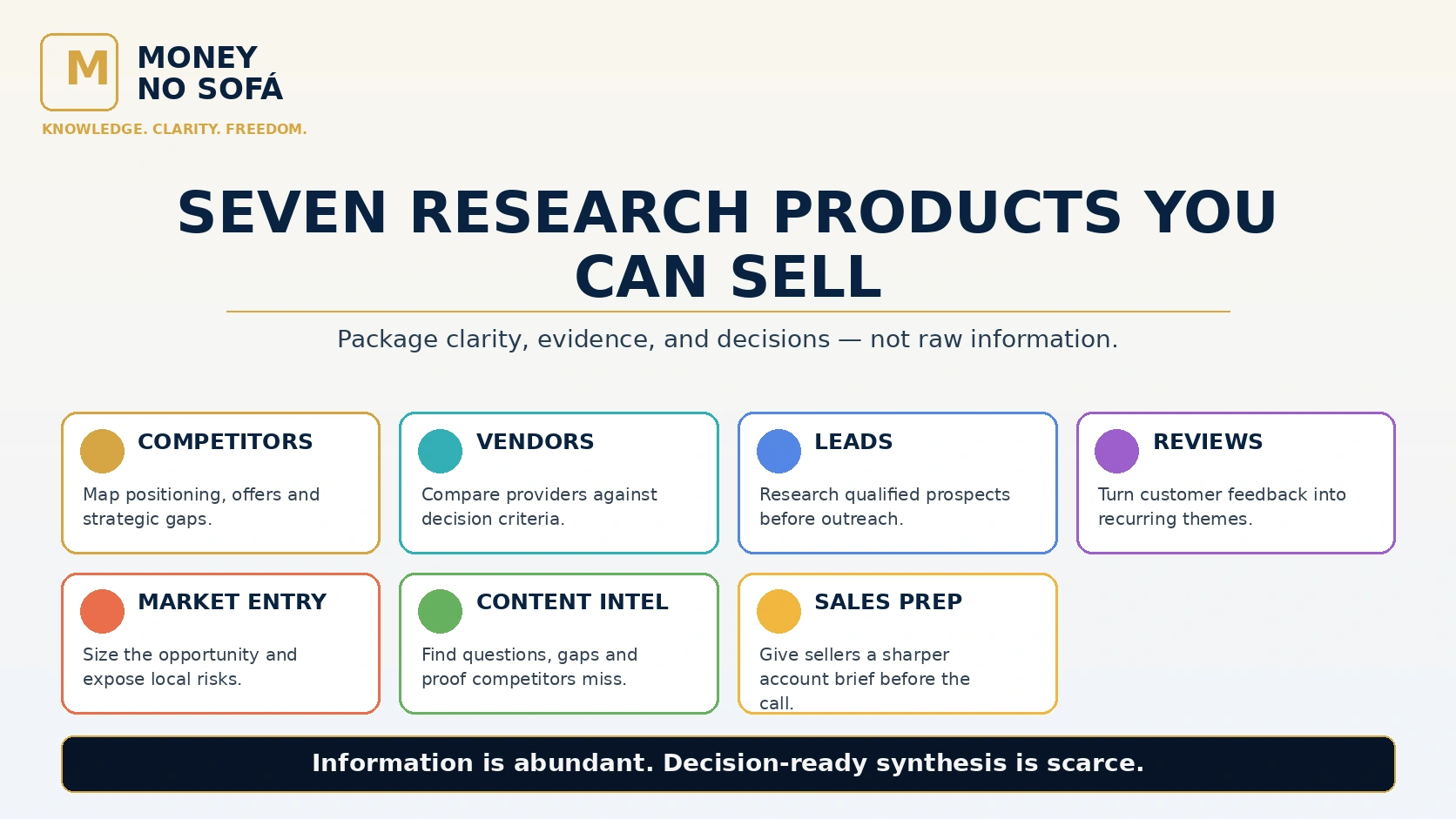
What research services can actually be sold?
The easiest services to sell have three characteristics: the question is recurring, the answer affects money or time, and the client would rather outsource the work than build the process internally.
Examples include:
- Competitor intelligence: pricing, positioning, product changes, messaging, reviews, offers, distribution channels and customer complaints.
- Vendor comparison: software, agencies, payment providers, logistics partners, tools, subscriptions or equipment.
- Lead research: qualified prospect lists enriched with relevant company facts, role information and buying signals.
- Customer-review synthesis: recurring themes extracted from reviews, support tickets, forums, interviews or surveys.
- Market-entry briefs: key competitors, demand signals, channel structure, pricing norms and obvious barriers in a new niche or geography.
- Content intelligence: search themes, competitor coverage, unanswered questions, source packs and evidence for high-authority articles.
- Sales preparation: short account briefs before high-value meetings, including company context, recent changes and likely priorities.
- Procurement support: structured comparisons that make a buyer’s shortlist faster and more defensible.
These services do not require pretending to be an investment banker or management consultancy. A solo operator can begin with narrow, practical assignments where the value comes from organization, verification and speed.
Choose a niche before you choose a tool
A common mistake is building a giant research stack before deciding whom to serve. The software does not create the business. Specificity does.
“Research for small businesses” is too broad. “Competitor and customer-review research for independent dental groups” is much easier to understand. So is “vendor comparison briefs for ecommerce operators,” “pre-meeting account research for B2B agencies,” or “market and content research for financial publishers.”
A niche gives you three advantages. First, you learn which sources matter. Second, you learn which questions repeat. Third, your examples become relevant enough that a buyer can imagine using the service immediately.
You do not need to commit forever. Choose a niche for the first ten assignments. The goal is to acquire pattern recognition. After ten projects you should know which questions are valuable, which data is difficult to obtain, how long the work actually takes, and which deliverables clients reuse.
Build a repeatable research protocol
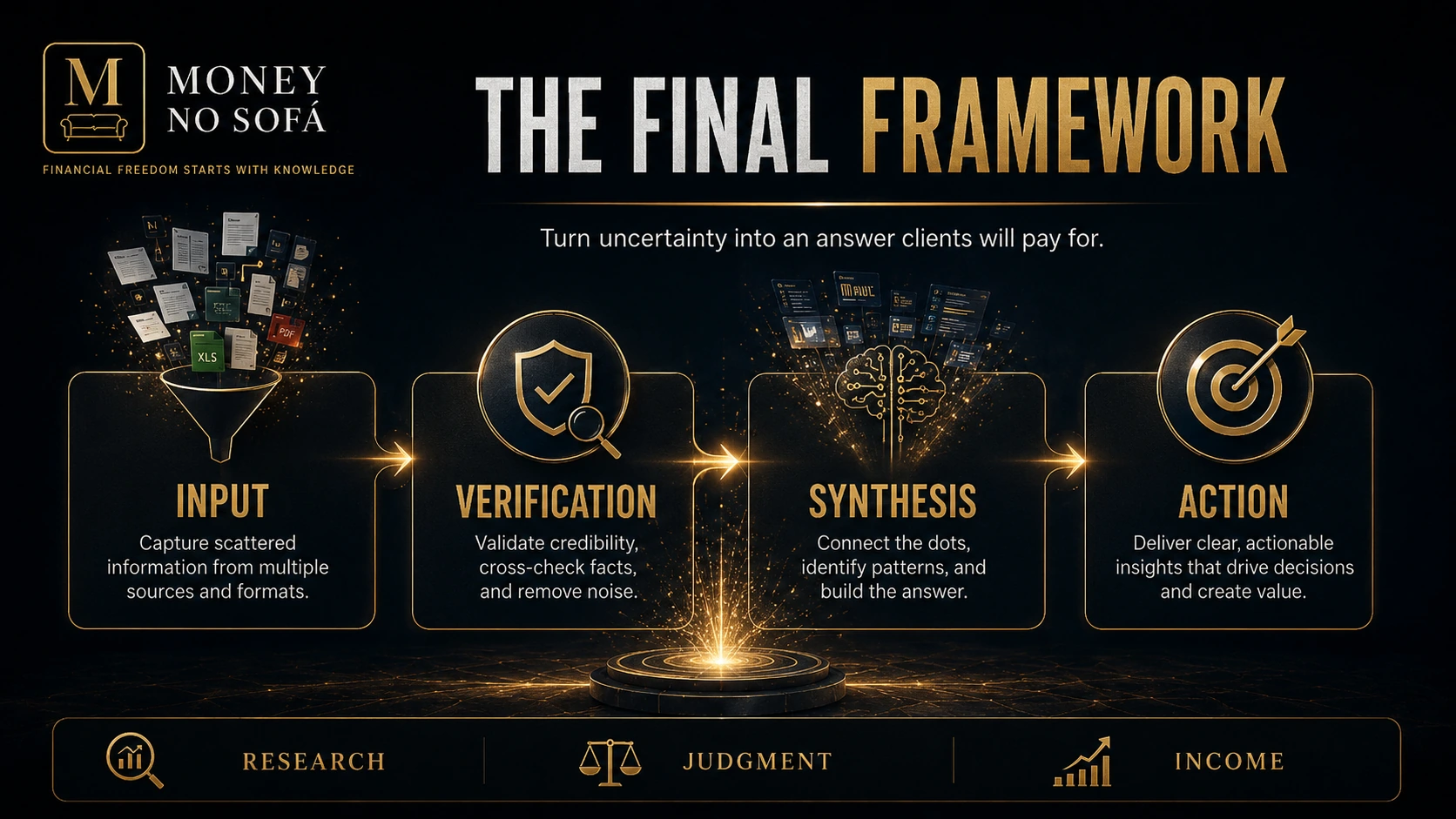
The fastest way to destroy trust is to produce a polished document built on weak evidence. AI makes this risk worse because it can generate confident language around incomplete or incorrect facts. A professional research service therefore needs a protocol.
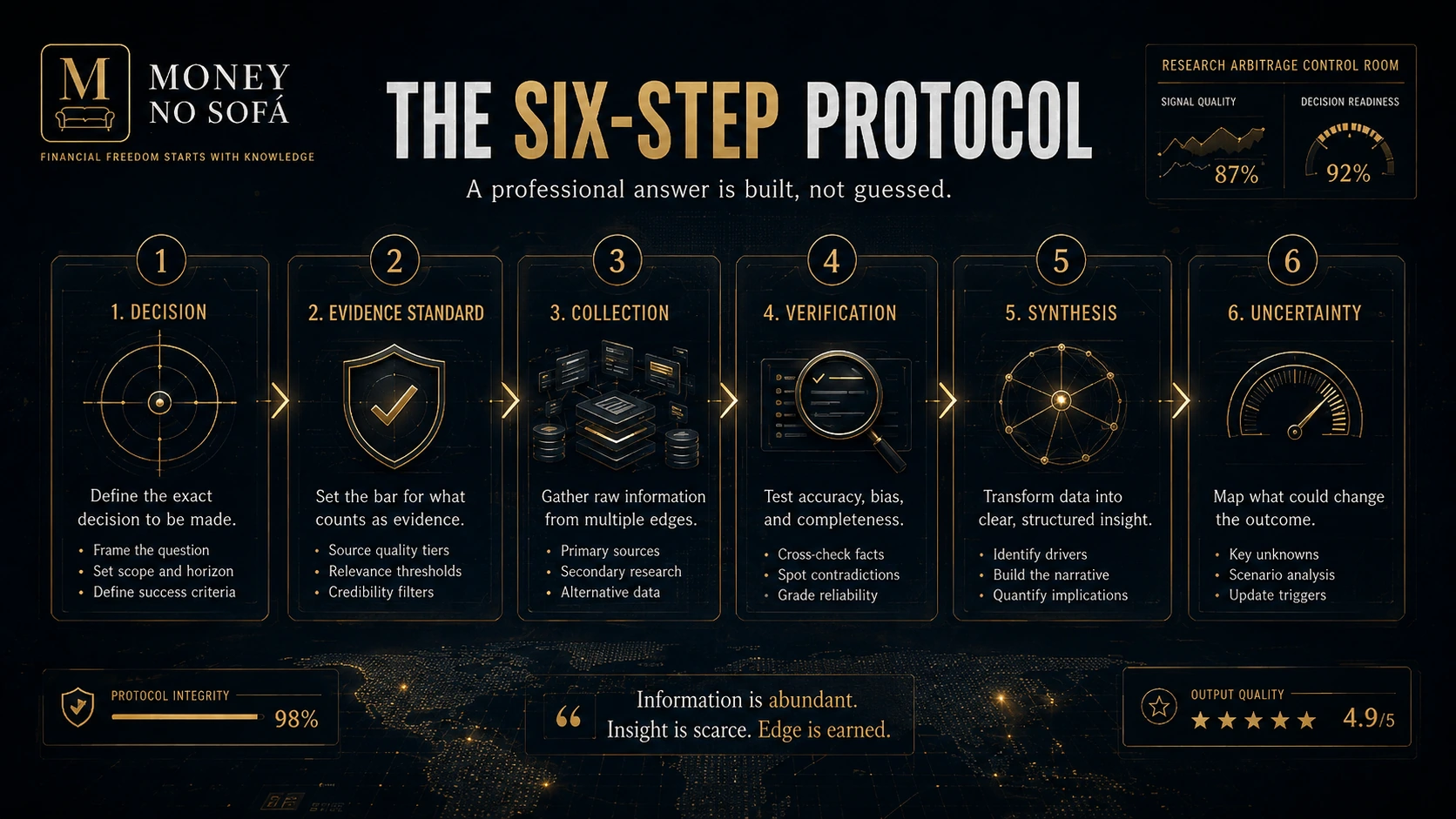
A simple protocol can have six steps:
- Define the decision. What will the client do differently after reading the brief?
- Define the evidence standard. Which claims require primary sources, official filings, direct product pages, customer reviews or independent reporting?
- Collect broadly. Gather enough information to see patterns before deciding what the answer is.
- Verify the important claims. Prices, dates, product limits, legal requirements and numerical claims should be checked against the strongest available source.
- Synthesize. Reduce the evidence into trade-offs, risks and a recommendation.
- Show uncertainty. Distinguish verified facts, interpretation and open questions.
This protocol turns research from “smart Googling” into a professional process. It also makes delegation easier later because another person can follow the same standard.
Use AI as a compressor, not as the source of truth
AI is extraordinarily useful in research when it is given the correct job. It can classify documents, generate comparison tables, extract recurring themes, suggest missing questions, summarize long material, clean messy notes, convert findings into multiple formats, and help draft a concise client brief.
It is much less reliable when asked to invent the factual foundation from memory. The stronger workflow is source-first: collect evidence, then use AI to organize and challenge it.
For example, imagine you are comparing five appointment-booking platforms for a clinic. You can collect the official pricing pages, integration documentation, security pages, customer reviews and support policies. Then AI can help normalize the features into one matrix, identify gaps, draft pros and cons, and flag questions that still need manual verification.
The final recommendation remains yours. This is important commercially. If a client is paying for your judgment, “the AI said so” is not a defensible methodology.
BCG’s 2025 research on generative AI in professional services found that specialized GenAI tools can produce meaningful time savings and quality improvements, but adoption remains constrained by issues such as privacy, confidentiality and the need for training. Those constraints are not obstacles to a research business; they are part of the service. A professional operator knows when information should not be uploaded to a third-party model and when a client’s data must stay inside approved systems.
The fastest offer to launch: the Decision Brief
If you want a simple first product, sell a short Decision Brief instead of a giant report. The client gives you one question. You return a focused answer.
A good brief can be five to ten pages and contain:
- the decision being evaluated;
- a one-paragraph executive answer;
- the criteria used;
- a comparison table;
- the strongest evidence;
- major risks or limitations;
- your recommended next step;
- a source appendix.
Shorter is often better because the client is buying clarity. A forty-page PDF that takes an hour to read can be less useful than a six-page brief that makes the decision obvious in five minutes.

How to price without becoming trapped by hourly work
Hourly pricing is useful while learning how long assignments take, but it can punish efficiency. If AI and a strong process let you complete a valuable comparison in three hours instead of eight, the client did not receive less value.
A better path is fixed pricing with a clearly defined scope. One practical ladder might look like this:
- Quick Scan — $149 to $250: one narrow question, limited source set, concise findings, no live call.
- Decision Brief — $400 to $750: structured comparison, verification, recommendation and one revision.
- Deep-Dive Research Sprint — $1,000 to $2,500: broader market, interviews or larger datasets, executive presentation and decision workshop.
- Monthly Intelligence Retainer — $750 to $3,000+: recurring competitor tracking, customer-signal monitoring, account research or content intelligence.
These are not universal market rates. They are examples of how to separate offers by scope and decision value. Your actual pricing should reflect niche, difficulty, source access, turnaround time and the economic importance of the question.
The best early signal is not whether a prospect says your price sounds fair. It is whether the client returns with another question. Repeat purchases tell you that the research has become part of a business process.
Your $500 service should solve a $5,000 uncertainty
One of the strongest pricing principles for small services is to attach the offer to a decision where the downside of being wrong is meaningfully larger than the fee.
A $500 vendor comparison is easier to justify if the buyer is about to commit $20,000 a year to software. A $500 customer-review analysis is easier to justify if it shapes a landing-page rewrite or product decision. A $500 account-research package is easier to justify when it supports a sales meeting worth tens of thousands of dollars.
This does not mean inventing exaggerated ROI claims. It means choosing problems where good information is naturally valuable.

How to get the first three clients
You do not need a large audience. You need evidence that you can produce the work.
Create one sample brief for a real niche using public information. Do not pretend a company hired you. Label it clearly as a sample. Make it specific enough that the quality is obvious.
Then build a list of 30 potential buyers. A strong prospect is someone whose role already involves the decision you research. For a competitor-intelligence service, that may be a founder, growth lead or marketing director. For vendor comparisons, it may be an operations manager. For account research, it may be a small B2B sales team.
Your outreach should not say, “I offer research services.” Lead with the pain:
I noticed your team sells into multi-location clinics. I built a short sample comparing the booking and messaging claims used by five competitors in that market. I can produce a monthly competitor brief that tracks pricing, positioning, new offers and recurring customer complaints. If useful, I can send the sample.
The sample does the selling. It reduces the buyer’s risk because they can judge your thinking before paying.
Where marketplaces fit
Freelance marketplaces can be useful training grounds because demand is visible. Upwork’s skills reports have repeatedly included general research services, market research, lead generation, business analysis and related specialties among high-demand categories. Its 2026 Future Workforce Index also reported a sharp increase in skilled knowledge workers freelancing, while arguing that AI is increasing the premium on judgment-driven work.
That does not mean you should build your entire business around a marketplace. Platform competition can pressure pricing and client ownership. Use marketplaces to learn what buyers request, earn proof, collect testimonials where allowed, and identify which assignments repeat. Then build your own acquisition channels around the highest-value pattern.
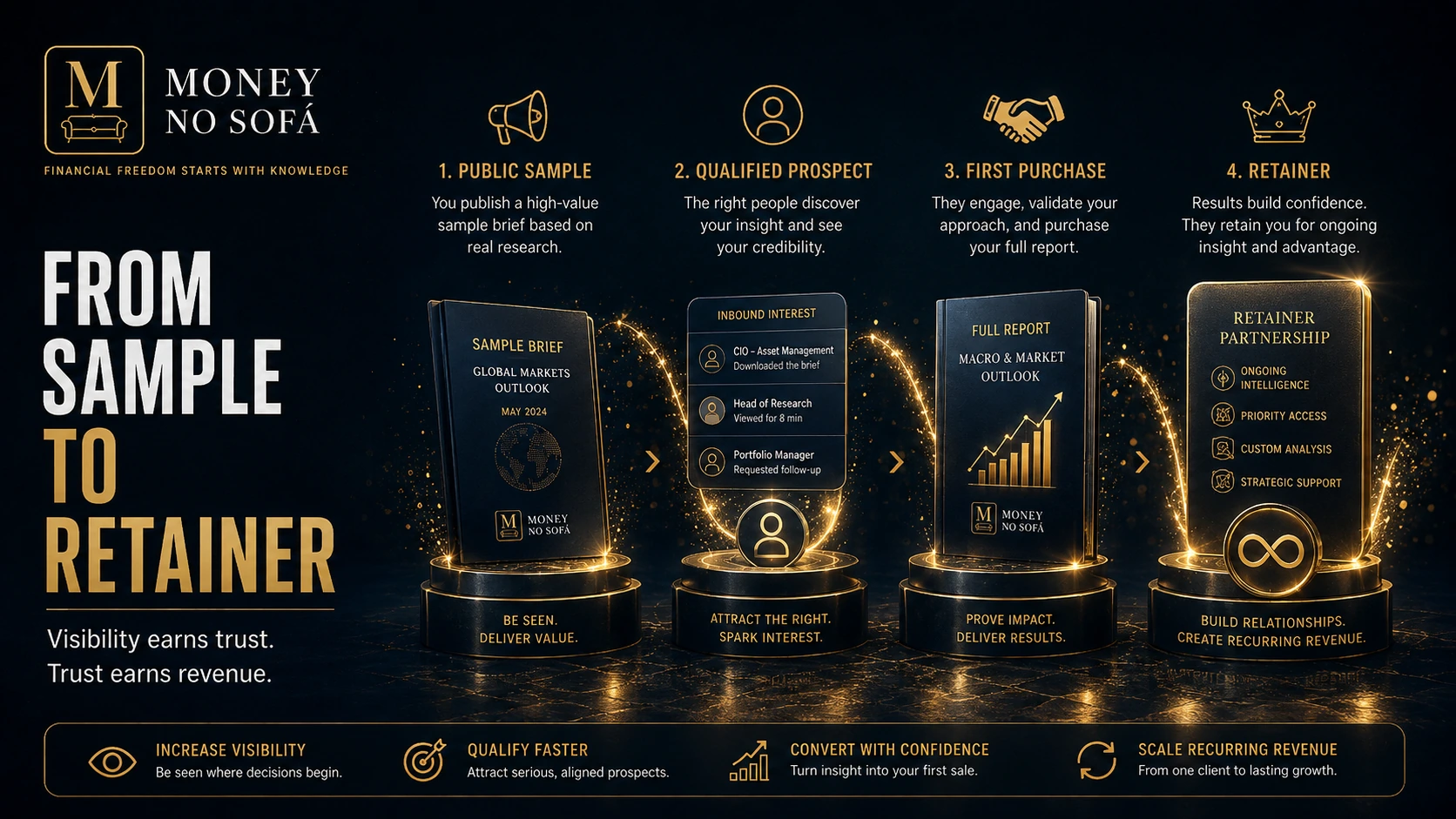
Turn one-off research into recurring revenue
One-off projects become a business when the question repeats. After delivering a project, ask what changes next month.
A competitor report can become a monthly monitoring service. A vendor comparison can become contract-renewal monitoring. A customer-review project can become a quarterly voice-of-customer report. A lead list can become a weekly prospecting feed. A content research assignment can become a monthly editorial intelligence package.
The retainer should not be “pay me every month to be available.” It should promise a recurring output with a clear cadence. For example: “Every Monday, receive 25 qualified accounts with buying signals and source links,” or “On the first business day of each month, receive a competitor change brief covering pricing, offers, messaging and customer complaints.”
Specific recurring deliverables are easier to retain because clients know what they are paying for.
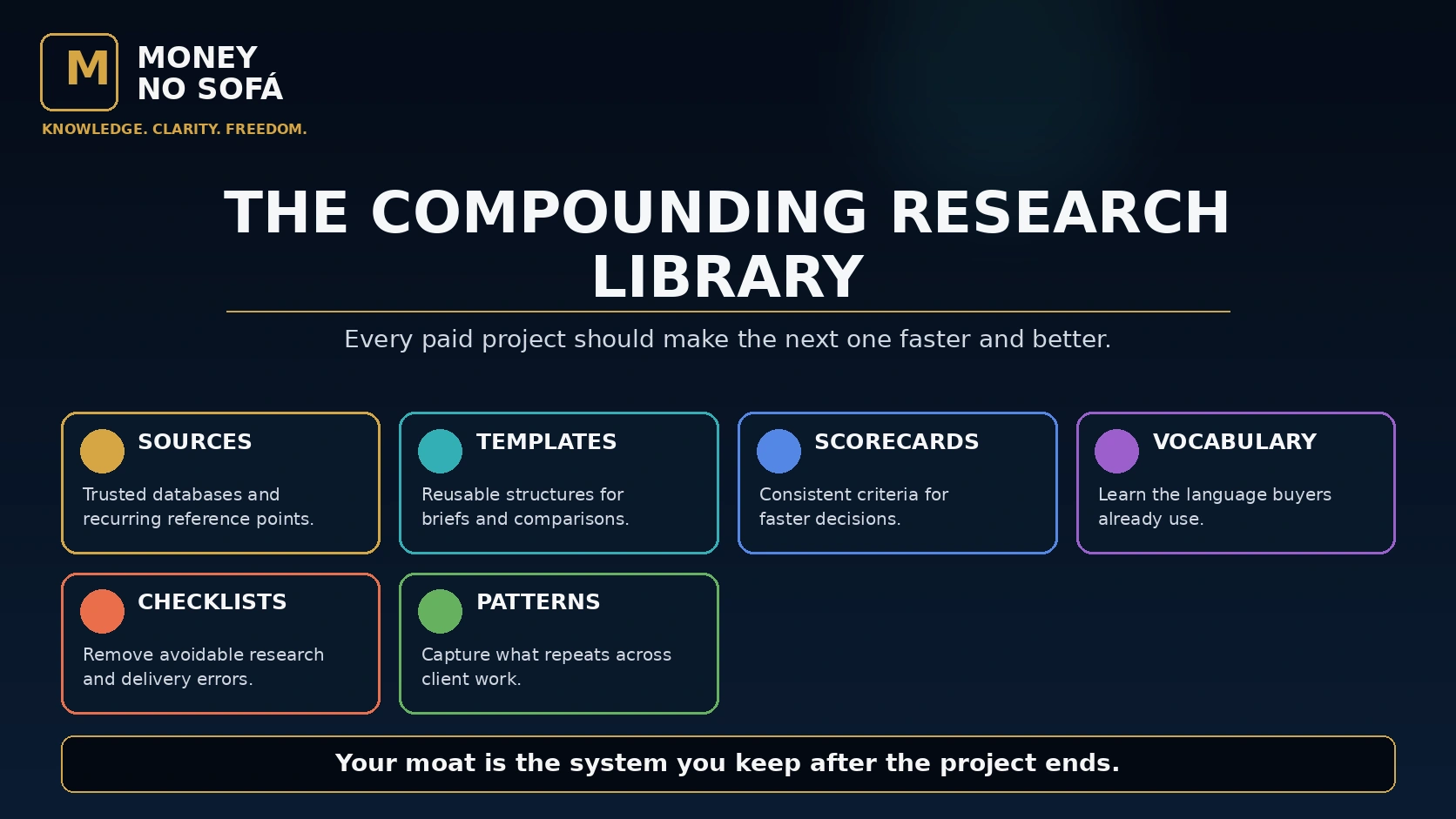
Build a research asset library
Every project should make the next project faster. Save source lists, search patterns, verification checklists, output templates, scoring criteria and industry vocabulary. Over time, the business develops proprietary process knowledge even when the underlying public information is available to everyone.
This is a form of compound advantage. On your first project in a niche, finding the right sources may take hours. By your tenth project, you know exactly where to look and what usually changes. You become faster without becoming superficial.
Do not build databases from information you are not permitted to store or resell. Respect website terms, privacy rules, intellectual property and client confidentiality. The business should get smarter through process, not through questionable data collection.
The credibility system
A premium research service needs visible trust signals. The strongest are simple:
- Source discipline: every important factual claim can be traced.
- Date discipline: time-sensitive information shows when it was checked.
- Confidence labels: verified fact, informed interpretation and open question are not mixed together.
- Conflict disclosure: affiliate relationships or commercial interests are disclosed.
- Data boundaries: client information is handled according to agreed privacy rules.
- No fake certainty: the brief explains what the evidence cannot establish.
This sounds slower than simply generating a report with AI. In practice it becomes a sales advantage. As low-quality synthetic content expands, buyers who care about decisions will pay for evidence they can audit.
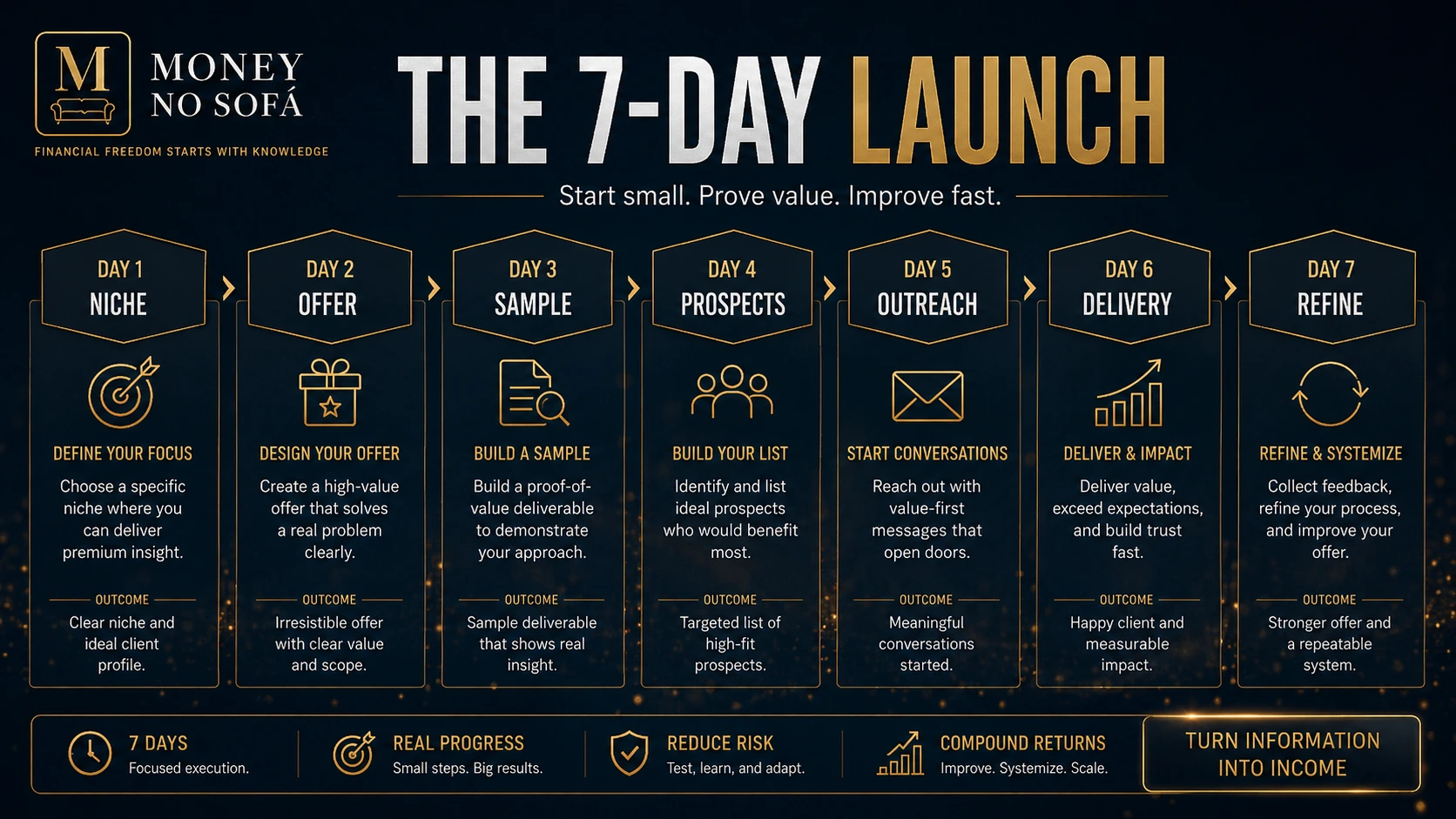
A seven-day launch plan
Day 1: choose one niche and one recurring question.
Day 2: define the five to eight criteria your brief will evaluate.
Day 3: create a sample using public sources.
Day 4: compress the sample into a clean five-to-ten-page decision format.
Day 5: identify 30 buyers whose roles match the problem.
Day 6: send ten highly relevant outreach messages offering the sample.
Day 7: send another ten, review responses, and refine the offer language around the questions prospects actually ask.
What to avoid
Do not sell copied reports. Do not scrape restricted data and pretend it is proprietary intelligence. Do not promise legal, medical, investment or compliance conclusions unless you are appropriately qualified. Do not hide uncertainty to make the deliverable look more impressive. Do not upload confidential client data into tools without permission. Do not fabricate citations.
And do not compete on volume. “I will give you 500 pages of research” is usually a weaker offer than “I will tell you which two choices deserve another meeting and why.”
The bigger opportunity
AI reduces the cost of processing information. That should make a skilled research operator more productive, not obsolete. The scarce layer moves upward: from finding facts to defining questions, from summarizing text to evaluating evidence, from generating possibilities to deciding what matters.
The strongest research businesses will not look like human search engines. They will look like compact decision systems. A client hands over uncertainty; the service returns structure.
That is the arbitrage. The raw ingredients are abundant. The value comes from turning them into a conclusion someone trusts enough to act on.
Research ethics is part of the product
A research service can become commercially dangerous when speed is rewarded more than legitimacy. Publicly accessible information is not automatically appropriate to collect, combine, store or resell. Websites may restrict automated access, personal data may be protected by law, and a client may not have the right to share confidential material with outside tools.
Build a red-flag checklist. Stop and clarify when a project asks for private personal information, deceptive access, impersonation, confidential competitor documents, medical or financial records, nonpublic securities information, or scraping that violates clear platform restrictions. A useful research business should reduce risk for the client, not quietly create a new one.
Also separate research from professional advice. A researcher can organize public regulations, compare official requirements and identify questions for counsel. That is different from giving legal advice. The same boundary applies to tax, medicine, investing and other regulated domains.
Professional boundaries may feel like friction when you are trying to win work. In practice they improve positioning. Serious clients want a provider who can say, “This part is within scope; this part requires a qualified specialist.” Trust is easier to monetize than recklessness.
Your first move
Pick one business decision you already understand well. Build one sample Decision Brief from public information. Then show it to ten people who routinely face that decision. Do not ask whether they “like the idea.” Ask whether they would pay to avoid doing the research themselves.
Frequently asked questions
Do I need formal research training?
Not for every type of commercial research. You do need a disciplined process, strong sourcing, clear writing and enough domain knowledge to recognize weak evidence. Regulated or highly technical decisions may require qualified specialists.
Can AI do most of the work?
AI can accelerate collection, classification, summarization and drafting. It should not replace verification, source selection, judgment or accountability.
What is the easiest research offer to start?
A narrow vendor comparison, competitor snapshot or customer-review synthesis is usually easier than a broad “market study” because the scope and output are clear.
How much should I charge?
Start with fixed-price scopes that you can deliver reliably. Increase pricing as the decision becomes more valuable, the research becomes more difficult, and your proof improves.
Can this become recurring income?
Yes, when the underlying question changes regularly. Competitors, prospect lists, customer feedback, content opportunities and account intelligence are natural recurring categories.
Selected sources
- U.S. Bureau of Labor Statistics — Occupational Outlook Handbook: Market Research Analysts, updated August 2025.
- Upwork — In-Demand Skills 2025, including General Research Services and Market Research among high-demand categories.
- Upwork — In-Demand Skills 2026, reporting continued demand for specialist human expertise as AI becomes embedded in everyday work.
- Upwork — Future Workforce Index 2026, on the growing share of skilled knowledge workers freelancing and the premium on judgment-driven work.
- Boston Consulting Group — GenAI Tools in Professional Services, April 2025.
Editorial note: Examples and price ranges in this article are illustrative, not guaranteed income claims. Results depend on skill, market, positioning, geography and execution.
The headline is only the start.
Ask Nova what this story could change in your budget, savings, debt, investments or next purchase.