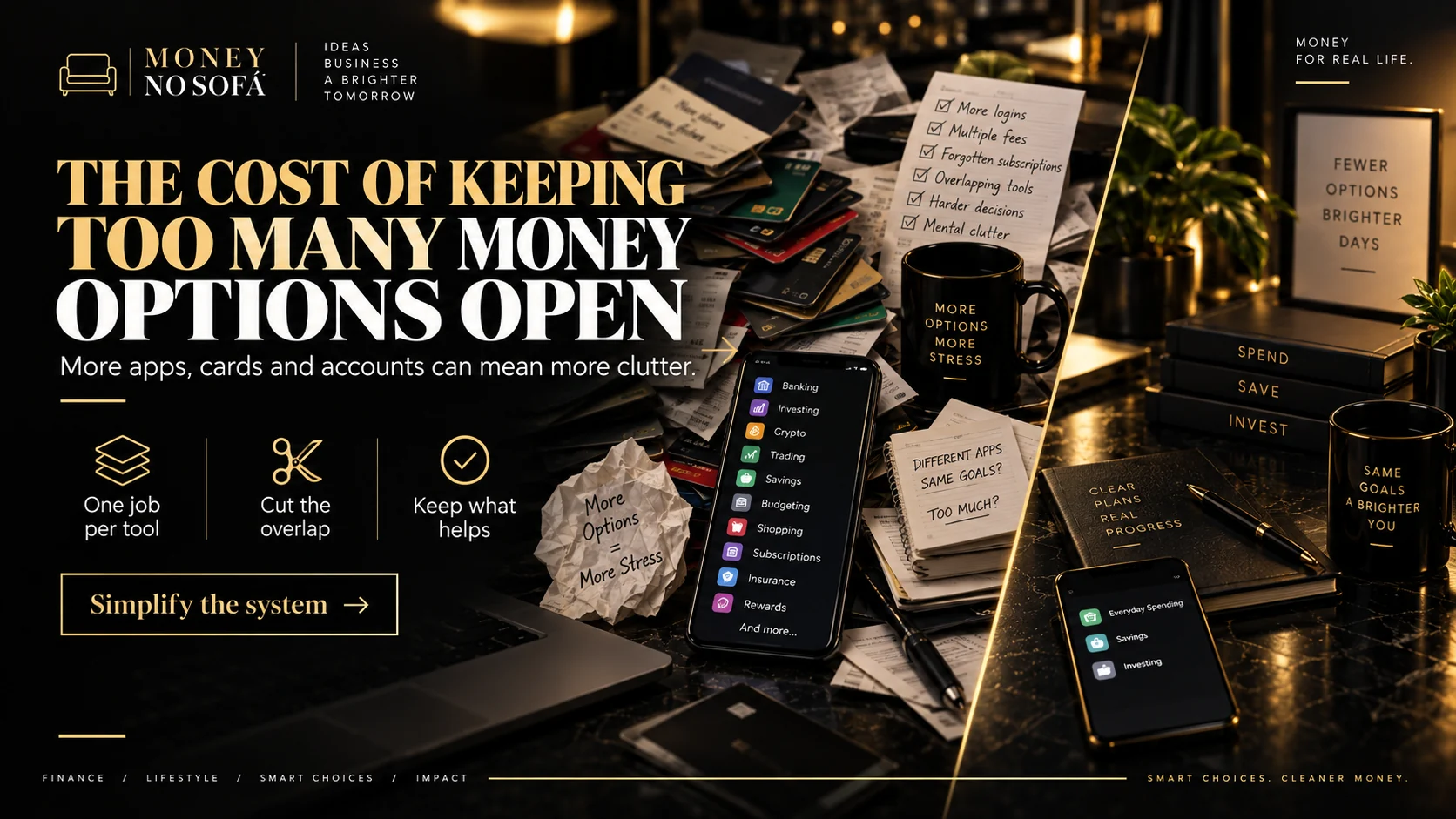
The Cost of Keeping Too Many Money Options Open More options can feel like more control. In money, too many accounts, cards, apps and payment methods often create the opposite: clutter, missed decisions and attention spread too thin. Choice has a maintenance cost Every extra account needs monitoring. Every card has a statement, due date […]
The Cost of Keeping Too Many Money Options Open
More options can feel like more control. In money, too many accounts, cards, apps and payment methods often create the opposite: clutter, missed decisions and attention spread too thin.
Choice has a maintenance cost
Every extra account needs monitoring. Every card has a statement, due date and possible fee. Every finance app asks for attention. Every subscription creates another renewal decision.
The individual cost may look small. The combined cost is mental load.
Use the MNS One Job per Tool rule
Give each financial tool a clear purpose. One account for bills. One place for emergency savings. One main card if that works for you. One system for tracking. If two tools do the same job, ask which one deserves to stay.
A consolidation checklist
- List every bank account you actively maintain.
- List every credit card and what purpose it serves.
- List payment apps and wallets you actually use.
- List subscriptions and automatic renewals.
- List investment platforms and recurring transfers.
- Mark duplicate tools that do the same job.
Do not simplify blindly
Redundancy can be useful. A backup payment method, separate business account or specialized savings account may have a clear purpose. Simplification is not about having the fewest tools. It is about removing tools without a job.
The decision rule
For every account, card or app, finish this sentence: “I keep this because it does ______ better than my alternatives.” If you cannot answer clearly, it belongs on the review list.
Pair this cleanup with the 10-Minute Money Review so the smaller system stays visible.
Money for real life.
The headline is only the start.
Ask Nova what this story could change in your budget, savings, debt, investments or next purchase.
