Stop chasing millions of views. Learn how to build a $500 offer, find the right buyer, create proof, do focused outreach and turn a few clients into real income.
MONEY NO SOFÁ — MAKE MONEY
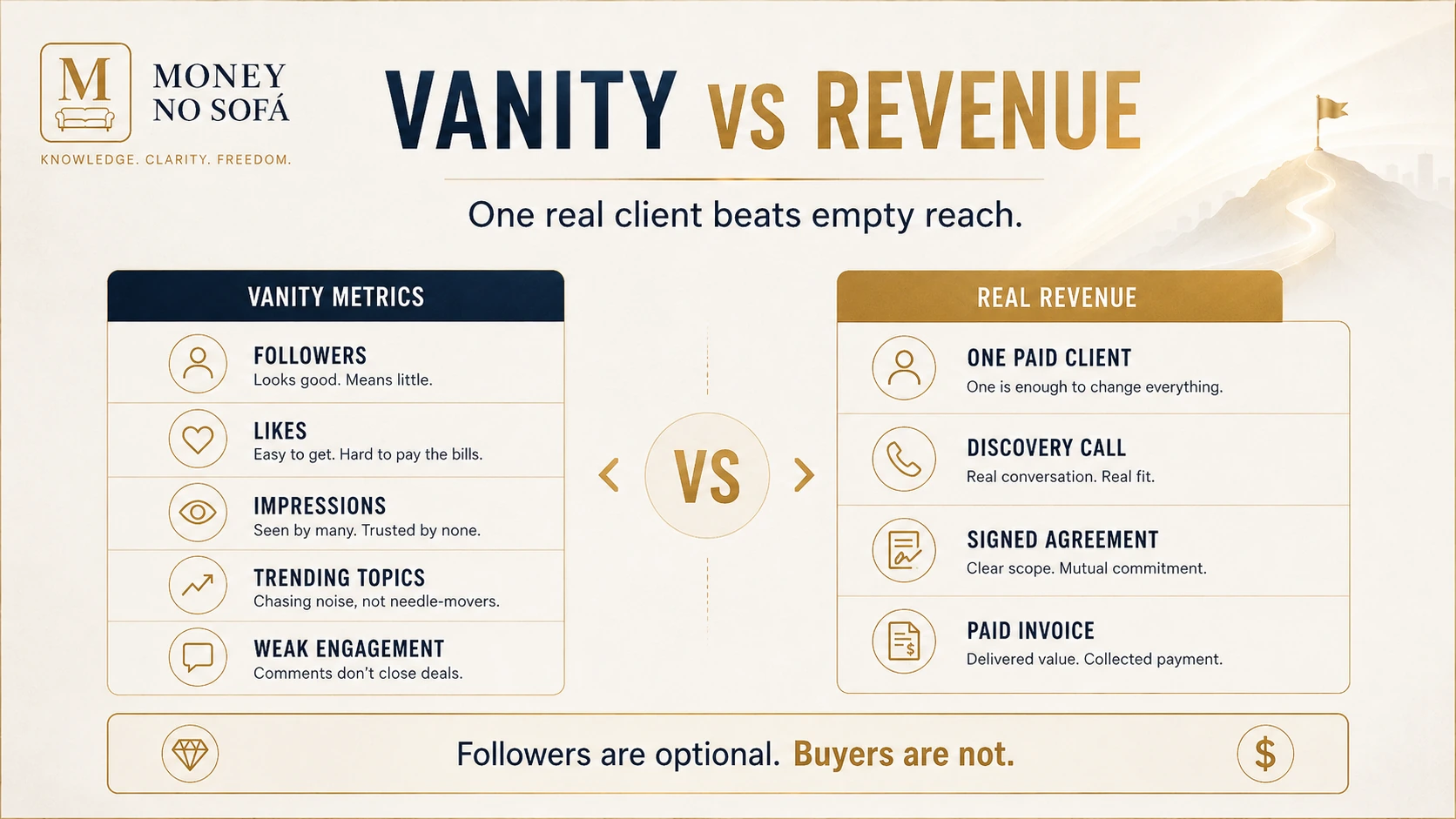
Going viral feels like leverage. For most beginners, it is actually a lottery. A small, specific offer sold to one real buyer teaches more about business than a thousand anonymous likes.
Approx. 17–19-minute read
The internet has created a distorted picture of how money is made. We see creators posting revenue screenshots, products launched to giant audiences, newsletters exploding in subscribers, and videos collecting millions of views. The visible event is scale. The invisible work that came before it—learning what people buy, earning trust, improving an offer, finding distribution and retaining customers—rarely looks interesting enough to become content.
That creates a dangerous starting goal: “I need an audience.”
You may not. You may need one person with a painful problem, $500 of budget and enough confidence in you to say yes.
The number is not magical. The point is the scale. A $500 client forces you to learn the essential mechanics of business without requiring celebrity, venture capital, a sophisticated product or a giant social following. You must identify a buyer, define a problem, make an offer, communicate value, reduce risk, deliver, collect payment and earn the right to ask for another project.
Those are the muscles that eventually support scale.
The math is small on purpose
Four $500 clients create $2,000 in revenue. Ten create $5,000. A creator trying to earn the same amount from low-value advertising, weak affiliate conversion or a cheap digital product may need far more traffic.
That does not mean services are always superior. It means direct client revenue has a powerful advantage at the beginning: the buyer is identifiable. You can speak to the person who paid, ask why they bought, understand what almost stopped them, see which part of the delivery mattered, and learn what they would buy next.
Virality often hides those answers. A post can perform brilliantly and attract people who will never pay for anything. A smaller audience of relevant buyers can be commercially stronger than a huge audience built around entertainment, outrage or curiosity.
So the beginner’s question should not be, “How do I reach everyone?” It should be, “What can I sell to four people this month that solves a real problem well enough to be worth $500?”
Why $500 is a useful training price
At $20, almost any offer can get a casual buyer. At $50, people may still purchase out of curiosity. Around $500, many buyers start asking serious questions: What exactly do I get? Why should I trust you? What happens if the project goes badly? How quickly will this help? What will I need to provide?
Those questions force you to become specific.
The price is also high enough that you cannot hide behind vague effort. “I will work hard on your marketing” is not a $500 offer. “I will audit your last 90 days of paid-search traffic, identify wasted-spend patterns, rebuild the negative-keyword list and deliver a prioritized action plan” is closer to something a buyer can evaluate.
The goal is not to charge $500 forever. The goal is to reach a price where clarity and trust matter.

Build the offer backward from a painful result
A strong small offer has a narrow before-and-after state.
Before: the client has a messy CRM. After: duplicate records are identified, key fields are standardized and a maintenance rulebook exists.
Before: the client has a weak landing page. After: the page has a rewritten value proposition, improved offer structure, proof placement and a prioritized testing plan.
Before: the founder does not know which competitors matter. After: there is a decision brief comparing the five most relevant competitors across pricing, positioning, offers and customer complaints.
Before: a local business has inconsistent profiles across the web. After: every major location profile has verified hours, contact data and service descriptions.
The narrower the transformation, the easier the first sale. Beginners often think a bigger service sounds more valuable. In reality, “I handle all your marketing” sounds risky from an unknown provider. A focused sprint sounds testable.
Choose a problem close to money
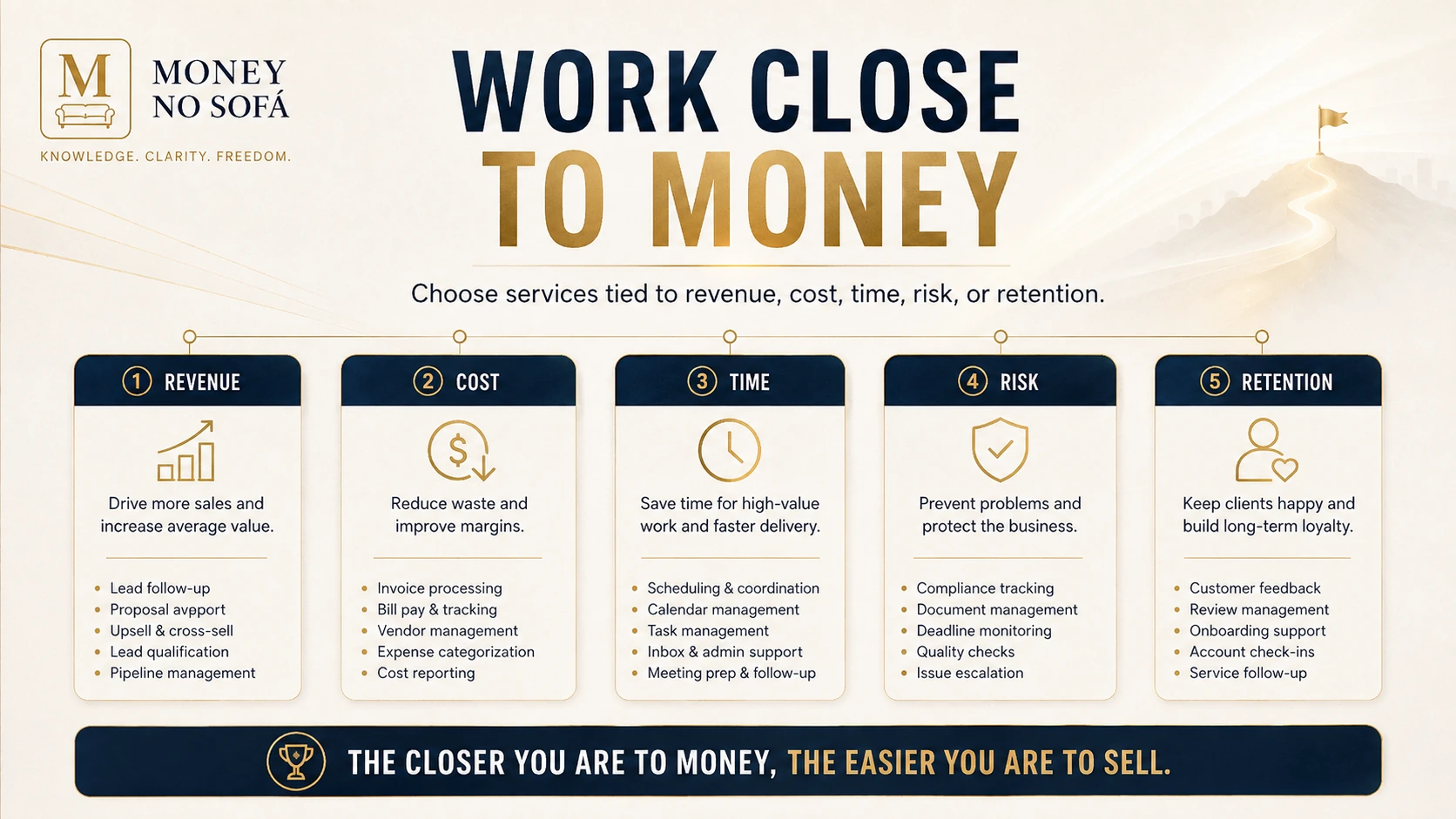
Your first offer becomes easier to price when it sits near revenue, cost, time or risk.
Examples include lead response, sales research, conversion improvements, retention workflows, payment follow-up, software cost reduction, reporting, operational cleanup and content that supports high-intent demand.
This does not mean promising revenue you cannot control. A landing-page audit cannot guarantee more sales. A lead-list service cannot guarantee closed deals. But the relationship between the work and the business objective should be obvious.
Upwork’s 2026 In-Demand Skills report continues to show strong demand across sales and marketing categories including social media marketing, SEO, sales and business development, lead generation, marketing strategy, email marketing and marketing automation. The deeper lesson is not which platform skill is ranked where. It is that businesses continue to buy specialist execution tied to commercial outcomes.
Use the $500 Offer Formula
A practical formula is:
One Buyer + One Pain + One Deliverable + One Deadline + One Boundary
For example:
For independent ecommerce brands spending at least $5,000 per month on paid media, I will review one advertising account, identify the ten highest-priority efficiency problems, and deliver a 60-minute action plan within five business days. The project covers audit and recommendations, not campaign management.
That is dramatically stronger than “I do performance marketing consulting.”
The boundary is important. A fixed-price offer becomes unprofitable when the client assumes it includes unlimited revisions, implementation, meetings and adjacent problems. State what the project does not include.
Do not wait for permission to create proof
The hardest part of selling the first client is the absence of case studies. You can reduce that problem without fabricating experience.
Create sample work using public information. Audit a public website. Build a mock competitor brief. Rewrite a public landing page. Analyze the onboarding of a product you use. Create a sample dashboard using synthetic data. Record a short teardown of a publicly visible funnel.
Label it honestly: “Sample analysis,” “public-data teardown,” or “demonstration project.”
Proof does not have to be a testimonial. It can be evidence of how you think.

Build a list of 50 buyers, not 50,000 followers
If the offer is narrow, prospecting becomes a research task.
Create a list of 50 businesses that clearly fit your criteria. Do not buy a random database and blast everyone. Look for signs that the problem exists.
If you sell review-management systems, look for businesses with active review volume and inconsistent responses. If you sell landing-page audits, look for companies running visible ads to weak pages. If you sell lead-response workflows, look for businesses investing in high-value lead generation. If you sell sales research, target teams whose representatives sell into complex accounts.
Each visible signal gives you a reason to contact the buyer.
Focused prospecting is slower than mass outreach, but it teaches positioning. If you contact 50 qualified buyers and none care, the lesson is useful. If you publish 50 social posts and none lead to sales, it is harder to know whether the problem is the audience, algorithm, content, offer or trust.
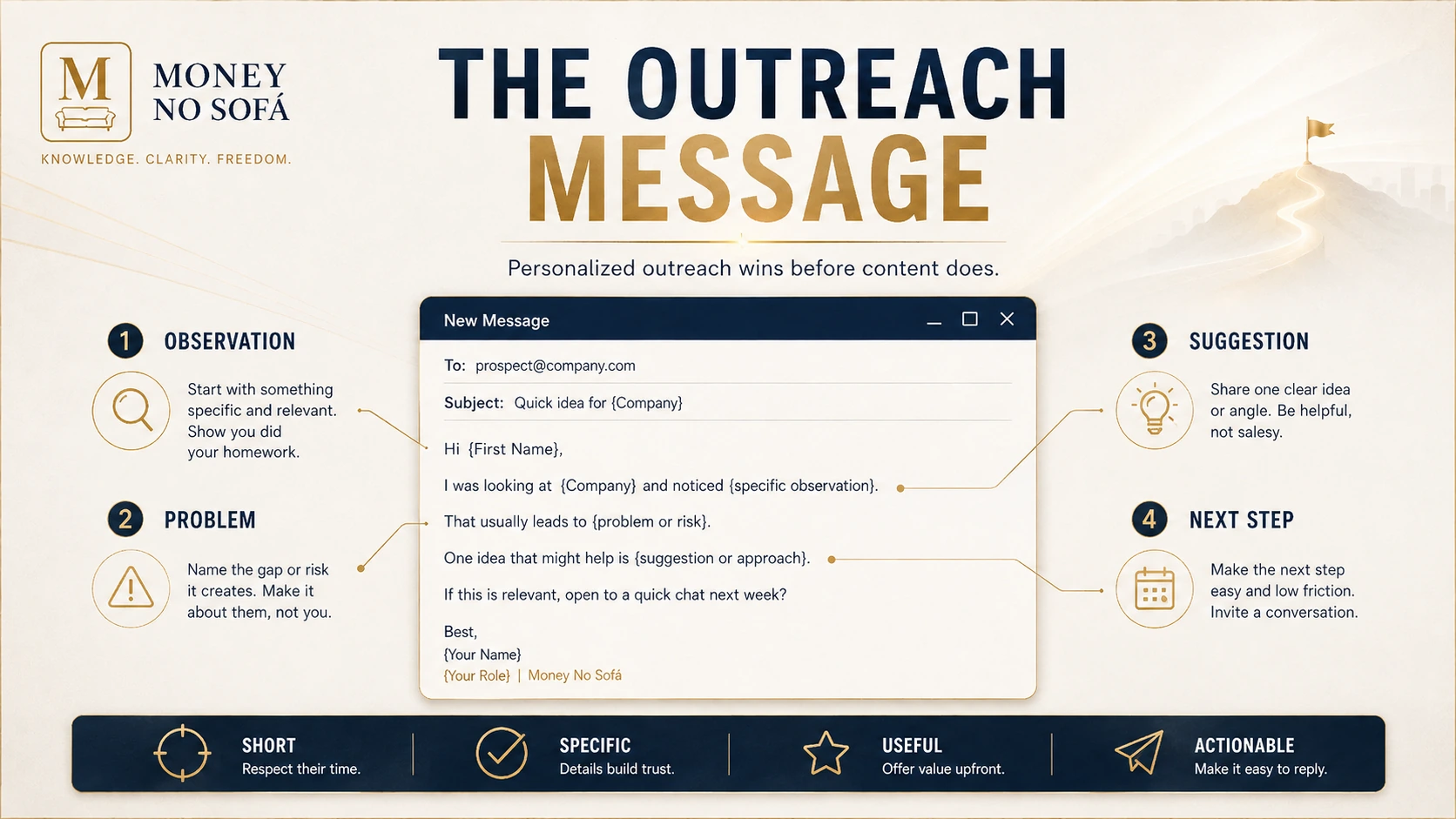
The outreach message should earn the next step
Cold outreach fails when it asks for too much attention. Do not send your life story. Do not demand a 45-minute call before explaining the problem.
A simple structure is:
- what you noticed;
- why it may matter;
- what you can do;
- a low-friction next step.
I noticed your paid search is sending traffic to three service pages with different calls to action and no clear proof above the fold. I run a fixed-scope conversion audit for service businesses. I can send you a two-minute sample showing the first three issues I would review. If it is useful, the full audit is $500 and takes five business days.
The message is not trying to close the entire deal. It is trying to earn enough curiosity for the prospect to see the sample.
Sales calls should diagnose fit, not perform theater
If a prospect wants a call, use it to determine whether your offer fits. Ask what they are trying to change, what they already tried, what the problem costs them, who must approve the work, what access is required and what a useful result would look like.
Do not turn the call into a free consulting marathon. The goal is enough diagnosis to confirm scope and reduce risk.
A strong close can be simple: “Based on what you described, the fixed audit fits. I will review X, Y and Z, deliver the report by Friday, and include one 45-minute walkthrough. It is $500. Implementation would be separate. If that works, I will send the scope and payment link today.”
Clarity is more persuasive than pressure.
Collect payment like a business
For a small fixed-scope project, many operators use full payment upfront or a meaningful deposit before work starts. The appropriate structure depends on the market, client type and local law.
Use written scope, payment terms, delivery date, revision limits, confidentiality expectations and cancellation rules. A simple agreement protects both sides by preventing memory from becoming the contract.
Do not build a $500 service around a checkout process that takes a week. Stripe’s 2025 Atlas review found that 20% of companies incorporated through Atlas landed their first paying customer within 30 days, more than double the 2020 rate. Modern payment and software infrastructure makes it possible to move from offer to revenue quickly. Your operating process should not reintroduce unnecessary friction.
Practical payment options for your first client
If you work with international clients, Wise can be worth comparing for receiving and moving money across currencies. Compare current fees, settlement terms, eligibility and availability before choosing a provider.
Partner terms and availability can change. Money no Sofá may receive compensation from eligible referrals, at no additional editorial influence on this article.
Overdeliver on certainty, not on free labor
Beginners often “overdeliver” by doing twice the work. That creates bad economics and teaches the client to expect scope expansion.
A better form of overdelivery is certainty:
- clear kickoff instructions;
- status updates before the client asks;
- organized files;
- evidence behind recommendations;
- delivery on or before the deadline;
- a clear explanation of what should happen next.
The client should feel that the project was under control.

Turn the first project into the second sale
The easiest next sale often appears inside the delivery.
A landing-page audit reveals that implementation is needed. A CRM cleanup reveals that monthly hygiene is needed. A competitor brief reveals that the market should be monitored monthly. A lead-response audit reveals that automation and reporting need to be built.
Do not manufacture additional problems. Document what the first project uncovered and separate immediate fixes from ongoing needs.
At the end, ask three questions:
- Which part of this was most useful?
- What still feels unresolved?
- Would it be useful if I owned the next step?
The answers can reshape your business faster than another month of content creation.
From $500 project to productized service
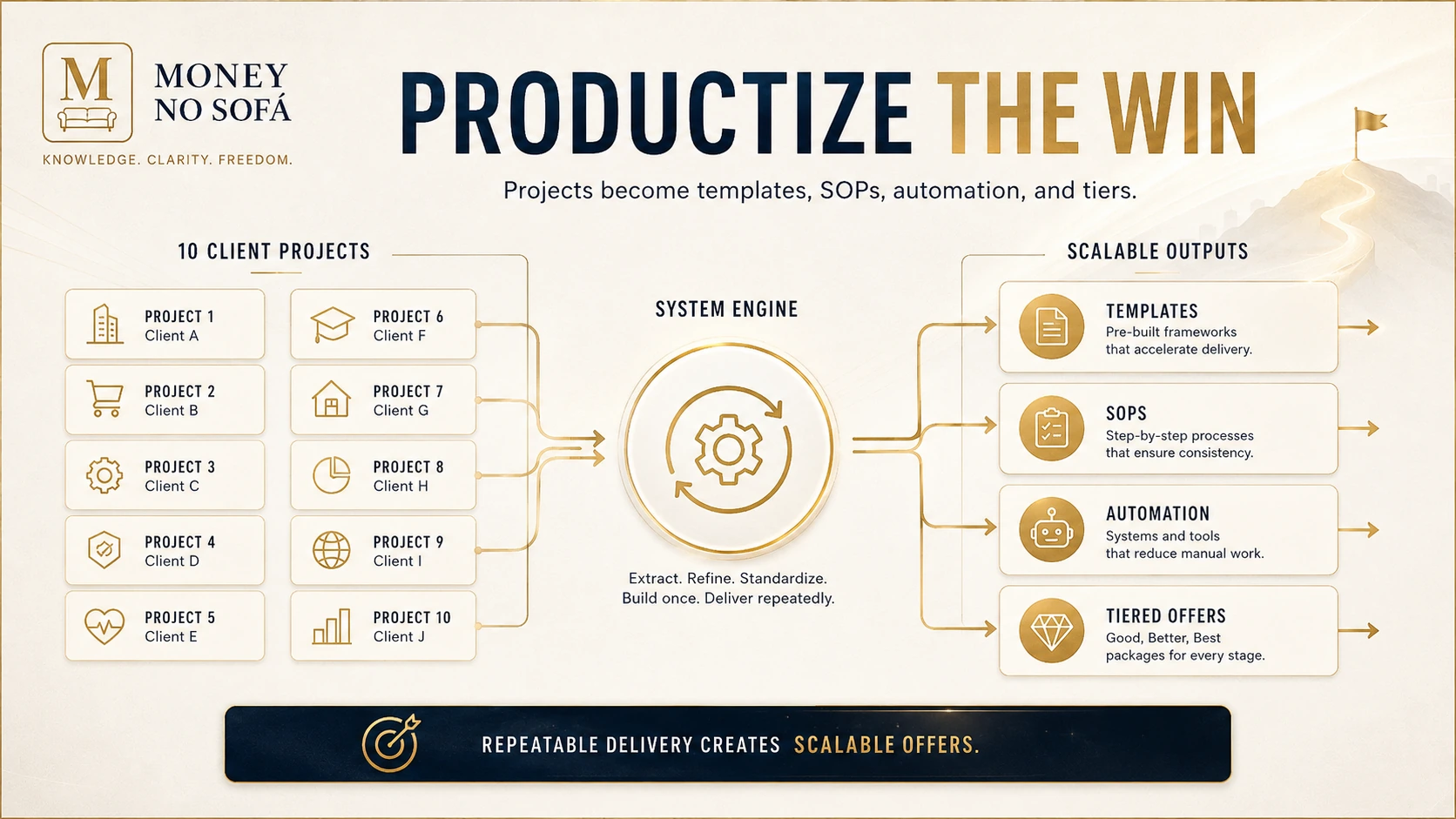
After five to ten clients, patterns emerge. The same questions repeat. The same steps take too long. The same deliverables get praised. The same extra requests appear.
Now you can productize.
Create templates, checklists, automated intake, standard reporting, fixed turnaround times and tiered scope. The offer becomes easier to sell because the buyer sees a proven process. Delivery becomes easier to delegate because the work is documented.
That is how a freelance project can become a small operating system.
When to raise the price
Do not raise prices because a social media post told you to “know your worth.” Raise them when the evidence changes.
Useful signals include:
- you are closing too many qualified prospects with little resistance;
- projects consistently produce valuable follow-on work;
- you have strong proof and references;
- your niche expertise makes delivery faster and recommendations better;
- demand exceeds your available capacity;
- the business problem is more valuable than you originally understood.
Then move from $500 to $750 or $1,000 with a better-defined package. Price increases should be attached to clearer value, not vague confidence.
Why virality can wait
Once you understand what buyers pay for, content becomes more useful. Instead of posting generic advice, you can publish the patterns you see repeatedly: the five CRM mistakes that create stale pipelines, the three landing-page problems that appear in every audit, the seven signals that a vendor comparison is overdue.
Now content has a commercial spine. It attracts people who recognize the same problem.
If a post goes viral, great. But it is amplification of a business you understand rather than a substitute for one.
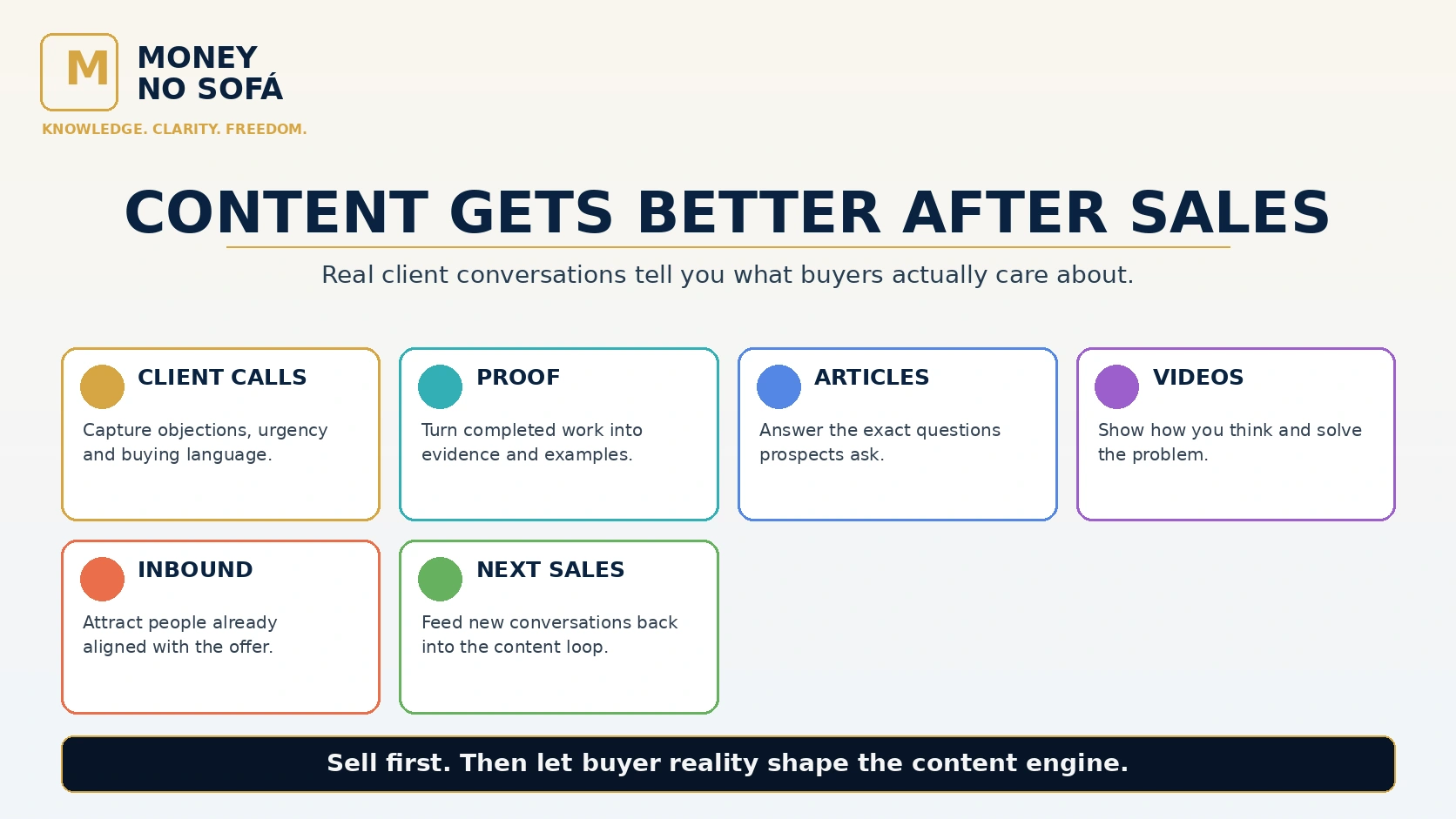
A 14-day first-client sprint
Days 1–2: choose one buyer and one painful problem.
Day 3: define the deliverable, deadline, boundary and $500 test price.
Days 4–5: create a sample using public or synthetic information.
Days 6–7: build a list of 50 qualified prospects.
Days 8–12: send ten personalized messages per day.
Days 13–14: follow up, run calls, tighten objections and close one project.
If nobody buys, do not conclude that entrepreneurship is impossible. Diagnose the failure. Was the buyer wrong? Was the pain weak? Was the proof unconvincing? Was the price disconnected from the outcome? Was your outreach too generic?
Each answer creates a better second attempt.
The scoreboard that matters
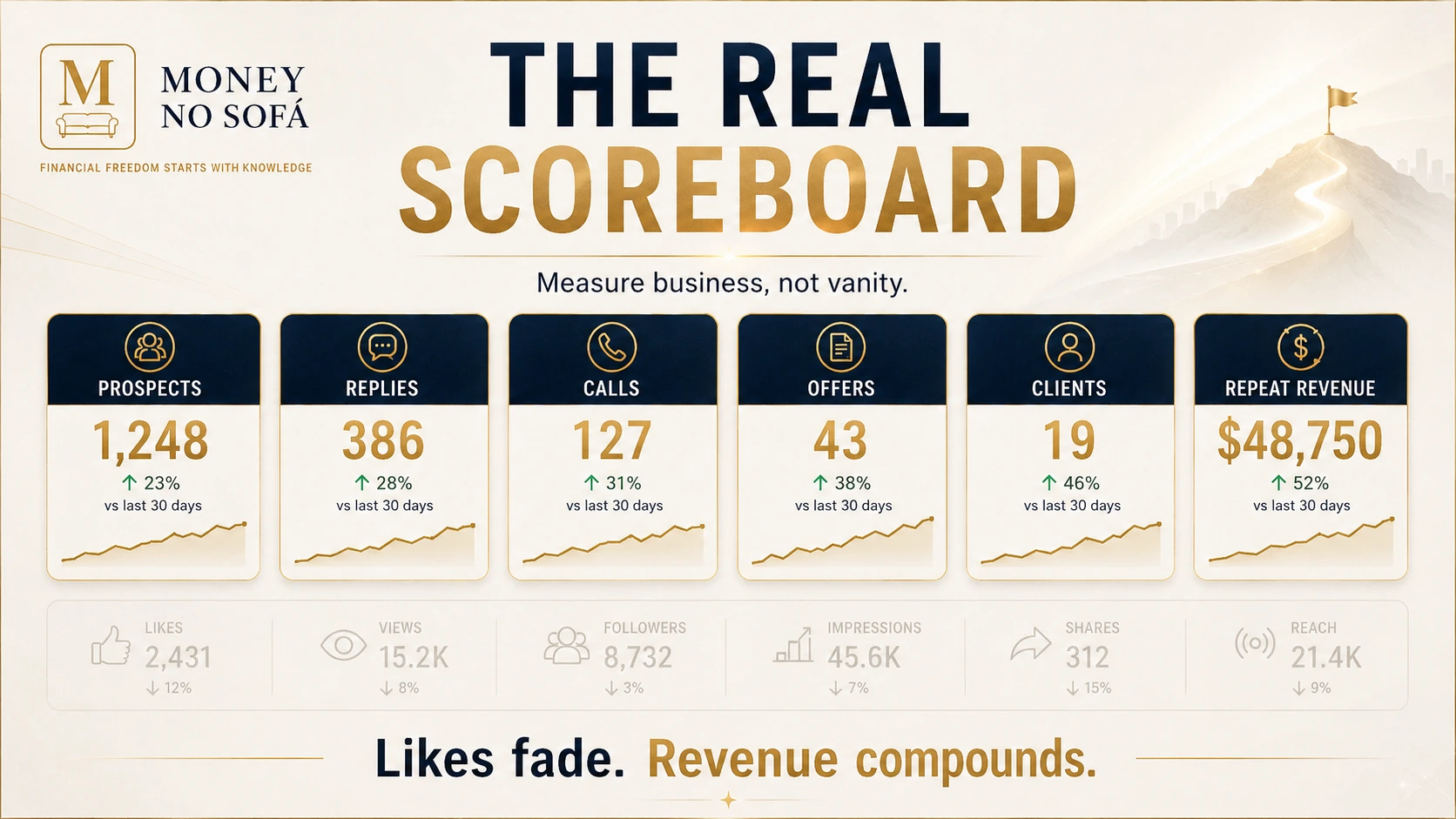
Early businesses should track commercial learning, not vanity:
- qualified prospects contacted;
- positive replies;
- calls booked;
- offers made;
- projects sold;
- average project value;
- repeat purchases;
- referrals;
- delivery time;
- gross margin after software and contractor costs.
A thousand followers do not tell you whether the offer works. Five paying clients do.
Define the proof metric before you start
A first project should produce proof that is easy to explain. Before delivery, decide which metric demonstrates that the work was completed well. The metric does not always need to be revenue.
A CRM cleanup can report duplicate records removed, missing ownership resolved and stale opportunities flagged. A research brief can show sources verified and decision criteria evaluated. A reporting project can show hours of manual work removed and reporting errors reduced. A landing-page project can document changes implemented and the testing plan created.
This matters because your next prospect will ask some version of “What have you done before?” A precise before-and-after story is stronger than a vague claim that the client was happy.
When possible, ask permission to turn the project into an anonymized case study. Protect confidential information and avoid claiming causation you cannot prove. Credibility compounds when each $500 project creates evidence for the next one.
Ask for referrals at the moment of maximum clarity
Many freelancers wait months to ask for a referral or never ask at all. The best moment is usually after the client has confirmed that the project was useful and can articulate why.
Do not ask, “Do you know anyone who needs marketing?” Be specific: “If you know another agency owner whose CRM has the same stale-pipeline problem, I have room for one more cleanup sprint this month.” Specificity helps the client think of a person.
A referral channel is powerful because part of the trust problem has already been solved. You still need a clear offer and professional delivery, but the buyer begins with a recommendation instead of a cold introduction.
One satisfied client can therefore create three assets: revenue, proof and distribution. That is another reason a small paying customer is a better starting target than anonymous reach.
If nobody buys, diagnose the system instead of lowering the price immediately
A failed first sprint contains information. Resist the instinct to cut the price before you know what failed.
If prospects do not reply, the targeting or message may be weak. If they reply but refuse calls, the problem may not feel urgent. If calls happen but proposals stall, proof, scope or trust may be insufficient. If buyers accept the price but delivery becomes chaotic, the offer is under-scoped. If clients are satisfied but never buy again, the service may solve a one-time problem rather than a recurring one.
Each failure points to a different fix. More outreach does not repair a weak offer. Better copy does not repair bad delivery. A discount does not create urgency where none exists.
Keep a simple objection log after every conversation. Record the exact words prospects use, not your interpretation. After twenty conversations, patterns usually emerge. Those patterns can improve the offer, the sample, the FAQ and the targeting.
This is another advantage of a client-first strategy: feedback is attached to buying behavior. You are not trying to infer commercial demand from likes.
Keep the first sales process intentionally simple. One offer, one price range, one sample, one call format and one follow-up sequence produce cleaner learning than five packages and constant experimentation. Complexity feels sophisticated, but early businesses benefit from fewer variables.
Your first move
Write one sentence using this formula: “For [specific buyer], I will solve [specific pain] by delivering [specific output] within [deadline] for $500. The project does not include [boundary].” Then build one sample and show it to ten qualified prospects.
Frequently asked questions
What if $500 is too high for my market?
Use the principle, not the exact number. Choose a price high enough that the buyer evaluates the offer seriously and low enough that the first engagement feels reversible.
Do I need a website?
No. A professional one-page site can help, but a clear offer, sample, payment method and written scope are enough to test demand.
Should I use freelance marketplaces?
They can help you see active demand and build proof, but you should still learn direct acquisition so your business is not dependent on one platform.
How many prospects should I contact?
Enough to learn. Fifty highly relevant prospects usually teach more than hundreds of random messages.
When should I create a digital product?
After repeated client work reveals a problem that can be solved with less customization. Services can be paid market research for future products.
Selected sources
- Upwork — In-Demand Skills 2026, showing continued demand for sales, marketing, automation and specialist freelance work.
- Upwork — Future Workforce Index 2026, on the growth of skilled independent knowledge work.
- Stripe Atlas — Startups in 2025: Year in Review, including speed-to-first-customer and early revenue data among Atlas companies.
- U.S. Small Business Administration Office of Advocacy — Frequently Asked Questions About Small Business 2026.
Editorial note: The $500 figure is an illustrative business-building target, not an income guarantee. Revenue depends on demand, skill, positioning, sales activity, market conditions and delivery quality.
The headline is only the start.
Ask Nova what this story could change in your budget, savings, debt, investments or next purchase.