A direct comparison for buyers choosing between maximum performance and a lower entry price.
PS5 Pro vs PS5 Slim: Which One Should You Buy?
Affiliate disclosure: Money no Sofá may earn compensation from qualifying purchases made through partner links on this page.
The PS5 Pro and PS5 Slim are not two versions of the same purchase. They are aimed at two different buyers. The Slim is the sensible way into the PlayStation 5 ecosystem. The Pro is the premium version for people who already know they care about image quality, frame rate, and getting the strongest console experience Sony currently offers.
In 2026, that distinction matters more because the price gap has widened. Sony’s U.S. suggested pricing now puts the PS5 at $649 and the PS5 Pro at $899. That means you should not choose by the word “Pro.” You should choose by the part of the experience you are actually paying to improve.
Quick answer
Buy PS5 Slim if you want the PS5 library at the lower total cost, still want excellent 4K gaming, or would rather put the savings toward games, a better TV, storage, or accessories.
Buy PS5 Pro if you already have a strong 4K TV, notice the difference between performance and fidelity modes, want the best console graphics available in the PlayStation ecosystem, and plan to keep the hardware for years.
The biggest difference is not the game library
Both consoles play PS5 games. That sounds obvious, but it changes the entire comparison. You are not paying more for access to a separate catalog. You are paying for a more refined version of supported games.
PS5 Pro brings stronger graphics hardware, improved ray tracing, more performance headroom, and PlayStation Spectral Super Resolution, Sony’s AI-assisted image reconstruction system. In March 2026, Sony rolled out an upgraded version of PSSR with improved clarity, motion stability, and more consistent image reconstruction in supported titles.
The Slim, meanwhile, remains a full PS5. It still supports fast SSD loading, the DualSense controller, 4K output, HDR, VRR, and 120Hz modes in compatible games. For many households, that is already more than enough console.
Watch before you buy
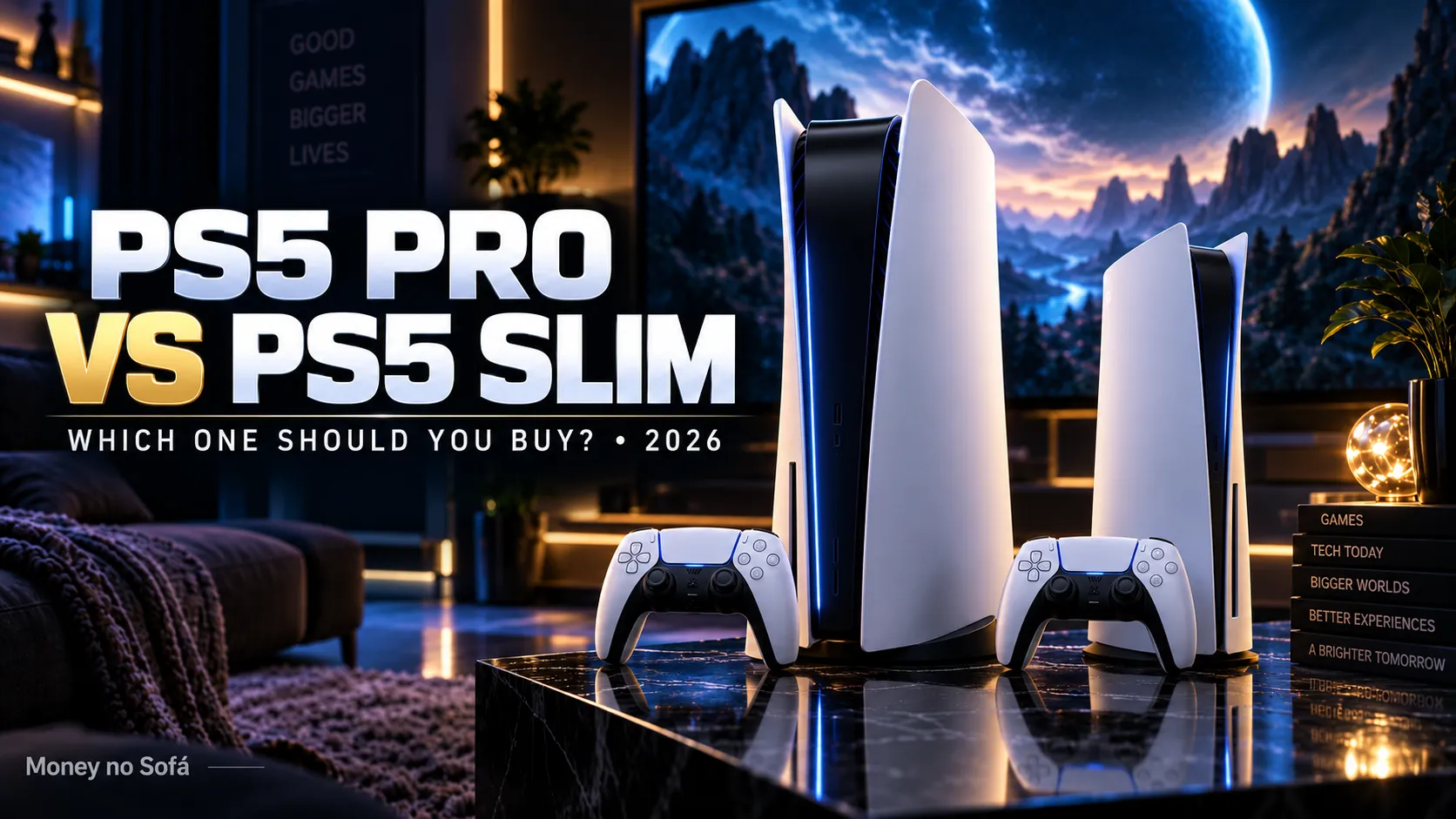
For this comparison, video matters more than a spec table. The Pro’s advantage often appears in motion: sharper detail while maintaining smoother frame rates, more stable image reconstruction, and better presentation in demanding scenes.
PS5 Slim is the value play
The strongest argument for the Slim is not that it is cheap. It is that it gives you the same generation of games without making you pay for performance you may not notice.
If you play from a normal sofa distance on a midrange 4K TV, a lot of the PS5 experience already looks excellent. If you mainly play sports games, Fortnite, indie titles, family games, or older releases, the Pro’s extra graphics capability may not change your week very much.
The Slim can also make more financial sense as part of a full setup. The $250 difference between Sony’s current U.S. list prices can fund several games, a second DualSense, a large NVMe SSD, or a meaningful portion of a television upgrade.
PS5 Pro is the enthusiast play
The Pro begins to make sense when you regularly notice compromises in standard-console modes. If you dislike choosing between a sharper 30 fps fidelity mode and a smoother but softer 60 fps performance mode, the Pro is designed to narrow that gap.
It is especially compelling on large OLED and Mini-LED displays, where better contrast, motion response, and 120Hz support make performance differences easier to see. The Pro also ships with 2TB of SSD storage, which is a meaningful quality-of-life advantage for players with large libraries.
Disc drive: check what you actually buy
Current PS5 configurations can make the disc question confusing. The standard PS5 console includes a disc drive. The Digital Edition does not, although current slim digital models can support Sony’s add-on drive. The PS5 Pro is sold as a digital console and buyers who want physical games should add the compatible disc drive to the total budget.
If you already own a shelf of PS4 or PS5 discs, this can materially change the comparison. Physical games also give you access to used copies, borrowing, resale, and retailer discounts that digital-only buyers may miss.
Storage changes the value equation
PS5 Pro includes a 2TB SSD. Sony currently lists the standard disc PS5 with 1TB and the PS5 Digital Edition with 825GB. The usable space is lower after system files, so players who keep many large games installed may eventually buy expansion storage anyway.
If you were already planning to add a 1TB or 2TB NVMe SSD to a Slim, part of the Pro premium effectively pays for storage you would have purchased separately. That does not make the Pro cheap, but it makes the comparison more honest.
What about Marvel’s Wolverine?
Marvel’s Wolverine launches September 15, 2026 and is officially labeled PS5 Pro Enhanced. It is exactly the kind of cinematic game that can make premium hardware attractive. But it still runs on standard PS5 hardware. One anticipated release is not a good reason to overspend unless it represents the kind of game you play repeatedly across the whole generation.
Which console is better for a new buyer?
For a new buyer with no PS5, the Slim is the safer default recommendation. It keeps the entry price lower and leaves budget for the things that often create a bigger real-world difference: a good television, games you actually want, and enough storage.
The Pro is the better choice when the rest of the setup is already premium. If you own a high-end 4K TV and are deliberately building the best console-based living-room experience you can, buying the cheaper console and wondering about the Pro for the next three years can be a false economy.
Which console is better for an existing PS5 owner?
This is where the bar should be higher. If you already have a standard PS5 or Slim, the Pro should solve a specific dissatisfaction. Maybe you want cleaner 60 fps presentation. Maybe you own a 77-inch OLED and see the softness of performance modes. Maybe 2TB of built-in storage reduces a recurring frustration.
If you cannot name the problem, the upgrade is probably emotional rather than functional. That is not automatically wrong, but it should be treated as a luxury purchase rather than a necessary one.
Pros and cons
PS5 Slim strengths: lower price, same PS5 library, disc option, smaller financial commitment, and more budget left for the rest of the setup.
PS5 Slim tradeoffs: less graphics headroom, smaller storage than the Pro, and more visible compromises in demanding games.
PS5 Pro strengths: stronger graphics, upgraded PSSR, improved ray tracing, 2TB SSD, and a better fit for premium 4K displays.
PS5 Pro tradeoffs: $899 U.S. list price, digital-first configuration, no separate exclusive library, and value that depends heavily on your TV and game choices.
MNS verdict
For most buyers, PS5 Slim is the smarter purchase. For the right buyer, PS5 Pro is the better machine.
The distinction matters. The Slim wins on value because it gives you the generation without forcing a premium hardware spend. The Pro wins on quality because it reduces some of the compromises enthusiasts notice most.
If you are deciding between the two, look at your TV before looking at the console. A premium console deserves a screen that can show why you paid for it.
COMPARE PS5 PRO AND PS5 SLIM ON AMAZON →
FAQ
Do PS5 Pro and PS5 Slim play the same games?
Yes. The Pro improves supported games but does not have a separate PS5 Pro-only library.
Is PS5 Pro worth it on a 1080p TV?
It can still provide performance benefits, but the value case is much weaker than on a capable 4K display.
Does PS5 Pro have more storage?
Yes. It includes a 2TB SSD.
Can the PS5 Slim Digital Edition add a disc drive later?
Compatible current slim digital models support Sony’s optional disc drive.
Read next
PS5 Pro Worth It in 2026? →
Best OLED TV for PS5 Pro →
VIEW ALL BEST PICKS →
The headline is only the start.
Ask Nova what this story could change in your budget, savings, debt, investments or next purchase.