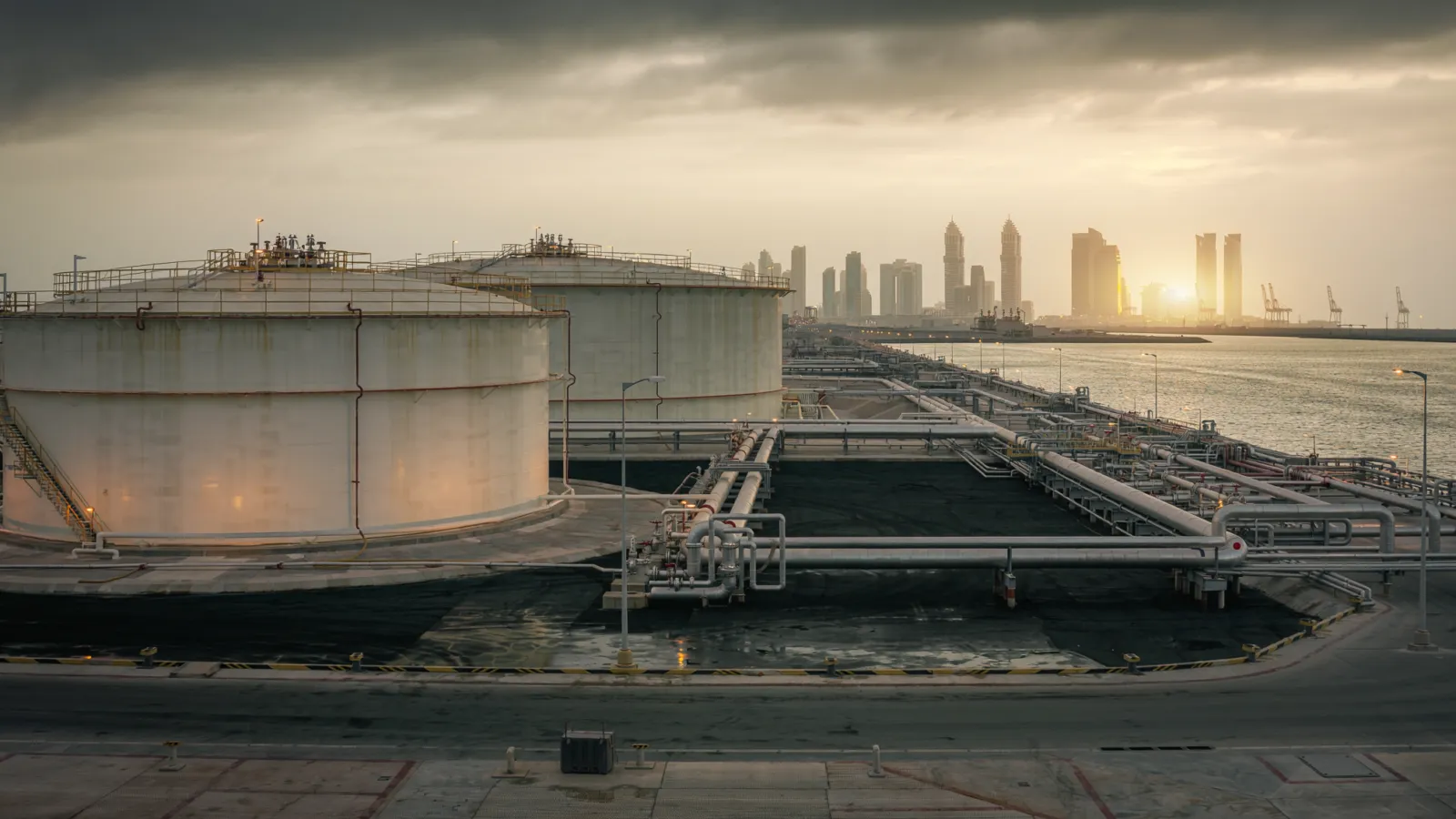
Oil prices lifted Saudi shares as Egypt and Qatar fell. Why the same energy shock creates different cash-flow winners and losers.
A market split, not a market verdict
One region, one oil shock, and three very different closing screens. On Sunday, October 18, Saudi Arabia’s benchmark stock index advanced about 0.8%, while Qatar’s index fell 2% and Egypt’s EGX30 declined 2.6%. Saudi Aramco gained 2.1%. The immediate temptation is to call higher oil a Saudi win and a regional loss. That would be too simple. The prices describe a trading session, not a forecast of who ultimately benefits from an extended energy disruption. The MNS question is more useful: which businesses can convert higher energy prices into cash, and which must pay the bill before they can adjust?
What actually moved
The Saudi market closed around 10,190, with the Saudi Press Agency’s market bulletin reporting a gain of 83.23 points to 10,189.77. Reuters reported the approximately 0.8% advance and the 2.1% rise in Aramco. Across the region, Qatar’s benchmark closed near 8,634, down 2%, while Egypt’s leading index fell about 2.6%. Those are separate national markets with different sector mixes, investor bases, currencies and exposures. A single explanation cannot account for every stock. Still, the divergence is striking because the same geopolitical headlines were circulating while energy prices remained elevated.
The Friday oil price behind Sunday’s trade
Brent crude futures settled on Friday, October 16, at $109.86 a barrel, up $3.94, or roughly 3.7%, in that session according to Reuters. That was a Friday closing price, not a new Sunday quotation. Oil markets and Middle Eastern stock exchanges do not all trade on identical calendars. Investors were evaluating supply risks connected to regional tensions and uncertainty over diesel availability. A price close to $110 can improve the revenue outlook for some producers while raising input costs for airlines, manufacturers, shipping companies and households. Those channels unfold over different time frames.
Why an oil producer can rise
A higher benchmark oil price can support expectations for cash generation at a producer, but the relationship is not mechanical. Realized selling prices, output volumes, operating costs, tax arrangements, transport capacity and potential disruptions all matter. An oil company whose facilities or export routes are exposed to conflict may also face rising insurance and operating risk. That is why a one-day stock gain should not be mistaken for proof that every producer will report higher profit. The equity market prices an expectation; the financial statements later test that expectation. Investors should distinguish those two moments.
Why importers and service businesses feel something different
For businesses that consume fuel, the first visible pressure may be a supplier quotation, a freight surcharge or a larger working-capital requirement. A logistics company pays for diesel before its customer necessarily accepts a higher invoice. An airline may hedge part of its fuel needs but cannot assume that all future purchases are protected. A food distributor may face both transportation and packaging costs. The ultimate consumer price depends on competition, inventories, contracts and government measures. Higher crude does not mean every product becomes more expensive by the same percentage, or on the same date.
Cairo and Doha are not one trade
Egypt’s and Qatar’s falling indexes show how investors can respond differently to regional risk even when oil rises. Egypt’s market carries its own domestic financing and external-balance considerations; Qatar’s market includes financial and industrial companies sensitive to local and global demand. On Sunday, Reuters reported a 4.3% decline in Industries Qatar and a 2.6% drop in Qatar Islamic Bank. Those company moves matter, but they do not establish that oil alone caused each decline. Country-specific exposure, risk appetite and market liquidity can change the direction of the day.
Three cash-flow questions that matter more than the headline
The first question is timing: when does a business pay more, and when can it charge more? The second is contractual: are fuel prices indexed, hedged, fixed or negotiated at renewal? The third is resilience: how many weeks of additional expense can the company absorb without cutting investment or missing payments? These questions apply to a small importer as much as to a regional industrial group. A 10% change in one input does not imply a 10% change in total costs. The relevant calculation is the input’s share of spending, adjusted for any offsets.
What would change the picture
A sustained easing of shipping and supply risks could reverse part of the oil premium. A fresh disruption could intensify it. Policy decisions on fuel reserves, subsidies or trade restrictions may alter the pass-through to consumers, but the scale and timing depend on implementation. Currency movements add another layer: a company that buys energy in dollars and earns local currency has a different exposure from one whose revenue is dollar-linked. Watch confirmed shipping flows, realized fuel prices, corporate guidance and inflation releases rather than extrapolating from one trading day.
The practical decision
For investors, a sector label is not a risk assessment. For founders, the immediate job is to map energy-sensitive costs and identify the next contract renewal. For households, it is worth checking transport and utility budgets without assuming an automatic increase tomorrow. The central lesson of October 18 is not that oil makes everyone richer or poorer. It is that the same global shock can move profits, prices and confidence in opposite directions. Sofa calm. Eyes open. Decisions based on the cash-flow path, not the loudest market screen.
Sources and methodology
Market moves are attributed to Reuters reporting dated October 18, 2026, cross-checked against the Saudi closing index level reported by the Saudi Press Agency and Saudi financial press. Brent $109.86 is the October 16 closing price. The discussion of cost transmission and financial planning is MNS analysis, not a forecast or investment recommendation.
Próximo passo: Ask NOVA to stress-test an energy-sensitive budget.
Fonte factual: Reuters, October 18, 2026
Fonte factual: Saudi market closing data, October 18
The headline is only the start.
Ask Nova what this story could change in your budget, savings, debt, investments or next purchase.