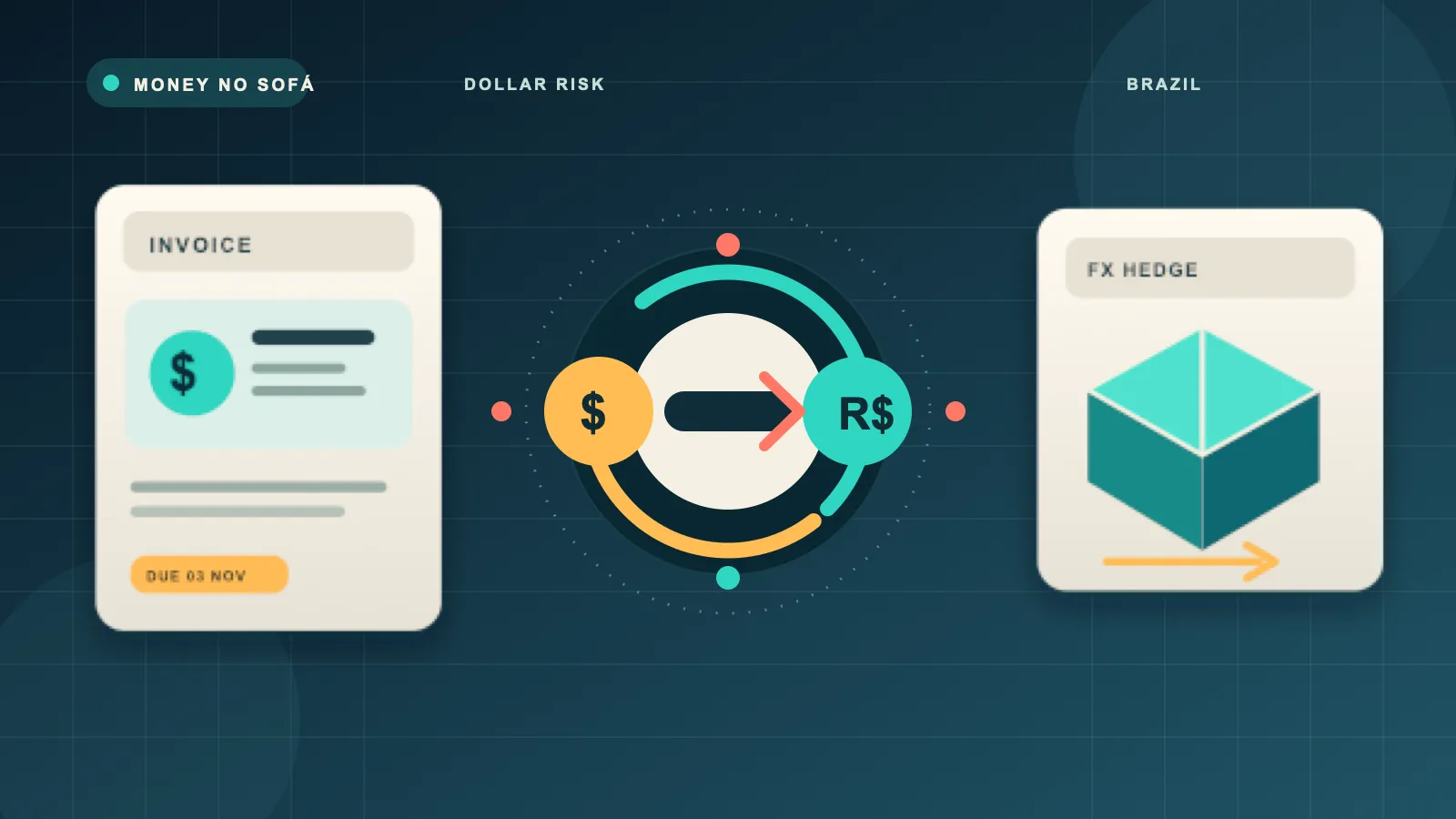
Brazil’s central bank scheduled a 50,000-contract currency-swap offer for October 19. The hedge helps manage dollar exposure; it does not set a company’s exchange rate.
A central-bank auction headline can look like a prediction about the dollar. Brazil’s latest announcement is more specific: it concerns rolling over currency-swap contracts that are approaching maturity.
For a business paying a supplier in dollars, that distinction matters. A policy operation in the derivatives market is not the same thing as a guaranteed exchange rate on the next invoice.
What was announced, and when
In an announcement listed by Banco Central do Brasil on October 14, 2026, the bank said traditional currency-swap auctions for rollover would resume from October 19. The contracts being rolled over mature on November 3.
The detailed terms appeared in BCB Communiqué 46,124: bids were scheduled for 11:30–11:40 a.m. Brasília time on October 19, with an offer of 50,000 contracts and a notional value of US$2.5 billion. Those figures describe the offer, not the amount accepted. The central bank may accept less depending on demand, and this article does not report an accepted volume or an exchange-rate reaction.
The problem a swap is designed to address
The central bank’s explanation of currency swaps describes a derivative used to provide exchange-rate hedging and liquidity. Its traditional contract exchanges dollar-linked returns, including a dollar-interest component, against accumulated domestic interest.
The purpose is to address currency-market functioning. The bank also distinguishes its foreign-exchange operations from monetary policy. An announcement about swaps is therefore not, on its own, an announcement of a change in the policy interest rate.
Why “rollover” is the important word
A contract has a time horizon. A business or financial institution can still face an economic exposure after a particular contract expires. Rolling over a position concerns continuing exposure into another period, rather than assuming that the original need for protection has disappeared.
That does not tell us the net size of the central bank’s position after the process. To assess that, readers need the actual auction conditions, accepted amounts and relevant maturities. An offered amount and an accepted amount are different observations.
Nor does the announced start date establish the price at which an importer can buy currency. The business still has to obtain its own quote and evaluate its own terms.
Where the currency risk reaches an invoice
Consider a hypothetical Brazilian company with a US$10,000 supplier bill. At an illustrative exchange rate of R$5.00 per dollar, the principal would cost R$50,000. At R$5.25, it would cost R$52,500 before any fees or taxes. The R$2,500 difference comes from the currency assumption alone. Neither rate is a current quote or a forecast.
If the company sells in reais, that difference can reduce the cash left after paying the supplier. But buying protection also involves contract terms and costs. A useful comparison needs the amount, currency and payment date of the underlying obligation, rather than only a view about which direction the dollar might move.
Three distinctions worth keeping
- Plan versus result: the announcement sets out an intended process; auction notices and outcomes supply the execution details.
- Market instrument versus customer quote: the central bank’s operation does not fix an individual business’s conversion price.
- Currency exposure versus speculation: covering an existing payment need is a different objective from trying to profit from a market move.
The news today is the scheduled resumption of a rollover process announced last week. Its significance is in the management of currency exposure, not a promise about the real. For a business, the practical starting point remains the same: identify the dollar obligation, its deadline and the full price of the available payment or hedging arrangement.
Primary sources: BCB rollover announcement; BCB Communiqué 46,124, published October 14; BCB currency-swap explanation. Prepared October 19, 2026.
The headline is only the start.
Ask Nova what this story could change in your budget, savings, debt, investments or next purchase.