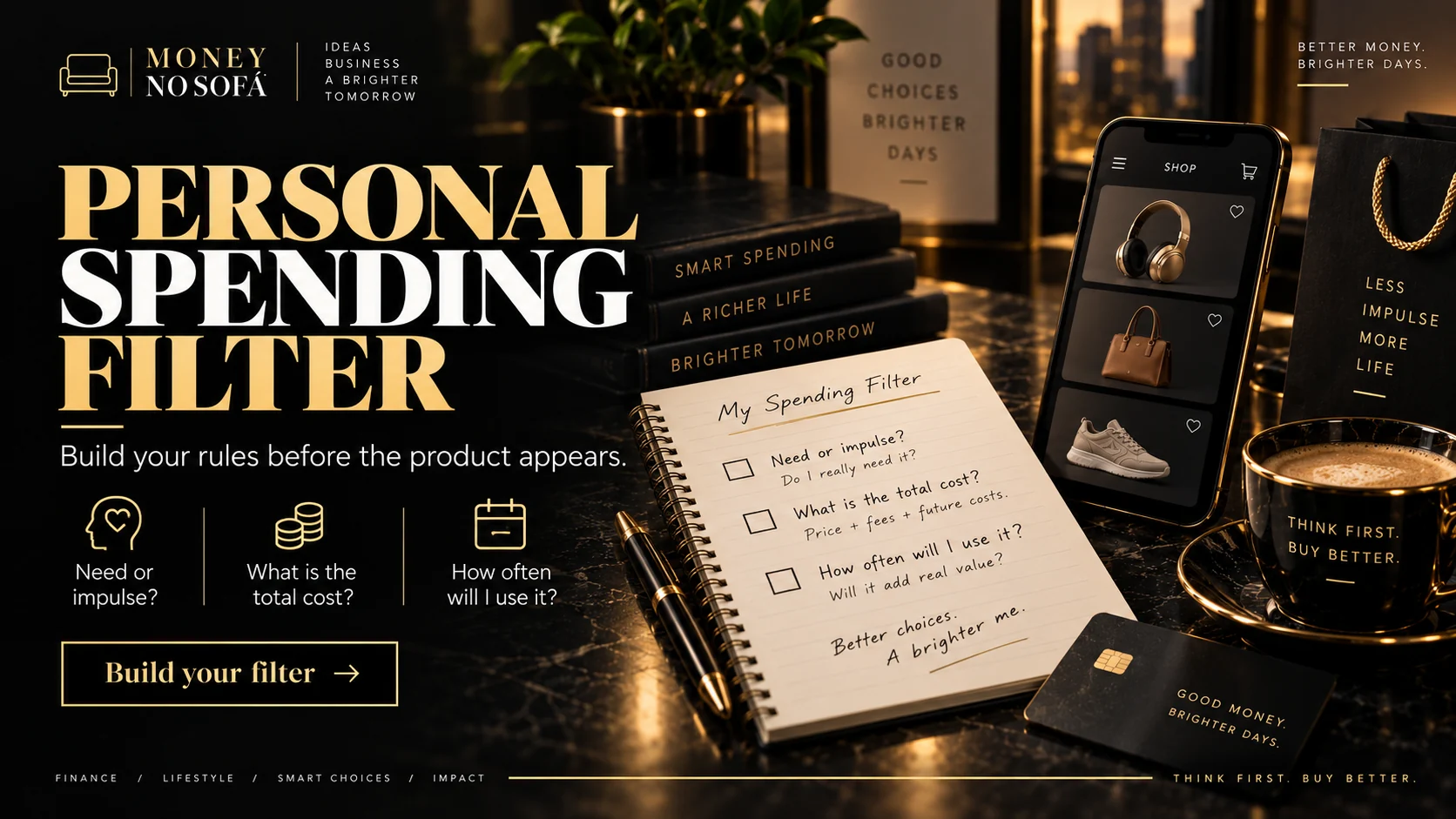
A simple spending filter can make buying decisions faster and cleaner by defining what matters before the product starts persuading you.
Shopping gets harder when every decision starts from zero.
You see a product, read a few reviews, compare prices, feel tempted and try to decide whether it is worth the money. Then you repeat the same mental process with the next purchase.
A personal spending filter makes that easier by deciding your standards before the product appears.
Start with five simple questions
Before a non-essential purchase, ask:
- What problem does this solve?
- Do I already own something that solves most of it?
- How often will I realistically use it?
- What is the total cost, not just the headline price?
- What would I delay by spending this money here?
The questions are simple on purpose. A filter only works if you can use it quickly.
Add a usage test
Products often look valuable because we imagine an ideal future version of ourselves using them constantly.
Estimate usage honestly. If a $300 device will probably be used three times, each use is effectively expensive. If it will be used every day for three years, the same price can be excellent value.
Usage is not the only measure, but it is a powerful reality check.
Separate need from upgrade desire
There is a difference between replacing something that no longer works and upgrading something that is still fine.
Both can be legitimate. They simply deserve different standards.
A replacement may only need to meet your requirements. An upgrade should create enough additional value to justify replacing something functional.
Define your red flags
Your filter can also include automatic caution signs:
- a subscription is required;
- the product only works inside one ecosystem;
- the discount requires a higher basket;
- returns are difficult;
- the financing makes the total unclear;
- you first saw it through repeated social-media exposure.
A red flag does not mean “do not buy.” It means “slow down.”
Use AI after your filter, not before it
AI can be extremely useful once your rules are clear. Give the system your budget, use case, must-haves and red flags, then ask it to eliminate weak fits.
That produces a better shortlist than starting with “What is the best?” because the comparison begins from your criteria.
This is the same principle behind smarter AI shopping decisions discussed in AI Shopping Traffic Is Worth More.
A filter protects against mood
The biggest advantage is consistency. Your standards remain the same whether you are bored, excited, tired or under pressure from a sale.
That does not remove emotion from spending. It prevents emotion from rewriting the rules every time.
Save your five-question spending filter in your phone. Use it before the next purchase above an amount that matters to you. If the product cannot survive five simple questions, it probably does not deserve a complicated justification.
Money no Sofá — Money for real life.
The headline is only the start.
Ask Nova what this story could change in your budget, savings, debt, investments or next purchase.
