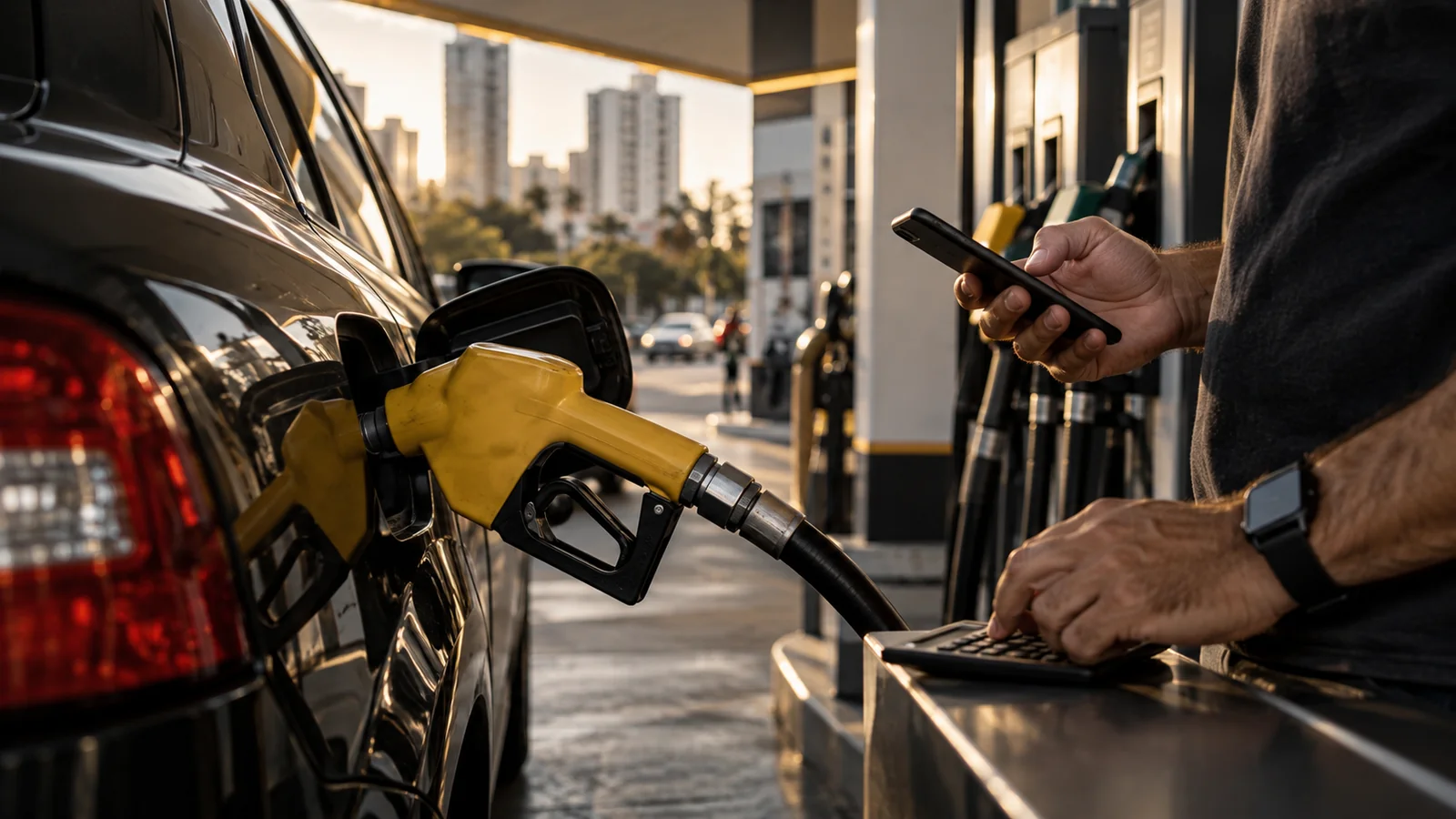
Brazil extended fuel-tax relief and raised the federal gasoline tax reduction to R$0.89 per liter. Here is why pump prices may not fall by the same amount.
Brazil is extending fuel-tax relief as higher international oil prices put pressure on household budgets.
On October 9, the government announced an additional month of federal tax relief for gasoline and ethanol, alongside changes to fuel subsidies.
The stated federal tax reduction on gasoline A increased from R$0.63 to R$0.89 per liter. But a tax reduction at one point in the supply chain does not necessarily produce the same price reduction at the pump.
What exactly changed?
The federal government extended zero-rate treatment of PIS/Pasep, Cofins and Cide on gasoline under its measure. The reduction was described as equivalent to R$0.89 per liter of gasoline A, compared with R$0.63 previously.
Federal tax relief for hydrous ethanol was also extended for another month.
The government says the measures aim to soften the impact of elevated international oil prices and reduce inflationary pressure.
Why pump prices may not fall by R$0.89
The number applies to gasoline A, the component before the mandatory ethanol blend is added.
Retail prices also depend on blending, distribution, transportation, wholesale costs, local competition and other taxes. A reduction in federal taxes can ease costs without producing an equal reduction on every fuel receipt.
Actual savings depend on how the measure travels through the supply chain.
What does this mean for a household budget?
Consider a hypothetical driver buying 120 liters each month:
- If retail gasoline falls by R$0.20 per liter, the monthly saving would be R$24.
- At R$0.40 per liter, the saving would be R$48.
- At R$0.60 per liter, the saving would be R$72.
These are scenarios, not predictions of actual retail price reductions.
The formula is simple: monthly liters purchased × change in retail price = monthly saving or extra cost.
Why the world should pay attention
Brazil is a major energy producer and consumer market. Its response to global oil prices illustrates a trade-off governments face: reducing financial pressure on households while managing tax revenue and public spending.
For international investors, relevant questions include how long support continues, how the measures are funded and how they interact with market prices.
The Money no Sofá perspective
A tax announcement is not the same as money already saved. The relevant evidence will be retail fuel prices, household consumption and the fiscal cost of the intervention.
For drivers, monitor pump prices and calculate the difference against actual monthly consumption.
Ask NOVA: If gasoline prices change by R$0.30 per liter, how much will my monthly transportation costs change?
Next decision: Ask NOVA to estimate how fuel prices change your monthly budget.
Source: Brazil Ministry of Finance — fuel tax relief announcement.
Money no Sofá — Time is Money. Start at Home.
The headline is only the start.
Ask Nova what this story could change in your budget, savings, debt, investments or next purchase.