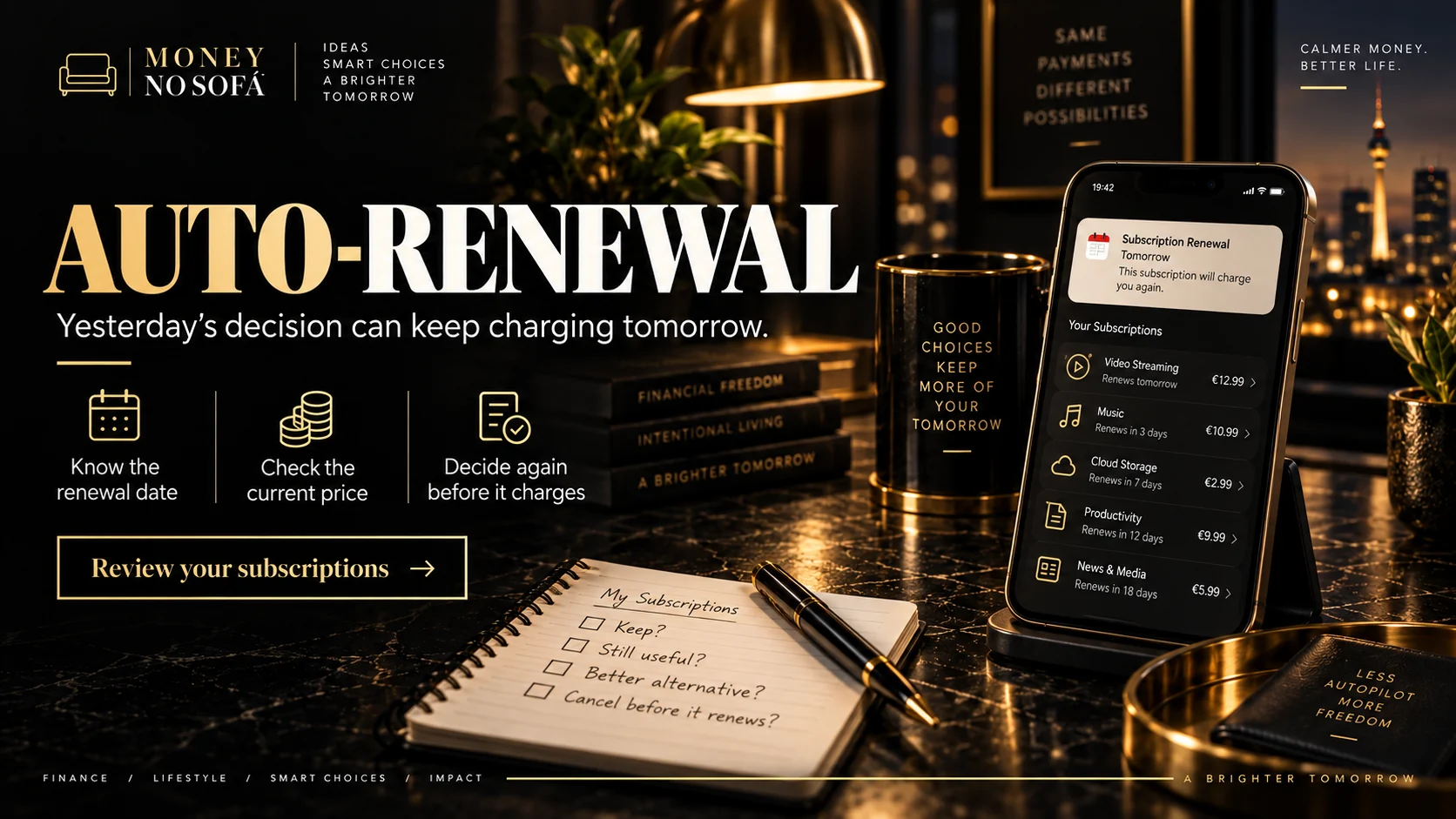
Auto-renewal turns yesterday’s choice into today’s expense. That is convenient—but it can also keep old decisions alive too long.
Auto-renewal is designed to remove one small decision from your life: whether to keep paying for a service next month.That can be helpful. You do not lose access, miss a payment or waste time repeating a choice you already made.But there is a catch. The original decision can continue long after the original reason disappears.
Auto-renewal turns yesterday’s choice into today’s default. Defaults save effort, but they also deserve review.
The first purchase gets attention. The fifth renewal does not.
When you subscribe, you usually think about value. You compare plans, imagine how often you will use the service and decide whether the price feels reasonable.Months later, the renewal may happen without the same evaluation. The service becomes part of the financial background.This is where spending drift begins: not necessarily because the product is bad, but because the decision is no longer active.Use can fall while payment stays the same
A subscription may be worth $20 when you use it every week and poor value when you use it twice a quarter. The price did not change. Your behavior did.This happens with streaming, cloud storage, software, gyms, memberships, delivery programs and professional tools.The right question is not “Was this worth buying?” It is “Is this still worth keeping now?”Annual plans can hide the same problem
Annual billing often lowers the monthly equivalent, which can be financially smart when usage is stable. It can also lock in a service you stop valuing halfway through the year.Discounts should not replace fit. A cheaper unused subscription is still unused spending.Our deeper look at recurring-cost drift is in The Subscription Trap: How Small Monthly Charges Add Up.Cancellation friction matters
Some services make signing up easy and leaving harder. That asymmetry has a financial effect because delay creates another billing cycle.A good rule is to evaluate the exit before the purchase. Ask:- Can I cancel online?
- When does the renewal happen?
- Is there a refund window?
- Does annual billing auto-renew?
- Will I lose important data or benefits immediately?
Create a renewal calendar
You do not need to review every subscription every week. You need the decision to become visible again before money leaves.Add annual renewals to your calendar 14 days before the charge. For monthly services, group the review into one fixed day each month. The purpose is not cancellation. It is consent.Keep the services that earn their place
Some subscriptions are excellent value. They save time, replace more expensive alternatives or provide something you use constantly.A strong money system does not reject recurring costs. It makes sure recurring costs continue to serve a current priority.SOFA ACTION
Money no Sofá — Money for real life. Open your last bank or card statement and identify every auto-renewing charge. Mark each one: KEEP, REVIEW or CANCEL. Do not judge the original decision. Judge whether you would subscribe again today at the same price.
MONEY NOW → NOVA
ASK NOVA ABOUT THIS →
The headline is only the start.
Ask Nova what this story could change in your budget, savings, debt, investments or next purchase.
