AI search compresses replaceable information, not genuine authority. Learn how publishers can defend traffic with evidence, tools, owned audiences, and stronger commercial architecture.
MONEY NO SOFÁ — PREMIUM EDITORIAL
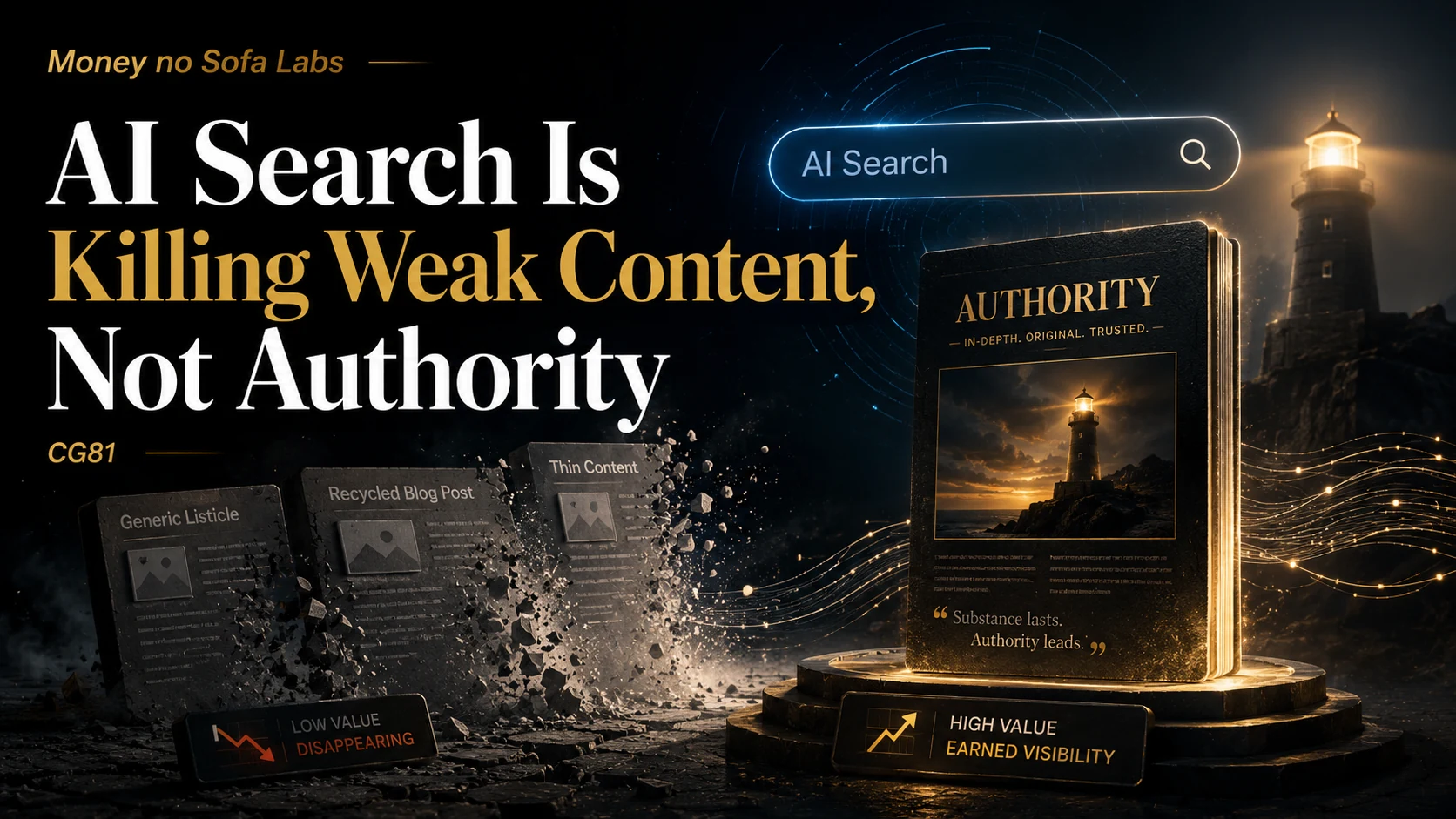
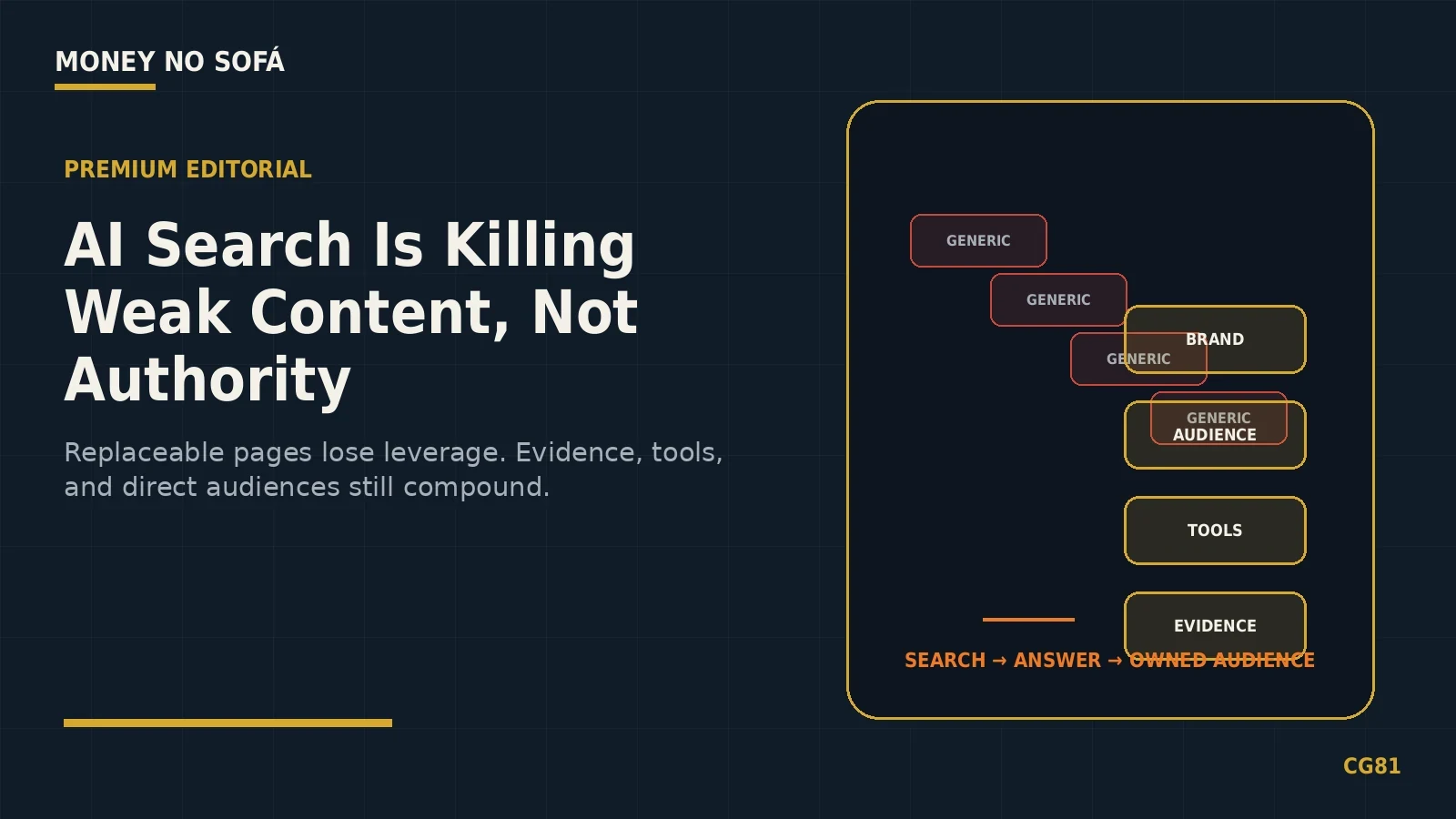
AI search is not destroying authority. It is compressing commodity information and exposing publishers whose pages offer nothing beyond a summary.
Approx. 18-minute read
Search used to operate as a traffic exchange. A person asked a question, a search engine ranked links, and a publisher earned a visit by offering the most useful page. Generative search changes that exchange. The search engine can now synthesize an answer before the user visits any source. The publisher may still provide the underlying information, but the platform increasingly controls the first explanation, the interface, and the moment of decision.
That shift is already measurable. A 2026 study using Google’s AI Overview rollout estimated an approximately 15% decline in daily traffic to exposed English Wikipedia articles, with larger relative declines in areas where a short synthesis could satisfy the query. Another large-scale measurement study found that AI Overviews appeared especially often for question-form queries and that some generated claims were not fully supported by the cited pages. The UK Competition and Markets Authority responded in June 2026 with a publisher conduct requirement addressing controls, attribution, and engagement metrics in generative search.
The wrong response is panic publishing. Producing more generic articles increases the supply of exactly the material AI systems can compress. The strategic response is to understand which content remains valuable after the summary has been given.
This article argues that the real dividing line is not human versus AI content. It is replaceable information versus defensible authority.
Authority survives when information becomes cheap
Every major information technology reduces the value of some forms of knowledge while increasing the value of others. Search reduced the value of memorizing where information was stored. Social media reduced the cost of distribution. Generative AI reduces the cost of producing a plausible first explanation.
That does not eliminate authority. It changes what authority must contain. A publisher can no longer rely on being the page that restates the public consensus in a clean format. The AI system can do that instantly. Authority now depends on assets the summary cannot fully reproduce:
- original data;
- first-hand testing;
- local knowledge;
- expert judgment under uncertainty;
- proprietary tools and calculators;
- updated databases;
- credible editorial standards;
- a trusted brand people seek directly;
- a community that contributes experience;
- products or services that solve the next problem.
The page is no longer the entire product. It is the public surface of a deeper system.
The winning signals are changing
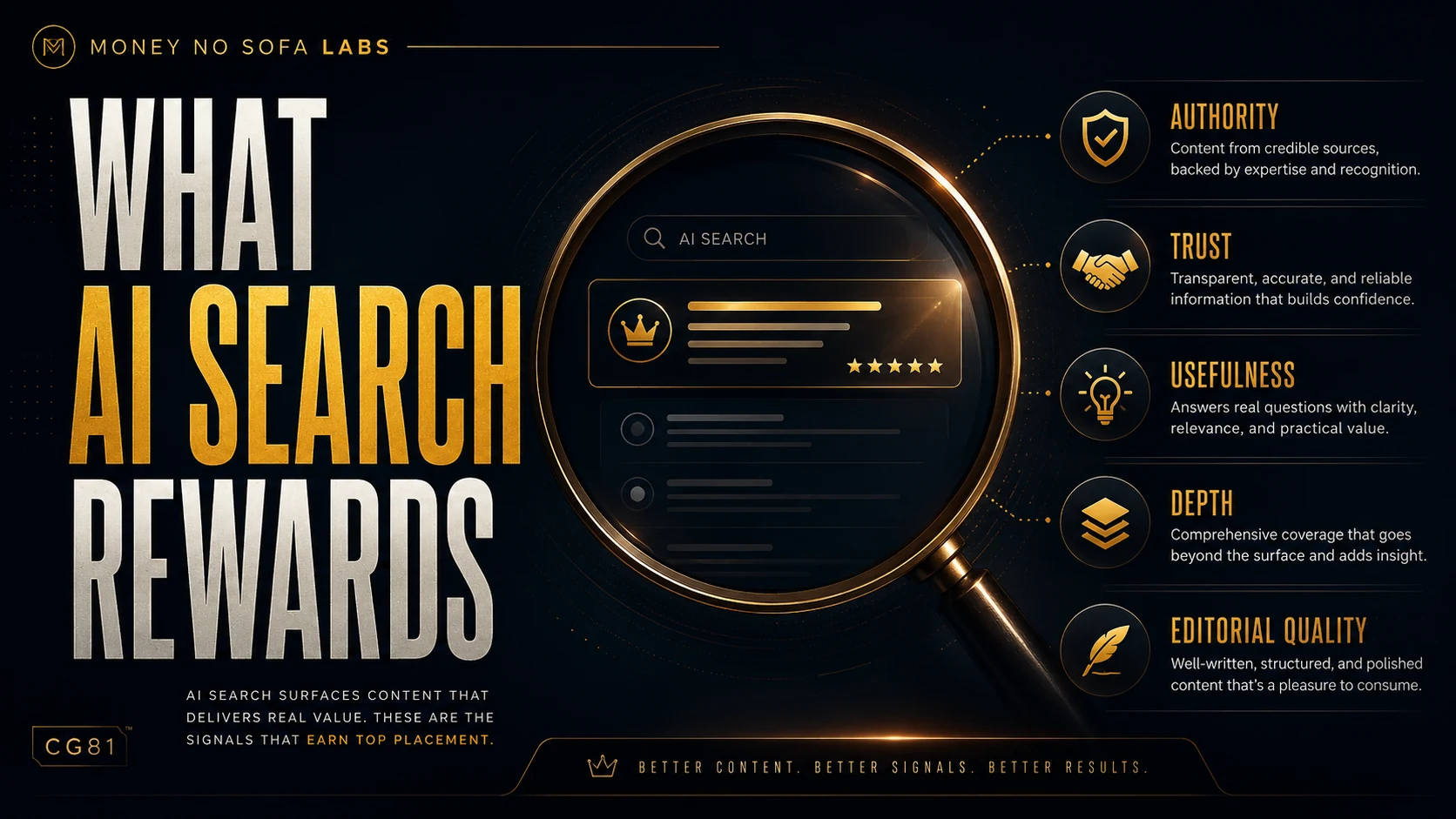
Publishers historically optimized for rankings, impressions, clicks, and advertising yield. Those metrics still matter, but they no longer describe the whole relationship. AI search can create visibility without a conventional click. Google announced dedicated Search Console reporting for generative AI features in June 2026, including views for AI Overviews and AI Mode, initially rolling out to a subset of sites.
The new dashboard should include:
- branded search volume;
- direct traffic;
- returning readers;
- email subscribers acquired by topic;
- downloads of tools and reports;
- assisted conversions;
- revenue by content cluster;
- citations and mentions in AI features;
- engagement after AI-feature clicks;
- the percentage of content with original evidence.
A site can lose some informational clicks and still become stronger if more readers remember the brand, subscribe, use a tool, or buy a product. The opposite is also possible: a site can retain traffic while losing strategic value because every visit is anonymous, one-time, and dependent on a platform.
Authority is not merely being seen. It is being selected again.
Turn search traffic into trust

Search traffic has always been rented. The platform decides how results are displayed, which features appear, and how much space remains for organic links. AI search makes that dependency more visible.
Every important article needs a trust path. The path does not need to be aggressive. It should answer a natural next question:
- download the checklist used in the article;
- use a calculator or comparison table;
- subscribe for updates to a changing dataset;
- read a deeper eBook;
- join a practical email sequence;
- compare tools relevant to the reader’s decision;
- save a template that turns insight into action.
The conversion asset should be more useful than the email address it requests. A generic newsletter box is weak because it creates no reason to act now. A specific tool tied to the article’s problem creates a fair exchange.
This also improves editorial discipline. If the team cannot define the next useful asset, the article may not have enough strategic purpose.
Weak content and authority content are different products
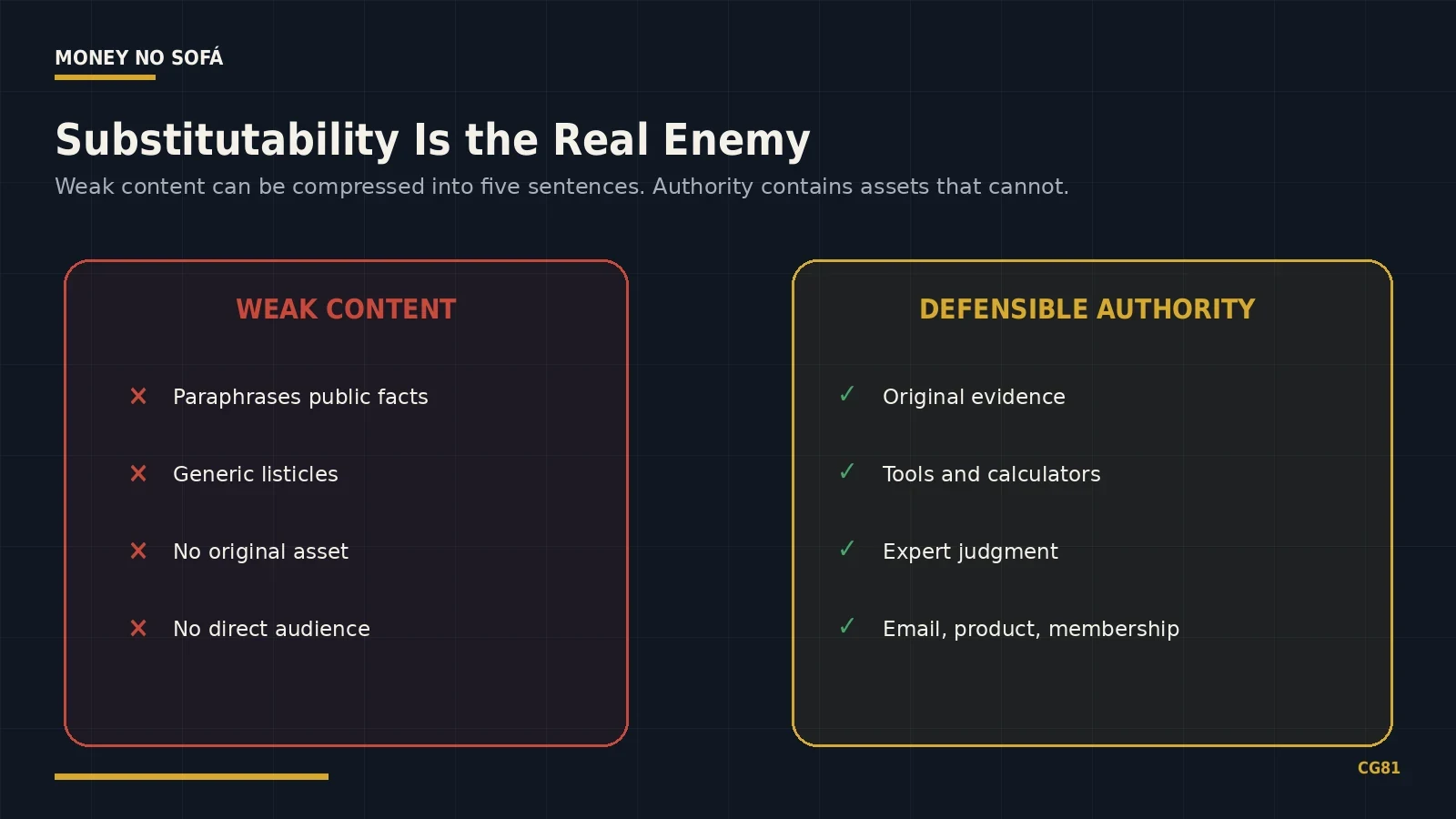
Weak content is not weak because AI wrote it. Human writers can produce weak content, and AI systems can assist with excellent work. Weakness comes from substitutability.
A replaceable article typically has these characteristics:
- the thesis is identical to the search query;
- the page paraphrases public sources;
- examples are generic;
- no original evidence is present;
- the conclusion merely repeats the introduction;
- the page exists to capture a keyword rather than solve a problem;
- the commercial section is unrelated or overly aggressive;
- the page becomes stale without anyone noticing.
Authority content has a different architecture:
- a clear point of view;
- primary sources;
- original analysis or data;
- real examples and constraints;
- transparent uncertainty;
- a decision framework;
- visual explanations that add meaning;
- a next step aligned with the reader’s intent;
- an update process.
The distinction matters because AI search is highly effective at compressing consensus. It is less effective at replacing a living database, a tested process, a local expert, or a publisher with a recognized standard of judgment.
Citation is visibility, not a business model
Publishers naturally want to be cited in AI answers. Citation can support discovery, reputation, and brand recognition. But a citation alone does not pay for research, editing, hosting, or reporting. The business model must exist beyond the citation.
There are four ways a cited page can create durable value:
- Brand lift: the reader remembers and later searches for the publisher.
- Qualified clicks: the citation sends a smaller but more motivated audience.
- Owned conversion: the page converts readers into subscribers, users, or customers.
- Commercial authority: the content supports a product, service, partnership, or affiliate decision.
The danger is confusing extraction with distribution. If an AI system uses the content to answer the question and the user never forms a relationship with the source, the publisher provided input but captured little value.
This is why the CMA’s 2026 publisher requirement is important. It requires clearer controls over how publisher content is used in generative AI, clearer information, engagement metrics, and reasonable steps toward accurate attribution and access. Regulation will not restore the old search page, but it can influence the terms of the new exchange.
Build a public layer and an owned layer
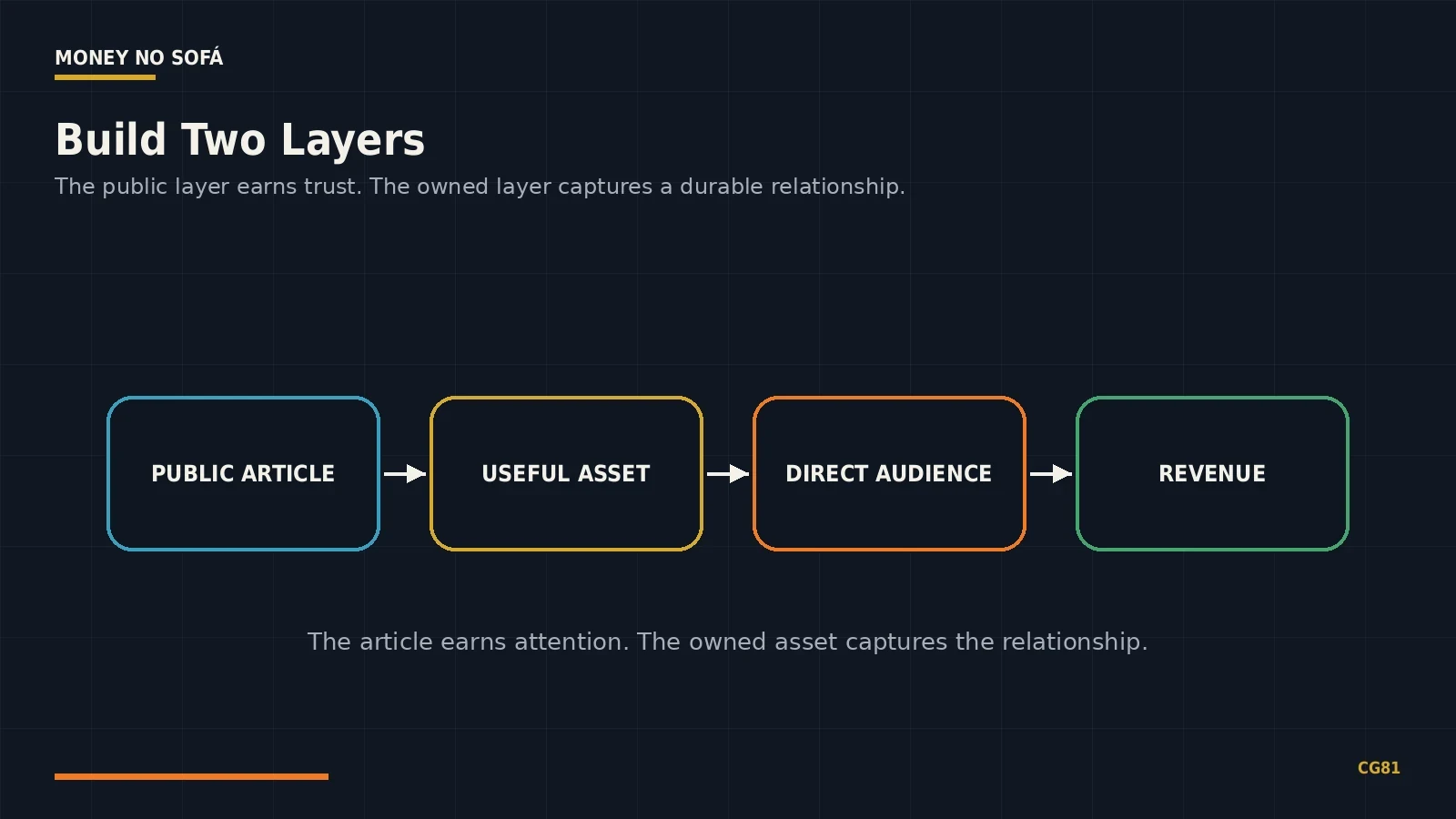
The public layer should answer the query clearly. Hiding the answer to force a signup damages trust and makes the page easier to abandon. The owned layer should provide depth or utility that cannot fit into a search summary.
Public layer
- clear explanation;
- strong thesis;
- primary evidence;
- useful visuals;
- transparent limitations;
- practical conclusion.
Owned layer
- downloadable template;
- interactive calculator;
- updated dataset;
- email course;
- premium report or eBook;
- member community;
- service or consultation;
- country-specific product comparison.
The two layers should be connected but not confused. The article is not a disguised landing page. The commercial asset is not an afterthought pasted onto unrelated traffic. The next step should emerge from the reader’s problem.
Tools worth evaluating
Publishers rebuilding around owned audiences should compare analytics, email platforms, SEO research, content databases, and conversion tools on data portability, attribution, cost, and long-term control—not only on headline features.
Authority needs a recognizable editorial system
A publisher cannot build authority page by page without a system. The organization needs standards for sourcing, claims, updates, corrections, visuals, and monetization.
A practical authority standard can require every major article to include:
- one original thesis;
- at least three primary or high-quality sources;
- one practical framework;
- one example with real constraints;
- one section explaining uncertainty or counterarguments;
- one cover image and nine internal visuals where the format justifies it;
- a minimum seventeen-minute reading experience for flagship pieces;
- internal links to relevant site assets;
- an editorially aligned monetization path;
- a review date.
This standard makes content more expensive to produce, which is precisely why it becomes harder to substitute. Commodity content competes on volume. Authority content competes on accumulated trust.
Search intent at scale without publishing sludge
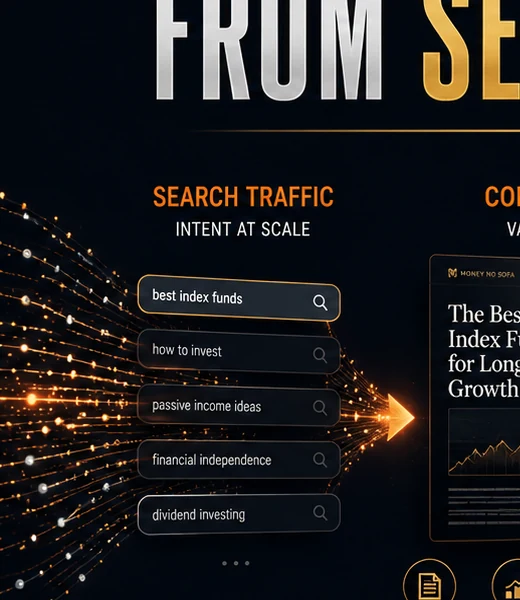
AI tools make it easy to produce one page for every keyword variation. That approach can create a large site with little distinct value. A stronger strategy is to cluster intent and build fewer, deeper assets.
For each topic, map:
- the informational question;
- the decision the reader is trying to make;
- the evidence required;
- the tool or asset that helps next;
- the commercial opportunities that genuinely fit;
- the update frequency;
- the internal links connecting the cluster.
A flagship page can answer the core problem while supporting articles address specific cases, countries, products, or changes. This creates a knowledge system rather than a pile of isolated posts.
Use AI to accelerate research organization, source extraction, structural drafts, internal-link suggestions, and image planning. Keep human responsibility for thesis, evidence, judgment, and final claims. The purpose of automation is to increase editorial leverage, not to remove the reason the publisher deserves trust.
Owned content and returning readers

The strategic metric is not how many visitors arrived once. It is how many people would notice if the publication disappeared.
Returning readers are created through consistency: recognizable topics, useful updates, honest correction, practical tools, and a voice that makes difficult subjects easier to understand. Email remains important because it creates a direct distribution channel. So do browser notifications, communities, saved tools, podcasts, and products people reopen.
Owned does not mean isolated. Search, social, AI citations, and partnerships remain valuable acquisition channels. The goal is to prevent every future interaction from depending on the same platform that produced the first one.
Build a simple relationship ladder:
- anonymous reader;
- engaged reader;
- subscriber;
- tool or resource user;
- customer or affiliate conversion;
- returning advocate.
Measure how content moves people through the ladder. A topic with modest traffic but strong subscriber and product conversion may deserve more investment than a high-traffic topic that produces no memory or action.
Affiliate monetization without destroying trust
AI search will likely increase pressure on display-ad and pure-traffic business models. Affiliate revenue can help, but careless affiliate content is also highly replaceable. Generic “best tools” lists with no testing, context, or country fit are easy for AI systems to summarize and easy for readers to distrust.
A defensible affiliate section should:
- appear only where a product is relevant to the decision;
- explain who should and should not use it;
- compare total cost and constraints;
- disclose compensation clearly;
- avoid invented discounts or false scarcity;
- provide a useful advantage such as a checklist, calculator, or updated comparison;
- route readers through a Money no Sofá resource page so partner links can be updated by country.
The commercial recommendation becomes part of the evidence. If the publisher would not recommend the product without a commission, it should not appear.
The traffic impact is real, but not uniform
AI answers do not affect every query, publisher, or content type in the same way. The 2026 Wikipedia study found stronger substitution in cultural topics and smaller relative effects in STEM, which is consistent with a simple principle: a short answer is more likely to replace a visit when the user wants a concise fact than when the user needs depth, evidence, or technical reasoning.
Another 2026 study of Reddit found that AI Overviews could increase engagement for experience-based discussions before the introduction of a more conversational AI Mode reduced those gains. Interface design matters. Source links, follow-up behavior, and the type of information all influence whether generative search complements or substitutes the publisher.
Publishers should therefore avoid one universal forecast. Segment the library by intent. Definitions, quick facts, and basic comparisons face the greatest compression. Complex decisions, local services, lived experience, tools, and regularly updated information may continue to attract visits or benefit from qualified citations.
The economics of flagship content
A deep article costs more than a generic post, but it can support several economic outputs: search visibility, AI citation, email acquisition, affiliate conversion, eBook demand, sales enablement, social distribution, and brand recognition. Evaluate the asset across its full life rather than against first-week pageviews.
For each flagship article, record research hours, editorial hours, image cost, update cost, subscriber acquisition, assisted revenue, direct revenue, and links earned. This makes it possible to compare a durable authority asset with a high-volume publishing strategy.
Repurpose without duplicating. One researched article can produce a visual carousel, short video, email lesson, checklist, podcast discussion, and eBook chapter lead. Each format should adapt the idea to the audience rather than repeat the same text.
Technical SEO still matters
Authority does not excuse technical weakness. AI features still depend on discovery, crawling, indexing, page quality, and the ability to understand the site’s content. Google states that standard SEO best practices remain relevant for AI Overviews and AI Mode and that no special markup is required solely to appear in those features.
Maintain clean canonical URLs, accessible pages, descriptive titles, useful internal links, structured data where appropriate, image alt text, fast rendering, and clear ownership. Make important information available in text even when visuals carry the story. Avoid blocking resources required to render the page.
Technical SEO creates eligibility. Editorial authority creates preference.
Use formats AI cannot flatten easily
A summary can reproduce conclusions more easily than experiences. Add formats that preserve context and utility:
- interactive calculators with user inputs;
- downloadable spreadsheets and templates;
- before-and-after case studies with constraints;
- local maps and directories;
- original interviews;
- annotated screenshots and process diagrams;
- benchmarks updated on a schedule;
- reader questions and expert responses;
- video demonstrations where execution matters.
These assets can still be described by AI, but the user often needs the original interface, evidence, or demonstration to complete the task.
Run a content experiment instead of guessing
Select three topic clusters and classify pages into summary content, authority content, and tool-supported content. Track ninety days of impressions, AI-feature visibility, clicks, branded searches, return visits, subscriptions, and revenue. Update one weak cluster with original evidence and an owned asset while leaving a comparable cluster unchanged.
The experiment will not isolate every platform effect, but it will reveal whether stronger assets improve the metrics that matter to your business. The point is to replace vague fear with operational evidence.
AI search is evolving too quickly for a static doctrine. Build a measurement habit that survives interface changes.
Trust and brand equity become the moat

Search rankings can change. AI interfaces can change. Citation policies can change. Brand equity compounds across those changes.
A trusted publisher gains advantages that are difficult to copy:
- readers search for the brand directly;
- experts agree to contribute;
- partners value the audience quality;
- corrections strengthen rather than destroy credibility;
- products launch to an existing relationship;
- new formats inherit trust from the publication.
Brand does not mean a logo applied to generic output. It means a consistent promise about what the reader will receive. For Money no Sofá, that promise should be clear decisions, practical money intelligence, independent analysis, and useful next steps without manufactured certainty.
Images and visual evidence are part of authority
Generic stock images decorate a page but rarely defend it. Visual authority comes from diagrams that clarify a process, charts built from cited data, annotated screenshots, comparison tables, and scenes designed around the article’s specific argument. A strong visual can preserve context that a short text summary loses.
For flagship Money no Sofá articles, one cover and nine internal images should follow the structure of the argument rather than interrupt it. Each image needs descriptive alt text, a useful caption, and a reason to exist. The visual sequence should let a reader understand the logic even when scanning.
Images also create additional discovery surfaces in search, social feeds, newsletters, and visual platforms. More importantly, they create a recognizable editorial identity that compounds across topics.
Editorial updates are a competitive feature
AI systems can summarize an old page as confidently as a current one. Publishers need visible review dates, change logs where material, and ownership for updates. An article about software, regulation, payments, prices, or search behavior should define the event that triggers a new review.
Updating is not only maintenance. It signals that the publication is alive, gives returning readers a reason to come back, and creates a stronger source for systems looking for timely evidence. A smaller library with disciplined updates can outperform a larger archive of abandoned pages.
That update discipline should be visible to readers and included in the production log, not left as an informal promise.
It is a measurable part of the product.
A 90-day response plan
Days 1–30: audit substitutability
Classify the existing library. Which pages are definitions, summaries, original research, comparisons, tools, local guides, or commercial pages? Identify pages whose value can be captured in five sentences. Consolidate, update, or retire the weakest material.
Days 31–60: build owned assets
Create one useful asset for each priority cluster: calculator, checklist, database, template, email course, or premium report. Add clear but restrained conversion paths to the public articles.
Days 61–90: change measurement and production
Add branded demand, return rate, subscriber acquisition, assisted revenue, and AI visibility to the dashboard. Require an original asset or evidence standard before approving new flagship content. Build updates into the editorial calendar.
The objective is not to escape search. It is to stop confusing search traffic with ownership.
What a defensible article brief should require
Before a flagship article enters production, the brief should state the claim that will be defended, the primary evidence, the reader’s decision, and the asset that remains useful after the summary. It should identify what is genuinely new: a test, calculation, local interpretation, dataset, interview, framework, or synthesis that changes action.
The brief should also define the commercial boundary. Which partner or product can help the reader next? What limitations must be disclosed? What free tool or comparison improves the recommendation? This prevents monetization from being added after the article in a way that feels unrelated.
Finally, define the update trigger. A law changes, a product price moves, a platform feature launches, or a dataset refreshes. Authority decays when nobody owns the next review.
The editorial decision
AI search is killing weak content because weak content was already economically fragile. It depended on platforms sending a click to a page that offered little more than the platform can now generate itself.
Authority survives by becoming more concrete: evidence, tools, judgment, community, products, and direct relationships. The publisher of the future will not win by producing the largest volume of text. It will win by creating the most useful system around a subject.
Do not ask how many articles AI can generate. Ask what asset, evidence, decision, or relationship each article creates that would not exist without the publisher.
Educational notice: This article provides general editorial and business information. Search features, reporting, regulation, and platform behavior change over time.
Selected sources
- Google Search Central — AI features and your website.
- Google Search Central — Generative AI performance reports in Search Console.
- UK Competition and Markets Authority — Google search publisher conduct requirement.
- Khosravi and Yoganarasimhan — Impact of AI Search Summaries on Website Traffic.
- Xu, Iqbal, and Montgomery — Measuring Google AI Overviews.
The headline is only the start.
Ask Nova what this story could change in your budget, savings, debt, investments or next purchase.