
The artificial intelligence boom is more than a technology story. It is a financing problem involving capital spending, debt, shareholder dilution and electricity.
The artificial intelligence boom is more than a technology story. It is a financing problem involving capital spending, debt, shareholder dilution and electricity.
Artificial intelligence often reaches the consumer as an instant answer on a screen. Behind that answer is a physical industry that has to buy chips, build buildings, secure electricity, lease fiber, train engineers and finance years of investment. The question is no longer simply whether AI is useful. It is who can pay for the infrastructure, when the investment becomes cash-generating, and what happens if demand grows more slowly than projected.
The scale is hard to hide
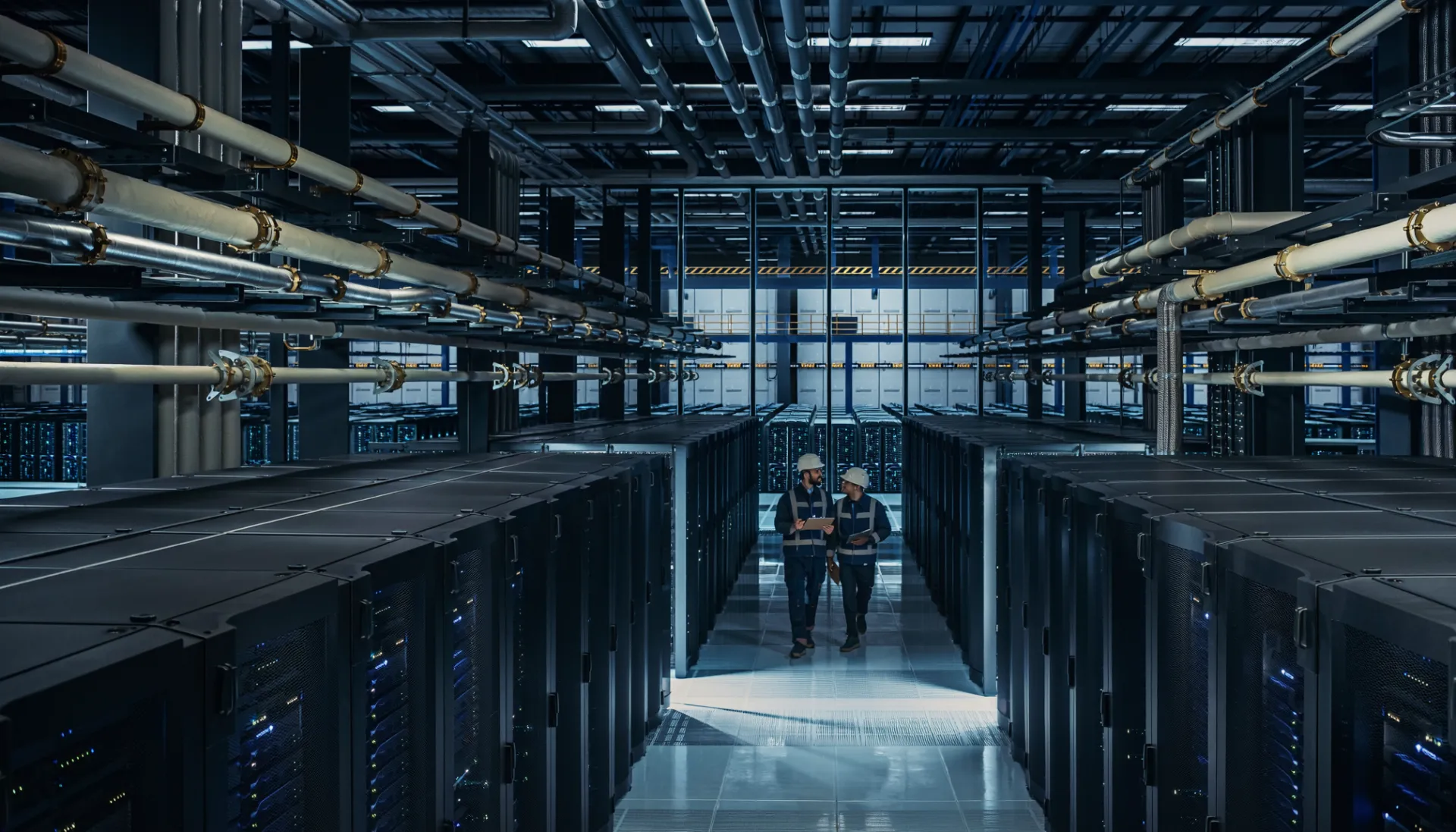
Meta raised the bottom of its annual capital-spending forecast to $135 billion, leaving a ceiling of $145 billion. The company also laid out plans involving non-voting shares as an additional financing channel. Reuters reported a third-quarter free-cash-flow deficit of $2.12 billion, compared with positive free cash flow of $10.63 billion in the corresponding period a year earlier. These figures are not evidence that the company is insolvent. They are evidence that a profitable business can have a period when investing demands more cash than operations produce after capital spending.
Start with the difference between earnings and cash

A company can report accounting profit while cash is tied up in new data centers or equipment. Depreciation spreads the accounting cost of an asset over time, while much of the cash may leave earlier. Free cash flow is commonly calculated as operating cash flow minus capital expenditure; exact company definitions can differ. That is why two companies with similar revenue growth may have very different financing needs. Investors should read cash-flow statements and capital-spending guidance alongside income statements instead of relying on earnings headlines alone.
Debt moves the risk. It does not remove it.

Borrowing can be a rational choice when future revenue is predictable and financing costs are manageable. It can become dangerous when long-lived projects rely on high utilization or continuously available credit. Higher interest rates reduce the present value of distant profits and make refinancing more costly. AI infrastructure operators often spend money years before demand is fully established. If future contracts are delayed or customers reduce their commitments, fixed financing costs remain. Credit quality therefore depends not just on demand forecasts but on the structure and maturity of liabilities.
New shares also come with a price

Raising equity can protect a balance sheet from additional debt, but new shareholders buy an economic claim on future profits. Issuing shares may dilute the share of those profits attributable to existing owners. Non-voting structures introduce another distinction between financial participation and corporate control. None of these mechanisms is necessarily bad. The appropriate question is whether the capital raised can earn more than its economic cost over a reasonable time horizon.
The infrastructure chain is not one company

Large cloud and consumer-platform companies buy computing capacity from a network of suppliers. Semiconductor makers, networking providers, utilities, construction firms and specialist data-center operators all receive different kinds of demand. A revenue increase for one supplier can be funded by borrowing at a customer several steps away. Those connections make the investment cycle powerful, but they can also concentrate risk. For example, an independent computing provider with high financing costs may face much less flexibility than an established platform with several profitable business lines.
Revenue alone cannot answer the return question

Imagine a hypothetical data center that requires $1 billion of upfront investment. That number is illustrative, not a valuation of any real facility. To judge the investment, an owner must estimate utilization, annual operating costs, future upgrades, depreciation, taxes and financing. Higher revenue does not guarantee attractive returns if electricity, chips and interest consume the gains. Return on invested capital offers one way to compare operating profit with the capital needed to create it; free cash flow tests how much money is left after investment.
Technology concentration changes everyone’s exposure
Reuters Breakingviews estimated technology represented close to 40% of the S&P 500’s market capitalization during the October sell-off. This creates an uncomfortable possibility: a diversified index investor may still have substantial exposure to one sector’s spending cycle. Index diversification reduces single-company risk but does not eliminate factor concentration. People who also own separate AI funds or technology stocks should consider their combined exposures rather than counting the number of funds in their accounts.
What to look for in earnings season

Upcoming results from major AI spenders provide a chance to test forecasts against execution. Look for capital expenditure revised upward or downward, the growth of paid AI products, operating margins, customer retention, contract duration, free cash flow and the rate of debt or equity issuance. Do not confuse announced infrastructure capacity with operational capacity, or a signed commitment with earned revenue. A pipeline is a plan until it is built and used.
The winners may not be the loudest companies

Artificial intelligence can create significant economic value while still producing disappointing investment returns for some firms that finance the buildout. The telecom and internet eras showed that useful infrastructure can coexist with overly optimistic financing assumptions. That is an analogy, not a claim that an AI collapse is inevitable. Investors should avoid equating a technological trend with a guaranteed profit stream. Customers benefit from cheaper or better services in ways that do not always accrue to the company that paid the most to build the network.
The Money no Sofá conclusion
Ask three questions before following an AI investment headline: who is paying, when does the money come back, and who bears the downside if assumptions fail? A company’s answer may include customers, bondholders, shareholders or a combination of all three. The strongest businesses can be those that align real demand with disciplined financing. The most expensive mistake is to mistake scale for return. Technology can be extraordinary. Its balance sheet still has to work.
Source: Reuters reporting on AI capital expenditure, October 22, 2026.
Money no Sofá editorial analysis. All cited market readings refer to their stated release or trading date; future policy decisions are not yet confirmed. This article is informational, not individualized financial advice.
Explore further: AI and business strategy
Interested in the business model behind the AI boom? Browse books about AI business strategy on Amazon.
Affiliate disclosure: This is a sponsored affiliate link. Money no Sofá may earn a commission from qualifying purchases at no additional cost to you. Our editorial analysis remains independent.
The headline is only the start.
Ask Nova what this story could change in your budget, savings, debt, investments or next purchase.