Trump’s tariff strategy is reshaping trade, prices and business decisions. Here is how tariffs can move through the dollar, oil, inflation and household budgets.
Tariffs look like a tax at the border. Their real impact travels much farther. A decision signed in Washington can move through factory contracts, shipping routes, currency markets, oil prices and, eventually, the monthly budget of a family thousands of miles away.
That is why Donald Trump’s tariff strategy matters even to people who never import a product directly. The policy is not only about customs rates. It is an attempt to change where companies produce, which countries gain access to the US market and how much negotiating power the United States can extract from trade relationships.
The political promise is clear: protect strategic industries, bring production back to the United States and reduce external dependence. The economic transmission is more complicated. Tariffs may support selected producers while raising costs for companies that rely on imported inputs. They may strengthen a negotiating position while increasing uncertainty. They may also affect the dollar and oil in opposite directions at different moments.
This is not a story about whether Trump is simply right or wrong. It is a practical map of how the policy reaches real money.
What changed in 2026
In February 2026, the White House announced a temporary 10% import duty under Section 122 of the Trade Act of 1974, scheduled for 150 days. The administration described the measure as a response to US balance-of-payments problems and as another tool to encourage domestic production. The action included exemptions for several categories, including certain energy products, critical minerals, pharmaceuticals, electronics and vehicles.
In June, the administration also adjusted tariffs on imported steel, aluminum and copper. According to the White House, some agricultural and industrial equipment rates were reduced from 25% to 15%, while a 10% rate became available for qualifying foreign capital equipment with high US metal content. Those changes were presented as temporary measures intended to support investment in domestic production through the end of 2027.
The official case for the strategy is that tariffs can protect industrial capacity, strengthen national security, attract investment and improve the bargaining position of US negotiators. That is the administration’s argument, not a guaranteed outcome. The result depends on how companies, consumers, trading partners and financial markets respond.
Sources: White House temporary import duty fact sheet and White House metals tariff update.
Tariffs are paid at the border, but the bill keeps moving
When an importer brings a tariffed product into the United States, the importer normally pays the duty. What happens next is a business decision. The company can absorb the cost and accept a lower margin. It can negotiate a lower price with the foreign supplier. It can raise the price charged to customers. It can redesign the product, change suppliers or move production.
Most real cases combine several of these responses. That is why a 10% tariff does not automatically create a 10% increase on the store shelf. Competitive pressure, inventory, exchange rates and contract timing can soften or delay the effect. But the cost does not disappear. Someone in the chain usually receives less income, pays more or accepts more risk.
The first visible effect may not be consumer inflation. It may be hesitation. A company that cannot estimate next year’s cost of components may postpone a factory, reduce inventory or delay hiring. Policy uncertainty becomes an invisible tax on planning.
What tariffs can do to the dollar
The dollar does not move for one reason. It responds to interest-rate expectations, economic growth, risk appetite, capital flows, fiscal policy and demand for safe assets. Tariffs enter that system through several channels.
A stronger-dollar channel
If tariffs reduce imports, the immediate demand for foreign currencies may weaken. If investors expect higher US inflation and higher interest rates, US assets may become more attractive. During global stress, investors may also buy dollars because of their role in trade, debt and reserves. These forces can strengthen the currency.
A weaker-dollar channel
If tariffs weaken growth, reduce confidence in US policy or encourage foreign investors to diversify away from dollar assets, the currency can lose support. Retaliation that hurts US exports can also reduce foreign demand for dollars associated with American trade.
The practical conclusion is that “tariffs make the dollar rise” is not a reliable rule. The exchange rate reflects which effect dominates at that moment. A stronger dollar can reduce the local price of imported goods for Americans, but it can make dollar-denominated debt and commodities more expensive for other countries. A weaker dollar can help US exporters while increasing the cost of imports.
Why oil reacts differently
Oil is priced globally and is heavily influenced by production, inventories, geopolitics, transportation routes and expected demand. Tariffs can affect oil, but often indirectly.
A broad trade conflict can reduce expected global growth. Factories produce less, freight slows and transport demand falls. That tends to pressure oil prices downward. At the same time, geopolitical conflict, sanctions or disruptions in major shipping routes can reduce available supply and push prices sharply upward.
The July 2026 update from the International Monetary Fund illustrates the tension. The IMF projected global growth of 3.0% in 2026 and 3.4% in 2027, while world trade-volume growth was expected to slow from 5.0% in 2025 to 3.5% in 2026. The report attributed part of the trade slowdown to tariffs and the adjustment of production chains.
Yet the same outlook assumed an average petroleum spot price index of about $89 per barrel, 9% above the IMF’s April reference forecast, because energy markets were also facing geopolitical and supply risks. Tariffs may restrain demand while conflict tightens supply. Oil reflects both stories at once.
Source: IMF July 2026 World Economic Outlook Update.
The inflation effect arrives in layers
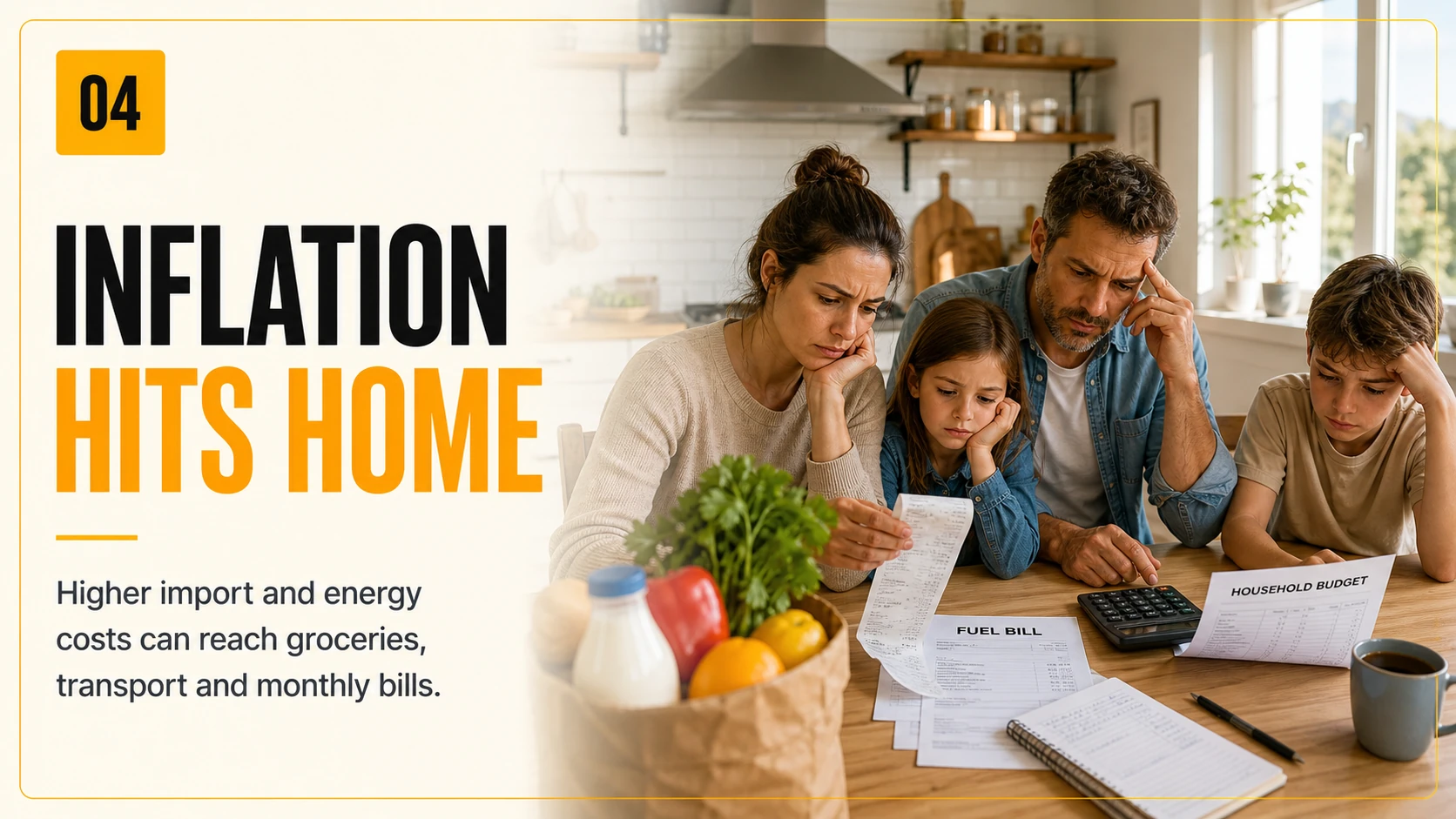
Households usually experience trade policy through prices rather than policy documents. The effects can appear in stages.
- Direct import cost: finished imported products become more expensive when duties are passed through.
- Input cost: domestic producers pay more for imported metals, electronics, chemicals or machinery.
- Currency effect: exchange-rate movements amplify or offset import-price pressure.
- Energy and freight: higher oil, gas and shipping costs spread across food, manufacturing and distribution.
- Expectation effect: businesses adjust prices early because future replacement costs are uncertain.
Lower-income families are often more exposed because food, fuel, housing and basic goods represent a larger share of their income. They have less room to substitute products, delay purchases or absorb a surprise.
The IMF’s July assumptions projected food prices 8% higher and fertilizer prices 26% higher, reflecting energy, transport and supply disruptions. Those figures are global assumptions, not a prediction for every supermarket. They show how multiple shocks can compound before reaching a household.
Who can win from Trump’s tariff strategy

Protected domestic producers can benefit when foreign competitors become more expensive. Companies that already manufacture in the United States may gain orders, pricing power or strategic importance. Regions receiving new factories can gain investment and jobs. Governments may collect tariff revenue, and negotiators may gain leverage in trade talks.
There can also be long-term benefits from diversifying critical supply chains. A country that depends entirely on foreign suppliers for energy equipment, medicines, semiconductors or defense materials accepts a risk that market prices do not always capture.
But protection only creates durable value if the breathing room produces productivity, investment and competitive capacity. If a protected industry raises prices without improving efficiency, customers pay more and the economy carries the cost.
Who carries the risk
Importers and retailers face the first operational shock. Exporters can face retaliation. Manufacturers that use foreign inputs may become less competitive even when the final product is made domestically. Small companies are especially vulnerable because they have less bargaining power, fewer suppliers and less cash to hold additional inventory.
Consumers face a less visible choice set: higher prices, smaller packages, fewer options or delayed product launches. Workers in protected industries may benefit while workers in export-dependent sectors face pressure.
Markets also react to unpredictability. A tariff announced, suspended, challenged or renegotiated within weeks forces companies to spend more time on scenarios and less on execution. The cost of uncertainty does not appear as a line on a receipt, but it can reduce investment and hiring.
What this means for Brazil
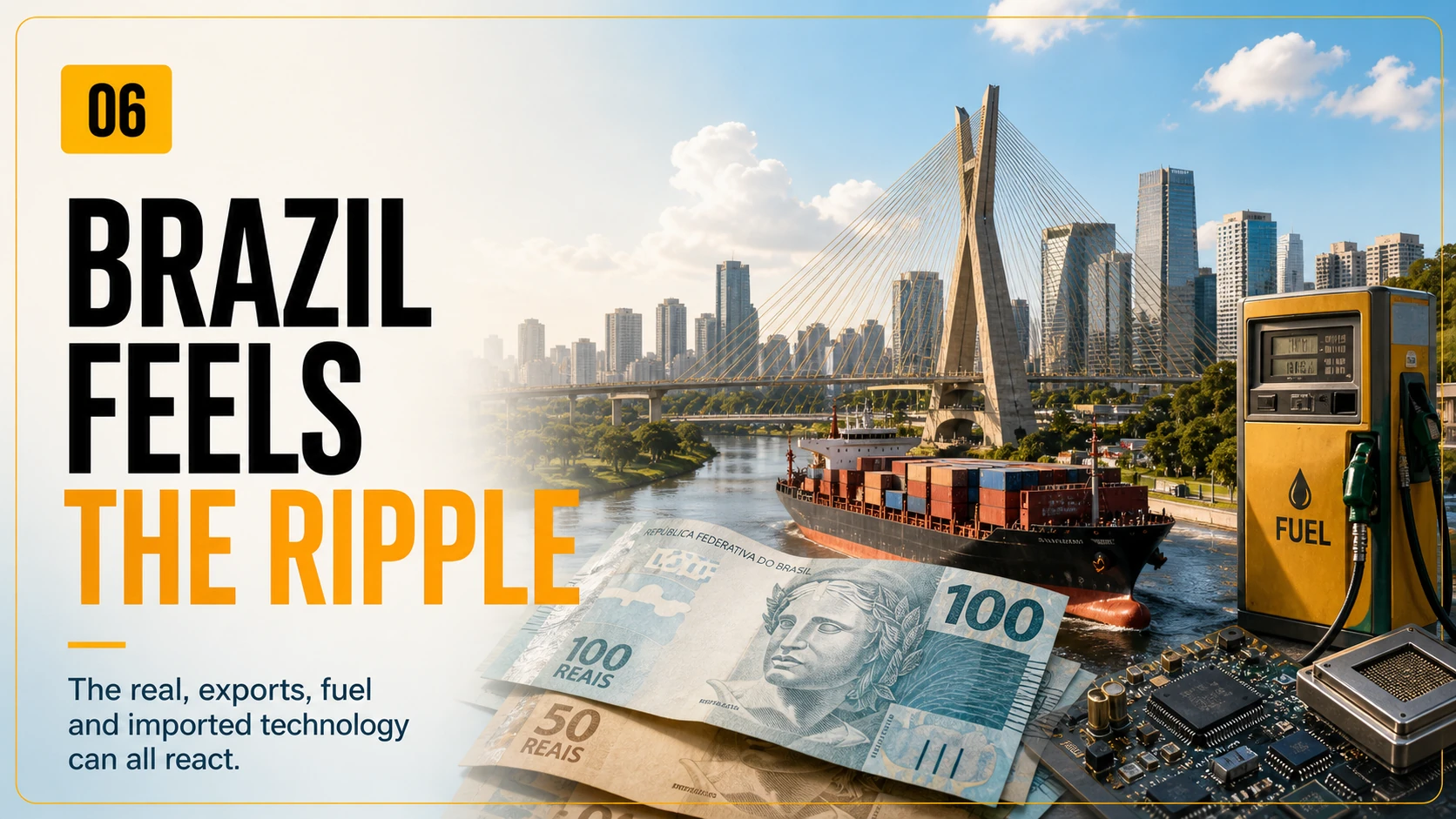
Brazil sits on both sides of the equation. It is a major commodity exporter and can benefit when trade diversion creates demand for Brazilian agriculture, energy or minerals. It can also face pressure if global growth slows, China buys less or a stronger dollar tightens financial conditions.
The exchange rate is the fastest transmission channel for many Brazilian families. A stronger dollar can raise the local cost of fuel, electronics, machinery, imported medicines and industrial inputs. Even products made in Brazil may become more expensive when their components or reference prices are linked to global markets.
Brazilian companies may find opportunities when US buyers search for alternative suppliers. But opportunity requires capacity, compliance, logistics and competitive pricing. Trade diversion rewards companies ready to deliver, not simply countries that appear on a map.
A practical household response
A family cannot control US trade policy, the dollar or global oil. It can control how exposed its budget is to abrupt price changes.
- Protect an emergency reserve before making speculative currency or commodity bets.
- Review expenses most sensitive to fuel, imported products and financing costs.
- Delay nonessential imported purchases when prices are distorted by short-term panic.
- Compare substitutes, but consider durability and total ownership cost instead of only the cheapest sticker price.
- Avoid treating political headlines as investment signals.
- Keep debt manageable because inflation and exchange-rate volatility can keep interest rates higher for longer.
The goal is not to predict every move. It is to reduce the number of ways one policy shock can damage the household at the same time.
A business checklist for the tariff era
- Map imported content in every major product, including inputs bought through domestic distributors.
- Identify contracts that allow price adjustments and those that lock margins.
- Build scenarios for the dollar, freight, energy and tariff rates rather than relying on one forecast.
- Qualify alternative suppliers before an emergency.
- Track customer price sensitivity and product-level profitability.
- Avoid excessive inventory unless the financing cost and obsolescence risk are understood.
- Communicate price changes with evidence instead of blaming politics for every increase.
Three scenarios to watch
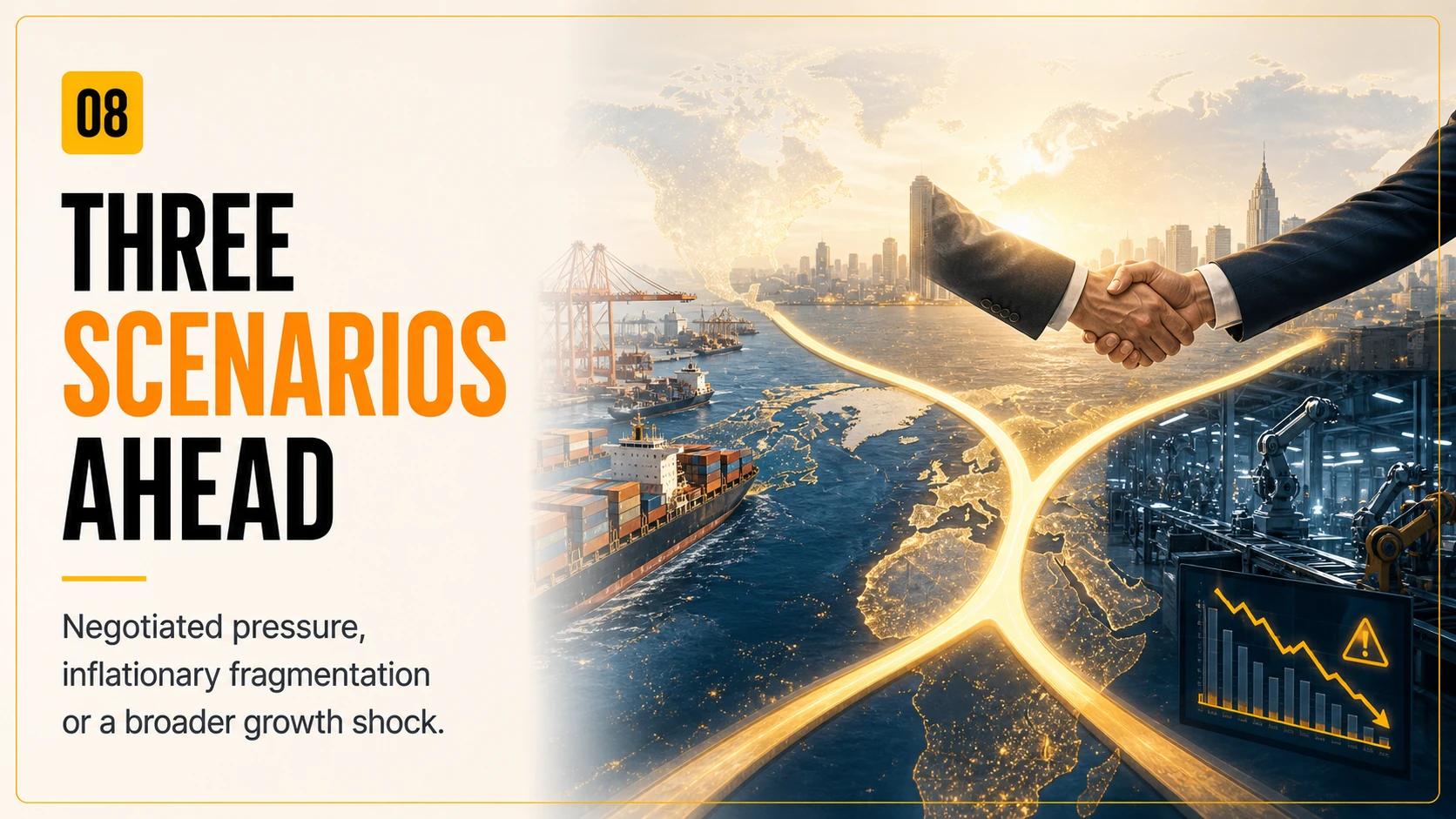
Scenario one: negotiated pressure
Tariffs remain high enough to influence negotiations but are repeatedly adjusted through agreements and exemptions. Companies adapt, trade routes change and the global economy absorbs the shock without a severe downturn.
Scenario two: inflationary fragmentation
Retaliation expands, supply chains duplicate and companies carry higher inventories. Growth slows while prices remain firm. Central banks have less freedom to cut interest rates, and households face prolonged pressure.
Scenario three: growth shock
Trade conflict combines with financial or geopolitical stress. Investment falls, unemployment rises and oil may initially increase because of supply risk before declining with weaker demand. Safe-haven flows can strengthen the dollar even as the global economy deteriorates.
The real issue is not one tariff rate
Trump’s trade strategy is changing the role of tariffs from a narrow customs instrument into a central tool of industrial, security and foreign policy. That shift is more important than any single percentage.
The strategy may attract investment and rebuild selected capacity. It may also raise costs, provoke retaliation and reduce predictability. Both can be true. Economic policy creates winners, losers and second-order effects that campaign language rarely captures.
For families and businesses, the practical rule is simple: do not build a financial plan that only works if the dollar, oil and politics remain calm. Resilience is the ability to continue making reasonable decisions when all three move at once.
Educational notice: This article provides general editorial information and does not constitute financial, investment, legal or tax advice. Economic forecasts are uncertain and can change as policies, markets and geopolitical conditions evolve.
The headline is only the start.
Ask Nova what this story could change in your budget, savings, debt, investments or next purchase.