Ethereum has made blockspace cheaper through rollups and blobs. The next contest is control, interoperability, user experience and where economic value ultimately accrues.
MONEY NO SOFÁ — PREMIUM EDITORIAL
Ethereum has made blockspace cheaper through rollups and blobs. The next contest is not simply transaction speed—it is who controls sequencing, captures value, protects users, and makes the layered system feel coherent.
Approx. 17–19-minute read
Ethereum’s scaling story has changed. For years, the central question was whether the network could support more users without turning every transaction into an expensive auction. The answer now emerging is not one enormous blockchain executing everything. It is a layered architecture: Ethereum provides settlement, security, and data availability while rollups process transactions and publish compressed evidence back to the base layer.
That architecture has already changed the economics of using Ethereum. The Dencun upgrade introduced blob transactions through EIP-4844, giving rollups a cheaper way to publish temporary data. Subsequent roadmap work continues toward greater data availability and a more rollup-centric network. Fees on many layer-two systems can be dramatically lower than base-layer transactions, making consumer applications, trading, gaming, payments, and social products more plausible.
But lower fees do not finish the job. They move the bottleneck. Users now face multiple networks, bridges, sequencers, fee tokens, withdrawal delays, liquidity pools, and security assumptions. Developers must decide where to deploy. Investors must distinguish activity from value capture. Ethereum must scale without allowing the user experience or trust model to fragment beyond recognition.
This article examines what comes after the headline victory of cheaper blockspace. The next phase will be decided by decentralization, interoperability, economic alignment, and whether the layered system can become understandable enough for ordinary users.
Ethereum chose a layered future

Ethereum could have pursued scaling mainly by increasing the capacity of the base chain. Instead, the roadmap increasingly assigns high-volume execution to rollups. A rollup executes transactions outside the base layer, compresses the results, and posts data or proofs to Ethereum. The base chain becomes a court and settlement system rather than the place where every user action must occur.
This separation has an important advantage. Different rollups can experiment with virtual machines, proof systems, account models, privacy, fee markets, and governance without requiring every change to become a universal Ethereum protocol decision. Innovation can happen at the edges while the base layer protects a shared settlement asset.
The trade-off is architectural complexity. A user may say they own ETH, but the ETH can exist on the base layer, inside an optimistic rollup, inside a zero-knowledge rollup, or as a representation on another network. The legal and technical ownership may be similar in spirit while the recovery paths, withdrawal conditions, sequencer dependence, and bridge risks differ.
A layered future therefore changes the meaning of scale. It is not only transactions per second. It is the ability to coordinate many execution environments around a credible base without forcing users to understand every layer.
Blobs changed the cost structure
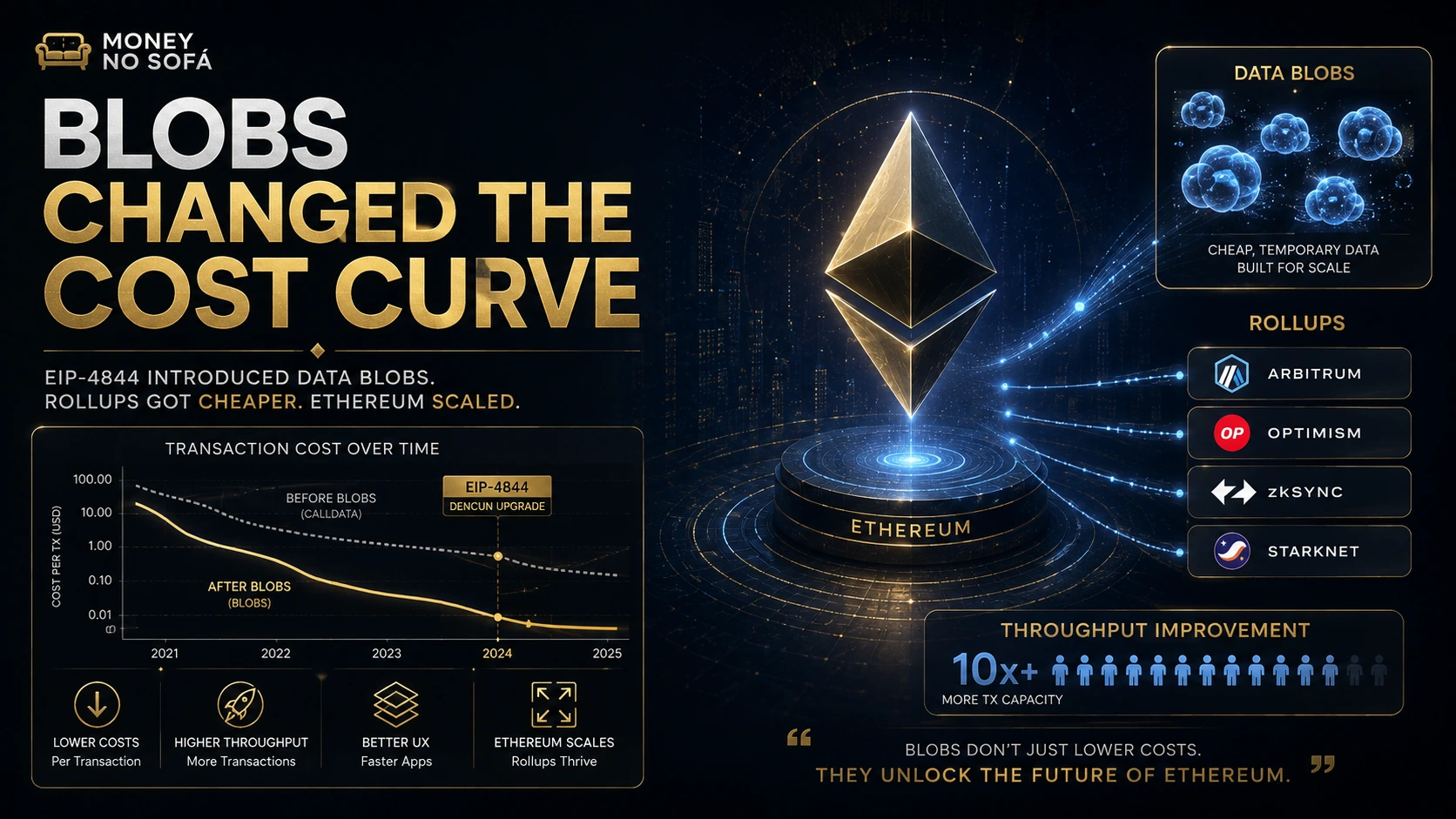
Before blobs, rollups commonly published transaction data through calldata, competing with other Ethereum activity for permanent blockspace. That made rollup costs sensitive to base-layer congestion. EIP-4844 introduced a separate transaction type carrying blobs: large packages of data that the consensus system makes available for a limited period without requiring the execution layer to store them permanently forever.
This matters because rollups need data availability more than permanent execution storage. Users and validators must be able to reconstruct the rollup state and challenge or verify claims, but the base chain does not need to treat every compressed transaction as ordinary application data. A dedicated blob fee market allows rollup demand to expand without bidding directly against every base-layer contract call.
Cheaper data can lower user fees, but the relationship is not automatic. A rollup may retain part of the savings, subsidize selected transactions, or face costs from proving, sequencing, congestion, and infrastructure. Fees also vary by application and market conditions. The correct measure is the all-in cost and reliability experienced by the user, not a protocol benchmark in isolation.
Blobs are an intermediate step toward a larger data-availability design. The roadmap points toward peer data availability sampling and greater blob capacity. Each increase must preserve the ability of the network to verify availability without pushing hardware requirements beyond a healthy validator population.
The sequencer is the new center of gravity
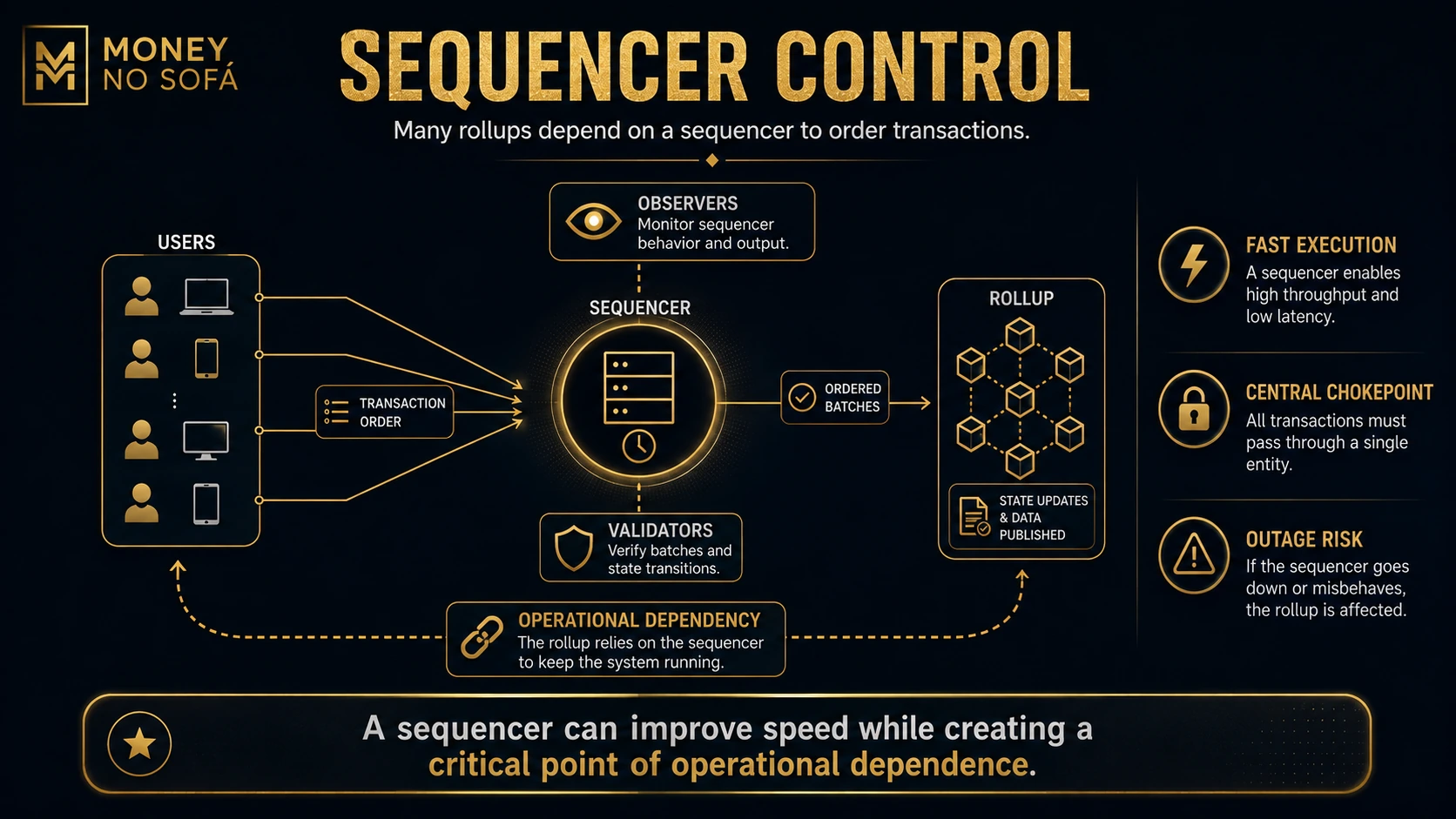
Most rollups use a sequencer to receive, order, and package transactions. The sequencer gives users fast confirmations and creates an efficient transaction flow. It can also become the most important centralized component in an otherwise decentralized narrative.
A sequencer can censor transactions, reorder them, experience downtime, or influence the extraction of maximal value. Some rollups provide a forced-inclusion path through Ethereum, allowing a user to bypass the sequencer eventually. That escape hatch can preserve liveness in theory while remaining slow, expensive, or unfamiliar in practice.
The next phase of scaling will require clearer sequencing guarantees. Projects are exploring decentralized sequencer sets, shared sequencing, based rollups that use Ethereum proposers, and designs that separate block building from final settlement. Each approach changes latency, revenue, composability, and security.
Users should ask practical questions. Who operates the sequencer? What happens during an outage? Can a transaction be forced through the base layer? How long does that take? Who captures ordering revenue? Is the sequencing software open and monitored? A low transaction fee does not compensate for an execution environment that can quietly stop or discriminate.
Sequencer decentralization is difficult because coordination has a cost. A single operator can produce a smooth product. A distributed set requires consensus, incentives, and fault handling. The challenge is to decentralize without making the service unusable.
Bridges remain the fragile connective tissue

A layered ecosystem needs bridges. Users move assets from Ethereum to a rollup, between rollups, or from an exchange directly into a selected network. The bridge may be canonical to the rollup, operated by a third party, backed by liquidity providers, or secured by a separate validator set.
Every bridge answers a trust question. What event causes the destination asset to be minted or released? Is the message proven through Ethereum, accepted after a challenge period, signed by a committee, or guaranteed by a liquidity provider that expects later reimbursement? The interface can make these designs look identical even when the failure modes are radically different.
Bridge security has repeatedly been one of the most dangerous areas in crypto because large pools of assets sit behind complex contracts and cross-system assumptions. A mistake in verification, compromised signer set, faulty upgrade, or manipulated message can affect an entire pool rather than one transaction.
Native interoperability efforts may reduce dependence on ad hoc bridges, but they will not remove the need for careful design. Standards must address message passing, asset identity, finality, and conflicting states. Wallets and exchanges also need to display the actual network and route rather than hiding critical details behind a generic asset symbol.
For users, the safest practice is to prefer well-documented canonical routes, test with a small amount, verify the destination network, and avoid assuming that a token with the same ticker has the same issuer or redemption path everywhere.
The user experience is now the scaling problem

Ethereum can scale technically while failing commercially if users must become network engineers. The current experience often requires choosing a chain, adding it to a wallet, acquiring the correct fee token, bridging funds, recognizing wrapped assets, and understanding why a transaction is final on one system but not yet withdrawable to another.
Account abstraction, smart wallets, sponsored transactions, session keys, and chain abstraction aim to hide this complexity. A user might sign one intent—buy an item, swap an asset, or enter an application—while software finds the liquidity, pays the appropriate gas, and settles across networks behind the scenes.
Abstraction must not become deception. A wallet that hides the route should still explain the custody, fees, asset form, and recovery options. Users need simple outcomes without losing the ability to inspect what occurred. The product should prevent wrong-network transfers, warn about risky bridges, and show when a fast confirmation is only provisional.
Exchanges can improve the experience by supporting direct deposits and withdrawals on major layer-two networks. That reduces bridging steps, but it introduces reliance on the exchange’s network support and maintenance windows. A withdrawal labeled ETH must clearly show where the ETH will arrive. Eligible readers comparing direct ETH and layer-two access can review the current Binance registration offer with code BITCOIN15 and then verify which networks, fees and withdrawal routes are actually supported in their region.
The winning wallet or application may not be the one with the most networks. It will be the one that makes multi-network execution feel coherent while preserving informed consent.
Who captures the economic value?

Scaling creates more activity, but activity and token value are not the same variable. Ethereum earns fees when rollups post data and settle. Rollups may earn the difference between user fees and their costs. Sequencers may capture ordering revenue. Applications may capture the customer relationship and charge their own fees. Liquidity providers earn spreads or incentives. Token holders receive value only when the protocol’s economics connect activity to their asset.
After blobs lowered data costs, the amount rollups paid to Ethereum could fall per transaction even while usage expanded. That can be healthy: cheaper capacity may create demand that did not exist. The long-term question is whether aggregate blob demand, settlement demand, staking demand, and ETH’s role as collateral and money create durable value.
Rollup tokens also require scrutiny. Some govern upgrades or incentives but do not automatically receive sequencing revenue. A high transaction count does not guarantee cash flow to the token. Governance rights can be valuable, but only when the governance controls something economically meaningful and cannot be bypassed by insiders.
Investors should trace the full value chain. Who pays? Who receives the fee? Which costs are subsidized? What happens when incentives end? Does the token secure the system, govern it, absorb fees, or simply represent expectation? Scaling makes these questions more important because the ecosystem distributes activity across more layers.
Decentralization must be measured by failure
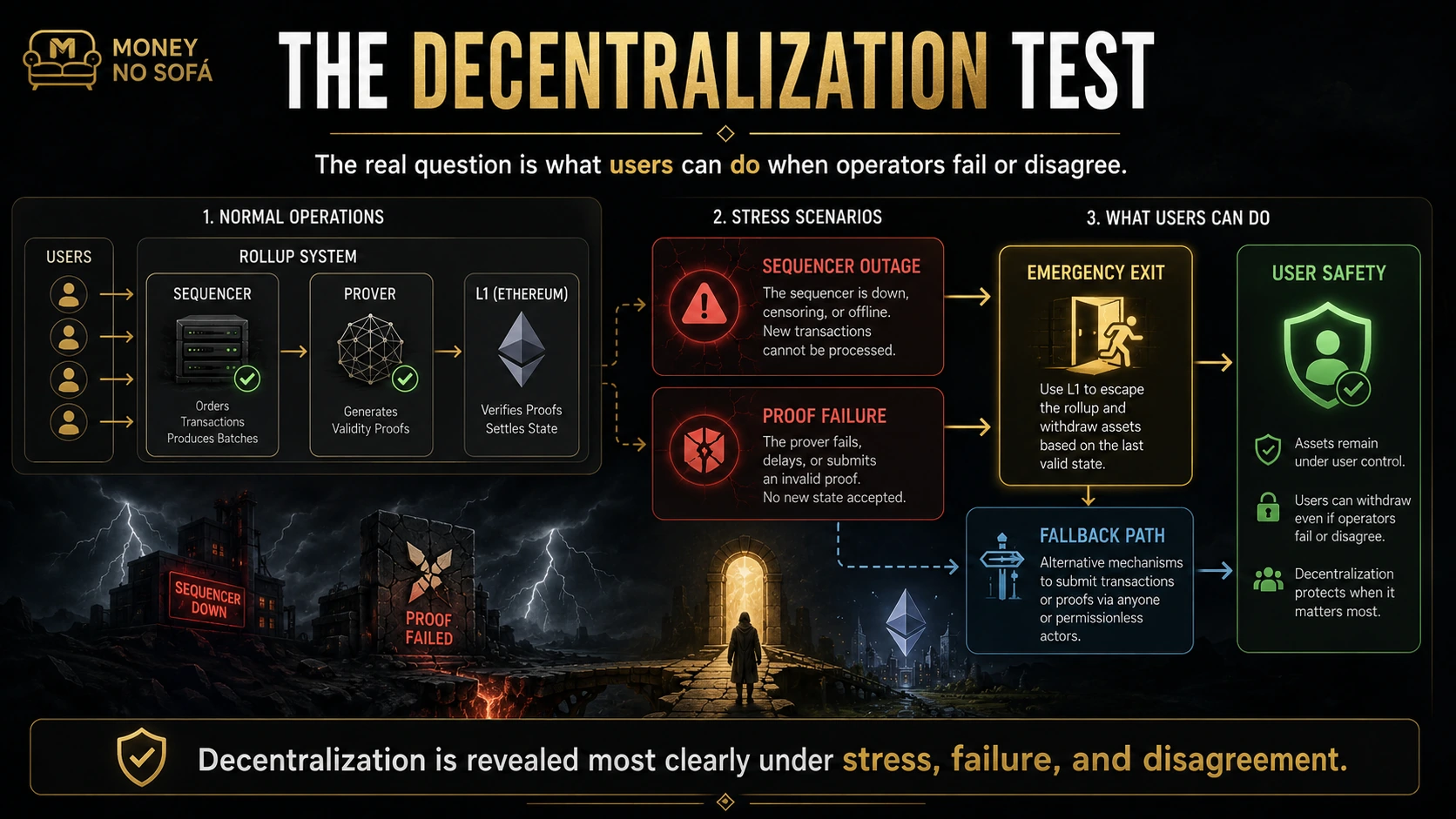
Marketing often describes a rollup as secured by Ethereum. The phrase can be accurate while omitting stages of dependence. A project may have upgrade keys, permissioned provers, centralized sequencers, emergency councils, or incomplete fraud-proof systems. These mechanisms can be reasonable during development, but users need to know which guarantees are live today.
A useful decentralization test begins with failure scenarios. If the sequencer disappears, can users submit transactions? If the proposer stops publishing state, can funds be withdrawn? If the proof system contains a bug, who can pause it? If the upgrade authority changes the code, how much notice do users receive? Can a minority exit before the change takes effect?
Rollup maturity frameworks attempt to classify these conditions. The important point is not to shame early-stage systems. It is to match risk disclosure to actual control. A fast and inexpensive chain operated by a known team can be useful, but it should not be evaluated as though every guarantee is already inherited automatically from Ethereum.
Decentralization is also economic. If all activity depends on one infrastructure provider, one bridge, one stablecoin, or one interface, the protocol may be open while practical access remains concentrated. Resilience requires multiple independent paths.
Developers face a distribution decision
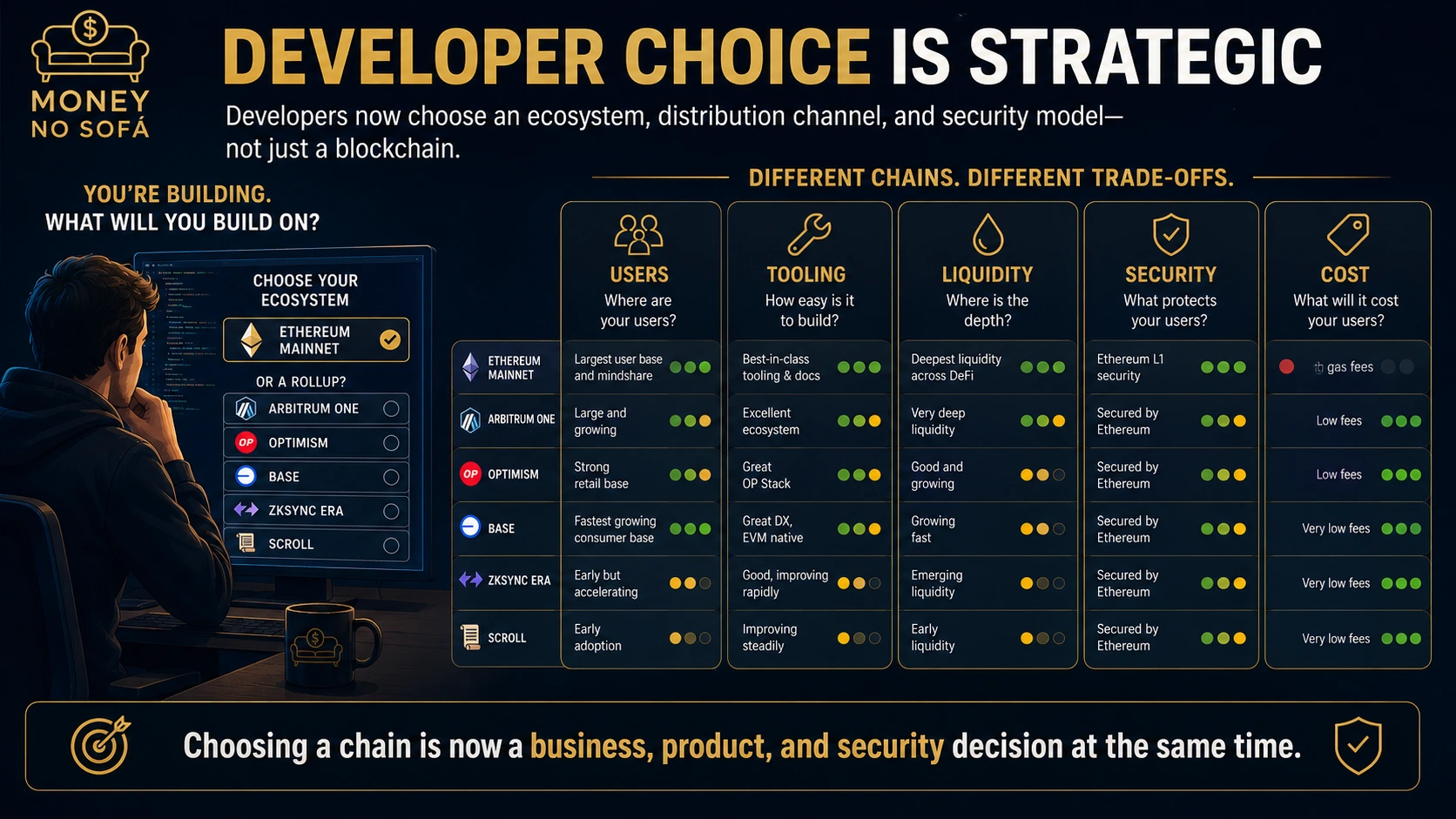
A developer deploying an Ethereum application no longer makes one chain decision. They compare user liquidity, wallet support, exchange connections, tooling, fee stability, block times, sequencer policies, bridge availability, incentive programs, governance, and the probability that the network remains strategically relevant.
Deploying on several rollups expands reach but fragments liquidity and increases maintenance. Smart contracts must be monitored across environments. Addresses can differ. Governance actions must be coordinated. Front ends need to route users correctly. Security reviews become more complex as cross-chain messages enter the system.
An application may eventually choose chain abstraction and treat rollups as backend infrastructure. Until then, distribution matters. A technically elegant rollup without users can be less useful than a more centralized environment with deep liquidity and strong wallet support.
Developers should avoid building a business model entirely around temporary incentives. Grants and liquidity rewards can attract initial activity, but retention depends on product value. The most durable application will solve a problem that survives the migration of subsidies and narratives.
A practical place to compare the market
Developers, users, and investors comparing ETH and layer-two markets can use Binance to inspect supported assets and available deposit or withdrawal networks. Exchange support is an operational signal, not a substitute for protocol research.
Check the current Binance referral offer with code BITCOIN15.
Availability, eligibility, fees, products, and referral benefits vary by country and account. Crypto assets are volatile and may result in loss.
A practical framework for users and investors
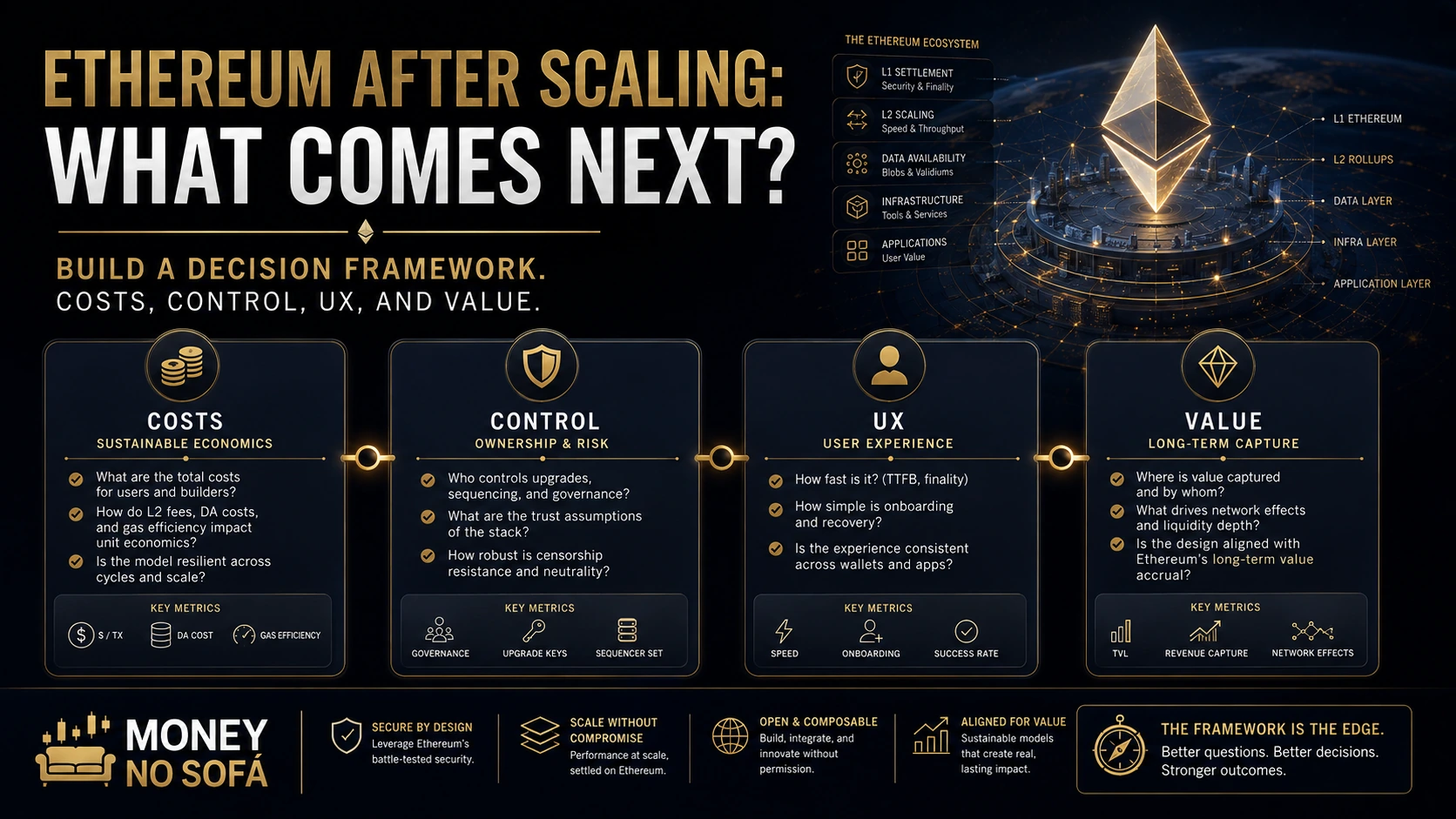
Users should evaluate a rollup in four layers: security, operations, liquidity, and product fit. Security covers proofs, upgrades, exits, and bridge assumptions. Operations cover sequencer reliability, fees, and network support. Liquidity covers the assets and applications actually available. Product fit asks whether the rollup improves the intended task enough to justify another dependency.
Investors need a fifth layer: economic capture. A useful network can still have an overpriced token. A token can rise on narrative while the protocol’s fees flow elsewhere. Compare circulating supply, future unlocks, governance authority, fee flows, subsidies, and the competitive position of the rollup.
Do not confuse a cheaper transaction with a lower-risk investment. Technology can improve while valuation becomes less attractive. Likewise, a period of lower fees on Ethereum does not prove the network is losing relevance if the architecture is intentionally moving execution to rollups.
The best question is not which layer wins everything. It is which combination of base settlement, rollup execution, application distribution, and user interface produces the strongest system with the fewest hidden assumptions.
What to watch over the next phase
The next phase of Ethereum scaling will be visible in several indicators: blob demand, fee stability, rollup uptime, proof-system maturity, forced-inclusion usage, bridge incidents, direct exchange support, wallet abstraction, and the concentration of sequencer revenue.
Watch whether users move between rollups without understanding or trusting third-party bridges. Watch whether shared standards reduce fragmentation. Watch whether decentralized sequencing becomes practical. Watch whether Ethereum validators can support increased data capacity without excessive hardware pressure.
Most importantly, watch user retention after incentives. Real scale is not measured by subsidized transactions alone. It is measured by applications people continue using because the network makes them better.
Frequently asked questions
Is Ethereum already fully scaled?
No. Rollups and blob data have increased effective capacity and reduced many transaction costs, but the roadmap continues toward greater data availability, better interoperability, stronger proof systems, and more decentralized operations.
Are layer-two networks as secure as Ethereum?
They can inherit important settlement and data guarantees from Ethereum, but actual security depends on the rollup’s proofs, upgrades, sequencer design, bridge, and emergency controls. Evaluate the live system rather than the category label.
Why do I need a bridge?
A bridge moves assets or messages between networks. Some exchanges support direct layer-two withdrawals, which can reduce bridging, but every route still requires verification of the destination network and asset.
Do lower rollup fees hurt ETH?
Lower cost per transaction can reduce immediate fees while enabling much more usage. ETH value depends on aggregate demand for data, settlement, staking, collateral, and monetary use—not one fee metric.
Will one rollup dominate?
Possibly in selected markets, but different rollups may specialize by application, geography, privacy, performance, or governance. Interoperability and distribution may matter more than a single winner.
What is the safest way to try a layer two?
Use a well-documented network, confirm wallet and exchange support, start with a small amount, understand the withdrawal route, and avoid unfamiliar bridges or assets with ambiguous contracts.
Rollup competition could strengthen Ethereum—or fragment it
Competition among rollups can improve performance, lower fees, and create specialized environments. It can also divide users, liquidity, developers, and standards. Every new network may duplicate bridges, governance, wallets, explorers, RPC infrastructure, and security monitoring. The ecosystem gains experimentation while paying a coordination tax.
The healthy version of competition keeps Ethereum settlement credible and makes movement between rollups safer. Applications can choose the execution environment that fits their workload while assets, identities, and messages remain understandable across the system. The unhealthy version creates isolated islands supported by incentives, proprietary bridges, and token speculation, with users bearing the complexity.
Interoperability standards will therefore shape the economics of the entire roadmap. Shared message formats, faster finality, consistent wallet behavior, and trustworthy asset identification can reduce the cost of fragmentation. But interoperability must not create one new central operator that becomes the hidden router for every network.
For Ethereum, the strategic balance is delicate. The base layer should remain neutral enough that competing rollups can thrive, yet valuable enough that they continue posting data, settling disputes, and using ETH. Rollups should be free to differentiate, yet compatible enough that users experience an ecosystem rather than unrelated chains. This is a governance and product challenge as much as a protocol challenge.
Institutional adoption needs operational clarity
Institutions evaluating Ethereum increasingly need more than a thesis about smart contracts. They need policies for custody, staking, layer-two exposure, bridges, token contracts, sanctions screening, transaction records, and accounting. A fund may be comfortable holding ETH through a regulated product while remaining unable to interact with a rollup or decentralized application.
This gap matters because some of Ethereum’s most important activity is moving away from the base layer. Market data, custody systems, and risk reports must distinguish native ETH from bridged or wrapped representations and identify the network where a liability exists. A generic portfolio line reading “ETH” can conceal different settlement and counterparty assumptions.
Institutional adoption may therefore favor rollups with clear governance, mature monitoring, exchange support, reliable exits, and transparent upgrade procedures. Performance alone will not determine adoption. Operational evidence and the ability to explain the system to auditors, boards, and regulators will matter.
Scaling was the beginning, not the destination
Ethereum’s scaling strategy has already altered the network. Rollups and blobs make cheaper execution possible while preserving Ethereum as a settlement and data-availability layer. That is a meaningful technical achievement.
The unresolved work is institutional and economic. Sequencers need credible failure paths. Bridges need safer standards. Wallets need to hide complexity without hiding risk. Developers need sustainable distribution. Token holders need evidence that activity connects to value.
Ethereum after scaling will not be one chain becoming invisible. It will be a network of layers learning to behave like one coherent financial and computational system. The projects that succeed will make the security assumptions explicit and the user experience simple.
A practical place to compare the market
Readers evaluating ETH or layer-two assets can use Binance to compare current liquidity, supported networks, deposit and withdrawal routes, and trading conditions. Confirm the exact network before every transfer and keep long-term custody decisions separate from exchange access.
Check the current Binance referral offer with code BITCOIN15.
Availability, eligibility, fees, products, and referral benefits vary by country and account. Crypto assets are volatile and may result in loss.
Educational notice: This article is general editorial information, not personalized financial, investment, legal, accounting, tax, or security advice. Crypto products, rules, prices, and availability can change rapidly.
Selected sources
The headline is only the start.
Ask Nova what this story could change in your budget, savings, debt, investments or next purchase.