THE STANDARD BEHIND THIS EDITION
Free should not mean disposable. This eBook follows the same editorial standard as paid Money no Sofá titles: complete structure, original writing, images, practical actions, checklist and source notes.
CONTENTS
CONTENTS
- Bitcoin Is A Network Before It Is A Price
- Scarcity Matters - But Scarcity Alone Is Not Value
- Exchange Custody And Self-Custody Are Different Risks
- Volatility Is Not A Footnote
- Scams Use The Same Emotions That Drive Fomo
- Your Process Matters More Than Your Prediction
- The Ten-Minute Bitcoin Readiness Test
- Checklist Before Putting In $1
- 30-Minute Action Plan
- Essential Glossary
- Sources & Further Reading
BEFORE YOU BEGIN
Before you begin
Bitcoin has become easy to buy. Understanding what happens after the click is still the hard part. In a few minutes, almost anyone can open an account, move money and purchase a fraction of a bitcoin. That convenience is useful, but it creates a trap: the buying experience looks much simpler than the asset itself. Behind one button sit volatility, custody, digital security, human behavior and decisions that can be difficult or impossible to reverse.
This guide creates a small distance between curiosity and impulse. It is not designed to persuade you to buy Bitcoin or to stay away from it. The goal is more practical: organize the questions that should come before a purchase. We are not trying to predict the next price move. We are trying to reduce preventable mistakes and improve the quality of the decision.
You will learn the difference between Bitcoin and the price of Bitcoin, why scarcity is not the same as guaranteed value, how custody changes risk, what volatility does to an oversized position, how scams exploit urgency and authority, why process matters more than a prediction, and how to run a readiness test before money leaves your account.
Read this as a pre-purchase manual. Mark anything you cannot yet explain in your own words. At the end, use the ten-minute checklist. If the decision still makes sense afterward, it will at least be better informed. If it does not, you may have just saved money, anxiety, or both.
- Bitcoin is a network and the digital asset native to that network.
- Price and network function are different things.
- Scarcity does not guarantee appreciation.
- Custody determines who controls access keys.
- Volatility makes position size part of the risk.
- Scams exploit urgency, authority and promises of return.
- Process and security matter more than guessing the next price.
CHAPTER 01
BITCOIN IS A NETWORK BEFORE IT IS A PRICE

The chart is the entrance, not the product
Most people meet Bitcoin through a price chart: green when it rises, red when it falls. The chart compresses a technical and economic system into an emotional signal. Bitcoin began as a proposal for peer-to-peer electronic cash, where transactions can be recorded and validated by a distributed network. The market price is simply what buyers and sellers agree to pay for the asset at a given moment. The network is the infrastructure that makes transfer and verification of digital ownership possible without one central operator.
What you are actually buying
When you buy bitcoin, you are not buying a company, a bond or a bank account. You are acquiring a scarce digital unit recorded on a public network, with access ultimately controlled by cryptographic keys. That difference changes the questions worth asking. Instead of only asking whether price will rise, ask how the network works, who controls access to your holdings, what depends on a third party, what depends on you, how liquid the market is, and how you would recover access if something goes wrong.
Price can move faster than the thesis
Markets can move within minutes because of liquidity, news, leverage, regulation, expectations or crowd behavior. A price move does not necessarily mean the underlying network changed by the same amount. Separating price from thesis reduces impulsive decisions. If your only reason to buy is that price is rising, you do not have a thesis; you have a reaction. If your only reason to sell is that price fell, you may be reacting to discomfort rather than to new information.
Your first assignment
Before putting in money, explain Bitcoin in three sentences without using the words price, profit or return. If you cannot, go back to the basics. The purchase can wait. Understanding what you are buying is a form of protection because it reduces dependence on influencers, headlines and forecasts. You do not need to become a cryptographer. You need enough understanding to know what you know, what you do not know and where you are placing trust.
Write one sentence describing the risk or decision in this chapter that matters most to your own situation.
CHAPTER 02
SCARCITY MATTERS - BUT SCARCITY ALONE IS NOT VALUE
A limited supply is part of the story
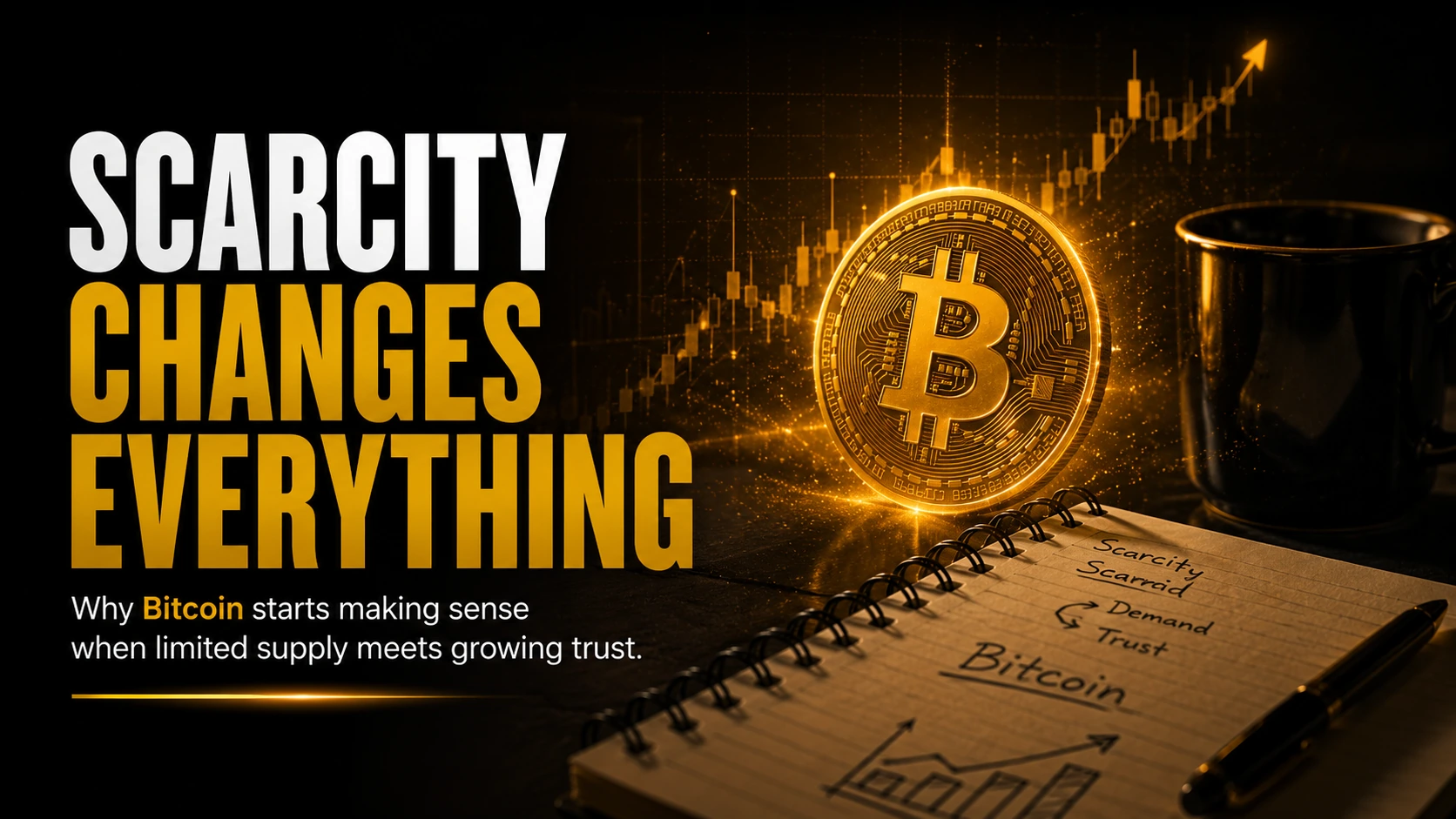
Bitcoin issuance follows protocol rules and the supply is designed to approach a maximum of 21 million units. That creates a different supply dynamic from assets whose issuance can change because of decisions by a company, government or other issuer. For many holders, this predictability is central to the thesis. But limited supply does not automatically make an asset a good purchase at every price.
Scarcity still needs demand
Rare things can remain worthless when nobody wants to own them. Market value comes from the interaction of supply, demand, liquidity, perceived utility, security, infrastructure and confidence. In Bitcoin, scarcity is important, but it lives inside a larger system. Buying only because “there will only be 21 million” ignores the other half of the market equation: what people and institutions are willing to pay and why.
Narrative does not replace position sizing
A long-term thesis can be correct and still produce a terrible personal outcome when the purchase price or position size does not fit your financial life. Belief in scarcity does not prevent large drawdowns. A mature decision combines conviction with capacity. You must be able to survive the path, not just like the imagined destination. If a decline would damage your household budget, the position was too large regardless of how persuasive the narrative felt.
Treat scarcity as an input, not a promise
Ask what could strengthen or weaken future demand. Consider adoption, regulation, competition, market infrastructure, security, liquidity cycles and institutional behavior. The point is not to forecast every variable. It is to avoid one-variable thinking. Strong theses know their weak points. The better you understand what could go wrong, the less you need slogans to hold the decision together.
Write one sentence describing the risk or decision in this chapter that matters most to your own situation.
CHAPTER 03
EXCHANGE CUSTODY AND SELF-CUSTODY ARE DIFFERENT RISKS

Buying is not the end of the decision
After the purchase comes a question many people skip: who controls the keys? On an exchange, a third party usually manages the infrastructure that gives you access to the asset. That may be convenient, especially for beginners, but it adds operational dependence. With self-custody, you control the keys directly. That can reduce some third-party risk, while increasing your responsibility for backup, recovery and physical and digital security.
There is no risk-free custody
A common mistake is labeling one option “safe” and the other “dangerous.” In practice, they carry different risks. A custodian can face hacking, withdrawal restrictions, operational failure or insolvency. In self-custody, you can lose recovery information, expose it to a scammer, store it poorly or make an irreversible transaction mistake. The right choice depends on amount, experience, liquidity needs, backup ability and comfort with responsibility.
A seed phrase is access, not a note
Many self-custody wallets generate a recovery phrase. It is not an ordinary password to email yourself, paste into a cloud note or send to support. Whoever obtains it may be able to reconstruct the wallet. Investor.gov specifically tells retail investors to protect seed phrases and never share them. If someone claiming to be support asks for your seed phrase or private key, treat that request as a major red flag.
Make a plan before you move funds
Before withdrawing bitcoin from an exchange to your own wallet, learn the process with a small amount. Confirm the address, network, fees, backup and recovery steps. Do not turn self-custody into a test of courage. It is an operational responsibility. If you do not yet understand the workflow, a small amount held with a carefully researched provider may be more sensible than a transfer you cannot verify.
Write one sentence describing the risk or decision in this chapter that matters most to your own situation.
CHAPTER 04
VOLATILITY IS NOT A FOOTNOTE

Risk is not only in the asset
Bitcoin has historically experienced large price swings. The effect depends on how much you invest, when you need the money and how you respond emotionally. Two people can buy the same asset on the same day and carry completely different risk. For someone with emergency savings, stable income and a small position, a decline may be uncomfortable. For someone using rent money or credit, the same decline can become a financial crisis.
The sleep test
Imagine the position falls 40% or 50% and stays there for months. Could you still pay your bills normally? Avoid debt? Sleep without checking the price every hour? If not, the problem may be the size of the position. The sleep test turns volatility into real life. Risk that does not fit the household budget does not become prudent because the thesis sounds convincing.
A long horizon does not eliminate short-term cash needs
Saying “this is long term” does not solve an emergency next month. Money with a defined near-term job should be managed according to that job. Emergency savings, rent, taxes, medical expenses and upcoming obligations should not depend on a volatile asset maintaining a particular value on the date you need it. The time horizon of the asset needs to fit the time horizon of the money.
Size is a risk decision
The better question is not “how much Bitcoin should I own?” but “how much of my financial life can be exposed to a volatile asset without forcing me into bad decisions?” That answer changes with income, net worth, debt, dependents and experience. This guide does not prescribe a percentage. It simply argues that a small, understood position is usually a better learning experiment than a large, anxious bet.
Write one sentence describing the risk or decision in this chapter that matters most to your own situation.
CHAPTER 05
SCAMS USE THE SAME EMOTIONS THAT DRIVE FOMO
Urgency is a fraud tool
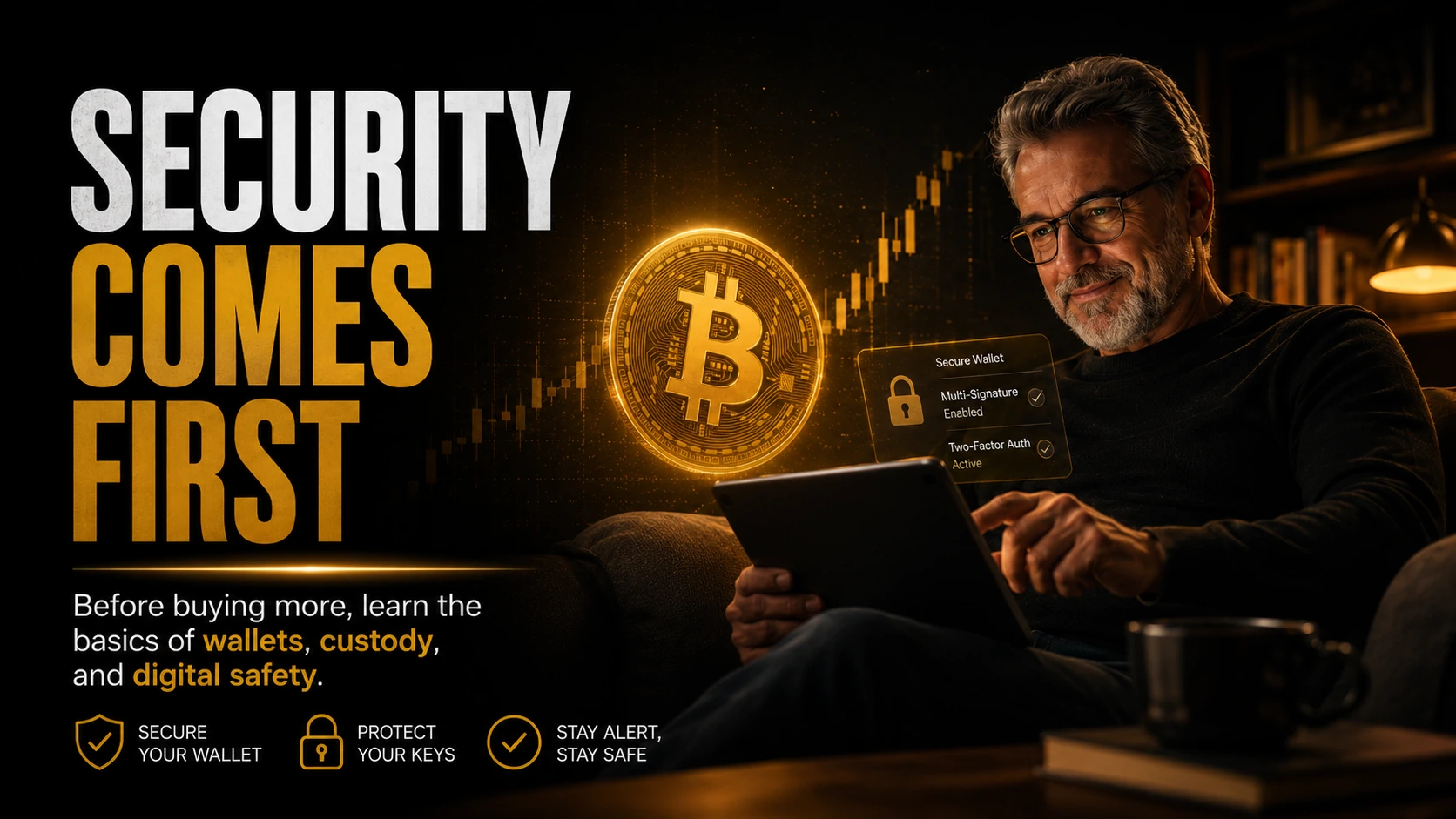
Scammers know people hate feeling late to an opportunity. They use countdowns, private groups, promised returns, fake experts, testimonials and profit dashboards. The FTC warns that investment scams often promise large gains with little or no risk, and cryptocurrency can appear as both the supposed investment and the payment method. The stronger the pressure to act fast, the stronger your reason to stop.
A polished interface does not prove a real business
Fake platforms can display balances, profits and professional-looking charts. Everything appears to work until you try to withdraw. Then come fake taxes, release fees, verification deposits or demands for more crypto. Appearance is not independent verification. Research the company outside the links provided by the person who contacted you. Check complaints, background, applicable regulation and withdrawal terms before sending money.
Authority can be manufactured
Fraudsters borrow the identity of celebrities, executives, agencies, influencers and even friends or romantic contacts. Images, video and audio can be manipulated. A useful rule is to never validate an offer inside the same channel where the offer arrived. If someone sends a link, do not treat that link as the only proof of legitimacy. Find the official site yourself and verify information through independent channels.
Guaranteed returns are a stop sign
No serious person can guarantee profit in a volatile asset. Phrases such as “zero risk,” “guaranteed return,” “double in 30 days,” “deposit more to unlock withdrawals,” or “send crypto to receive more crypto” should end the conversation. Security starts with being willing to walk away from opportunities that look too good. Missing a possible gain is cheaper than sending irreversible money to a fraud.
Write one sentence describing the risk or decision in this chapter that matters most to your own situation.
CHAPTER 06
YOUR PROCESS MATTERS MORE THAN YOUR PREDICTION
Predictions create dependency
If every decision depends on calling the next market move, you need to be right over and over again. That is fragile. A better process defines purpose, size, frequency, custody, pause conditions and security rules before money enters the market. It does not remove uncertainty. It reduces the number of decisions you must improvise under pressure. In personal finance, less improvisation often means less room for emotion to dominate.
Write down why you are buying
One written sentence sounds simple, but it changes behavior. “I am buying a small amount to learn custody” creates different decisions from “I want to double my money fast.” “I want long-term exposure to a scarce digital asset” requires another set of expectations. If you cannot state your reason without words like certain, guaranteed or rich, you may be buying an expectation rather than an investment thesis.
Define what you will not do
Useful negative rules are easy to remember: no debt; no emergency savings; no leverage you do not understand; no unknown links; no sharing seed phrases; no sending money to unlock a withdrawal; no increasing a position only because price rose; no panic sale only because price fell. These rules do not need to predict the market. They exist to limit behavioral damage.
Review beats reaction
Choose an interval for reviewing your thesis and position. It may be monthly, quarterly or triggered by a meaningful change in your financial situation. The point is to prevent every price notification from becoming an emergency meeting. Planned reviews make it easier to separate information from noise and conviction from impulse. Changing your mind because facts changed is not failure. It is different from reacting because you became afraid.
Write one sentence describing the risk or decision in this chapter that matters most to your own situation.
CHAPTER 07
THE TEN-MINUTE BITCOIN READINESS TEST
Minimum understanding
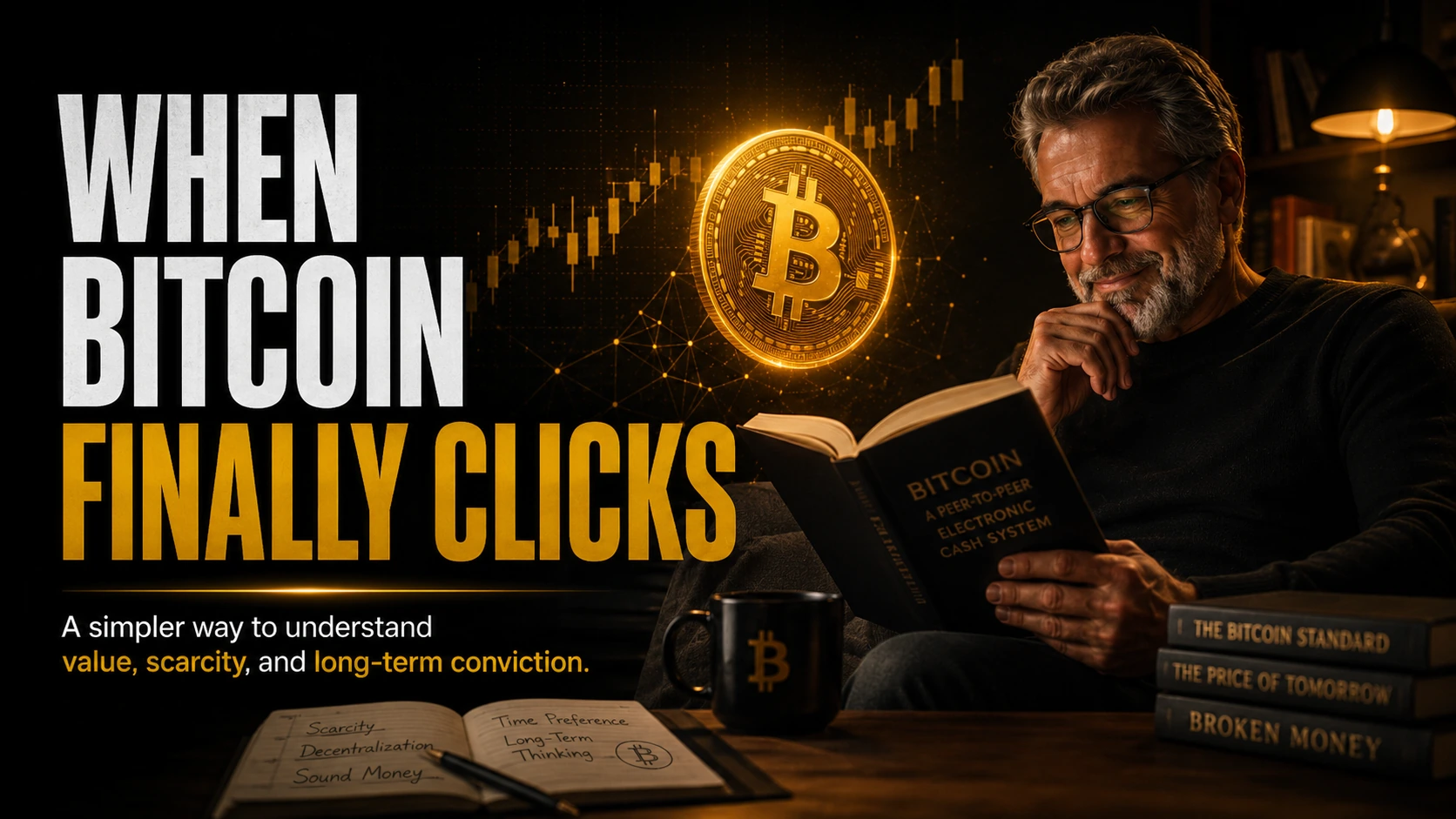
Before your first dollar, you should be able to explain what Bitcoin is, how its market price forms, where the asset will be held and which risks come with that custody choice. You do not need expert-level knowledge. You need enough to reduce dependence on slogans. If you do not know who controls the keys, how withdrawals work, what fees exist or how access could be recovered, important operational questions are still open.
Financial capacity
Ask whether a large decline would change your practical life. Could you keep paying essential expenses? Would you have to sell at a bad time? Would you create debt? If the investment can force a worse financial decision later, it is too large or using money assigned to the wrong job. A good position is not the one that maximizes excitement. It is the one that allows learning without compromising stability.
Security and verification
Verify the platform independently, use a unique strong password, enable multi-factor authentication when available and understand the withdrawal process. If you choose self-custody, test backup and recovery before transferring meaningful amounts. Never share a seed phrase. Avoid decisions that begin with private messages, investment groups or people pressuring you to move fast. Security is a collection of habits, not a button.
The final decision
After answering everything, you may reach three valid conclusions: buy a small amount to learn, wait and study more, or decide Bitcoin does not fit your strategy. All three can be intelligent. The readiness test is not designed to push you toward a purchase. It is designed so that, if a purchase happens, it comes from clarity rather than FOMO. Money becomes calmer when you know why you are acting and which risks you have consciously accepted.
Write one sentence describing the risk or decision in this chapter that matters most to your own situation.
CHECKLIST
CHECKLIST BEFORE PUTTING IN $1
READINESS SCORE
How ready are you?
Count how many checklist statements you can answer with confidence. This score is not a recommendation to buy; it shows how many operational questions are still open.
You understand most pre-purchase basics. Keep any first move small and educational.
Important gaps remain. Revisit custody, security and financial capacity before moving money.
Your best next move is learning. A delayed decision is cheaper than an irreversible mistake.
30-MINUTE ACTION PLAN
30-MINUTE ACTION PLAN
ESSENTIAL GLOSSARY
ESSENTIAL GLOSSARY
Bitcoin — The peer-to-peer network and the digital asset native to that network.
Blockchain — A distributed transaction record organized into linked blocks.
Private key — Cryptographic information used to authorize control of associated assets.
Seed phrase — A sequence of words used to recover certain wallets. It must be protected and never shared.
Custody — How access to crypto assets is stored and controlled.
Self-custody — A setup in which the user directly controls the keys.
Exchange — A platform that facilitates buying, selling and often custody.
Volatility — The magnitude and frequency of price changes.
Liquidity — How easily an asset can be bought or sold without large price impact.
FOMO — Fear of missing out, often linked to impulsive financial decisions.
SOURCES & FURTHER READING
SOURCES & FURTHER READING
This guide was written as educational editorial content and checked against primary or official investor-education sources.
- Bitcoin white paper · Open official source
- Investor.gov - Crypto Asset Custody Basics for Retail Investors (Dec. 12, 2025) · Open official source
- FTC - What To Know About Cryptocurrency and Scams · Open official source
- FTC - Investment Scams · Open official source
- Investor.gov - Investor Alerts and Bulletins · Open official source
Educational content only. This is not investment, financial, tax or legal advice. Crypto assets may be highly volatile and involve risk of loss. Do your own research and consider professional guidance appropriate to your situation.
NEXT STEP
IF THIS GUIDE PREVENTED ONE IMPULSIVE DECISION, IT ALREADY DID ITS JOB.
Continue with the Money no Sofá Bitcoin collection. The full books go deeper into custody, institutional power, monetary policy and the future of money - with a focus on clearer decisions, not promised returns.
EXPLORE THE BITCOIN COLLECTION
CG81 · MONEY NO SOFÁ